2026 Guide to Centralized Medical Waste Reporting for Healthcare Systems
2026 Guide to Centralized Medical Waste Reporting for Healthcare Systems
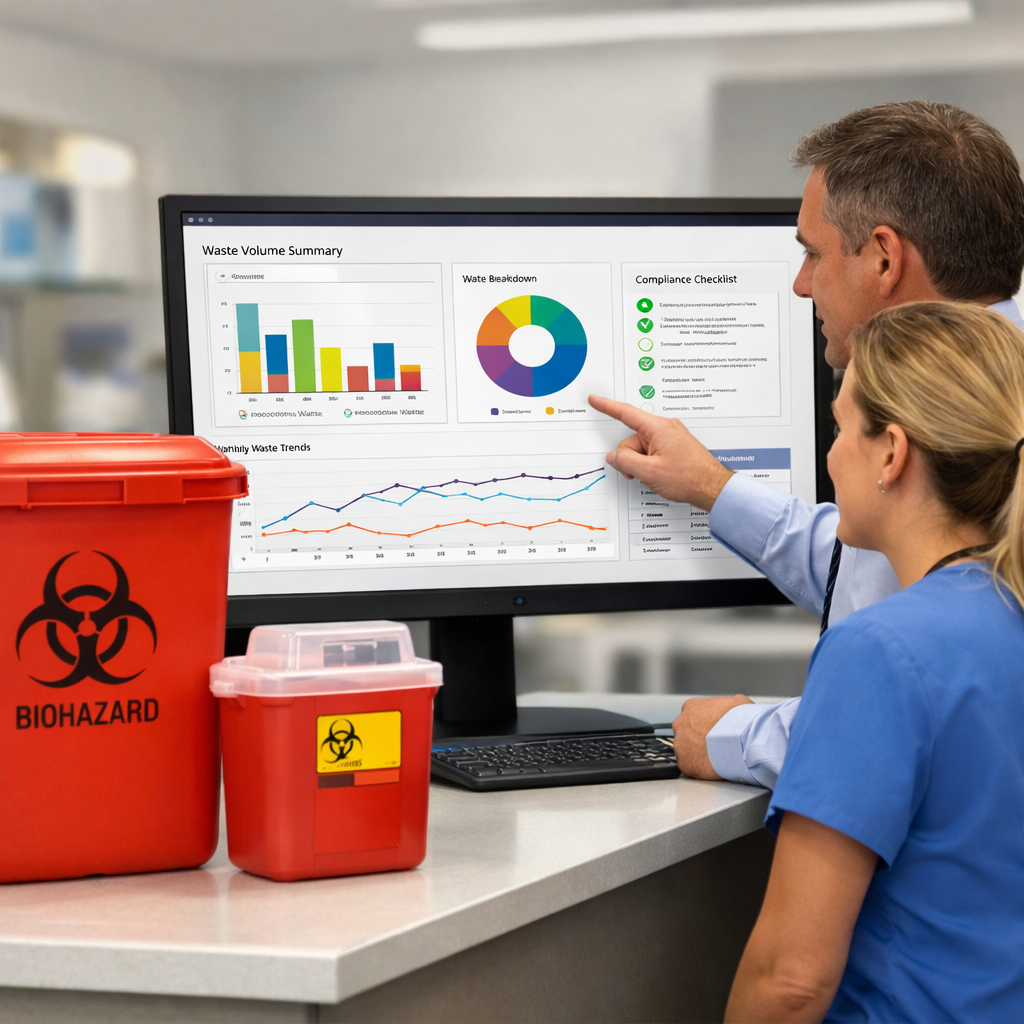
Healthcare systems are moving fast from spreadsheets and siloed binders to centralized medical waste reporting for hospitals and clinics. The payoff: faster audits, fewer errors, clearer chain-of-custody, and lower costs—plus visibility into on-time pickups and environmental impact. Centralized reporting is available through medical waste software with e-Manifest repositories, vendor portals that surface real-time manifests and certificates, and dashboards that track generation, costs, and GHGs. This guide shows how to implement a secure, digital-first model across multiple facilities, mapping concrete steps, KPIs, and technology with an operations-first lens that pairs reliability (pickup SLAs, proof-of-service) with compliance. Recycler Routing Guide emphasizes practical, operations-first steps and repeatable checklists.
Why centralized reporting matters
Centralizing manifests, pickup logs, treatment certificates, and training records in one access-controlled system reduces audit prep from days to minutes and cuts error risk by standardizing fields, timestamps, and retrieval. Digital portals that deliver real-time manifests and certificates are now “emerging best practice” for audit readiness and visibility across sites, according to industry solution briefs from MedSharps’ 2026 guidance (see Biomedical Waste Solutions for 2026).
Centralized waste reporting: A unified, access-controlled repository and workflow that aggregates all medical waste records—manifests, pickups, treatment certificates, and training—across sites, enabling standardized metrics, faster audits, role-based access, and digital chain-of-custody from generation to final treatment or destruction. It centralizes retention rules, retrieval SLAs, incidents, and sustainability metrics.
Sustainability context: U.S. healthcare is responsible for roughly 9–10% of national greenhouse gas emissions; system-wide, centralized data lets leaders quantify disposal choices and track GHG metrics alongside cost and service performance, as emphasized in SecureWaste’s 2026 packaging guidance (see Packaging Medical Waste: Step-by-Step Guide for 2026).
Regulatory and privacy foundations
Regulators are accelerating toward electronic manifests and mandatory electronic reporting. Facilities should be ready for digital recordkeeping, standardized fields, and rapid retrieval across generators and sites, as summarized in SD MedWaste’s compliance updates for 2026 (see Healthcare Waste Regulations & Compliance Guide).
PHI in medical waste: Any discarded material that can identify a patient—labels, wristbands, prescription bottles, documents, device tags, or media—constitutes PHI. HIPAA requires disposal methods preventing unauthorized access, documented custody, and certificates of destruction where applicable, with policies and training proving controls from generation through transport, treatment, and destruction (see MedPro Disposal’s HIPAA Compliance and Medical Waste: 2026 Guide).
Watch state and universal waste updates that affect device and battery flows, and consider hospital-at-home implications: residential generation points expand routing and custody scope and should be included in policy, routing, and documentation (see Healthcare Waste Regulations & Compliance Guide).
Program scope and roles
Centralize these core record types system-wide:
- Manifests and pickup logs
- Treatment/destruction certificates
- Staff training and competency records
- Business Associate Agreements (BAAs)
- OSHA Exposure Control Plans and updates
- Incident logs and corrective actions
Unifying clinical, compliance, and facilities workflows improves OSHA and HIPAA satisfaction. Recommended role alignment:
- Generator units: Segregation at point-of-use; container checks; complete pickup logs.
- Waste coordinators: Container placement, right-sizing, manifest verification, vendor dispatch.
- Compliance officers: Policy, training, PHI destruction documentation, record retention, audits.
- Facilities/operations: Dock scheduling, proof-of-service capture, surge readiness, cost controls.
- Vendors: Timely pickups, custody documentation, certificate turnaround, portal access.
Suggested RACI (sample):
- Segregation (R: Generator units; A: Compliance; C: Waste coordinators; I: Facilities/Vendor)
- Container audits (R: Waste coordinators; A: Compliance; C: Generator units; I: Vendor)
- Custody capture (R: Vendor; A: Compliance; C: Waste coordinators; I: Facilities)
- Reporting/dashboards (R: Compliance; A: Executive sponsor; C: Waste coordinators; I: Units)
- Vendor management/SLAs (R: Facilities; A: Supply chain; C: Compliance; I: Units)
Step 1 Audit containers and placement
Validate safety, right-sizing, and point-of-use placement:
- Certify, label, and right-size containers by unit acuity and generation rate.
- Sharps audits: verify puncture resistance, wall or cart mount stability, visible fill lines, and removal by threshold—not calendar.
- Minimize carry distance: place where care happens to reduce needlesticks.
Checklist highlights inspectors prioritize: correct container types for waste streams, consistent labeling, and leak-preventing storage and transport practices, supported in MedSharps’ field guidance (see Biomedical Waste Solutions for 2026 — Blog).
Step 2 Standardize labels and segregation
Adopt system-wide labels and color coding, with brief, role-specific training to reinforce correct segregation and prevent mixed loads. Post a one-page visual key in every unit.
Segregation rules: Facility-wide standards specifying which waste types belong in which containers, reinforced by colors, labels, and examples. Clear rules minimize cross-contamination, reduce needlestick and exposure risks, and prevent regulatory violations by guiding staff to sort sharps, infectious, pharmaceutical, chemical, and general waste at point of use.
Step 3 Centralize records and retention
Move manifests, pickup logs, treatment certificates, and training records into a searchable, access-controlled repository. Favor cloud e-Manifest tools that give compliance teams standardized fields, audit trails, and quick retrieval. Use role-based permissions, immutable logs, and automated retention aligned to policy. Include certificates of destruction for any PHI-bearing waste. Recycler Routing Guide templates help teams standardize fields, permissions, and retention policies.
Sample folder taxonomy:
- /Manifests/{Year}/{Site}/
- /Certificates/{Year}/{Site}/{Stream}/
- /Training/{Year}/{Role}/
- /Policies/Exposure-Control-Plan/
- /BAAs/{Vendor}/
- /Incidents-and-Corrective-Actions/
Record governance (example):
| Record type | Owner | Retention | Retrieval SLA |
|---|---|---|---|
| Manifests | Waste coordinator | 3–7 years (state policy) | 1 business day |
| Pickup logs | Waste coordinator | 3 years | 1 business day |
| Treatment/destruction certificates | Compliance | 6–7 years (PHI) | 1 business day |
| Training records | Compliance | 3 years (OSHA); 6–7 years (HIPAA relevance) | 2 business days |
| Exposure Control Plan | Compliance | Current + 3 revisions | Immediate |
| BAAs | Compliance/Supply chain | Term + 6 years | 2 business days |
| Incident reports & CAPAs | Compliance | 6 years | 1 business day |
Step 4 Digitize chain of custody
Chain of custody: A chronological record documenting each handoff of regulated or PHI-bearing waste from generation through collection, transport, and final treatment or destruction. It includes timestamps, signatures, container IDs, and certificates, proving compliance, enabling audits, and deterring diversion or loss by showing continuous, accountable control over materials.
Require vendor portals or mobile capture for real-time manifest and certificate access—now an emerging best practice. Use barcode or RFID labels on containers and auto-attach custody logs to manifests so each movement is timestamped and attributable. Recycler Routing Guide checklists outline barcode/RFID practices and proof-of-service requirements.
Step 5 Align HIPAA and OSHA workflows
- Update the OSHA Exposure Control Plan to reflect current rules, devices, and procedures.
- Provide annual role-based training on PHI handling and disposal; maintain written PHI destruction policies and certificates.
- Review BAAs for every disposal and shredding/media vendor; document role-specific training completions within the centralized system.
Step 6 Evaluate treatment options
Localizing treatment can cut transport exposure, pickup delays, and costs. Clinics evaluating modern on-site technologies report 30%+ cost reductions and roughly 50% lower GHGs versus legacy off-site-only models, with some units achieving up to 90% volume reduction that translates to fewer pickups (see Innovations in Medical Waste Treatment Technology for Clinics).
Comparison of treatment methods:
| Method | Capex/Opex | Volume reduction | GHG impact | Space/staffing | Regulatory proof |
|---|---|---|---|---|---|
| Off-site autoclave/incineration | Low Capex / Contract Opex | Moderate–High (post-treatment) | Transport emissions included | Minimal on-site | Manifests + certificates from vendor |
| On-site autoclave | Medium Capex / Lower Opex | Moderate–High | Cuts transport; electricity/steam load | Dedicated room; trained operator | Logbooks + spore tests + certificates |
| On-site microwave | Medium Capex / Lower Opex | High | Lower energy vs. steam in some configs | Small footprint; trained operator | Cycle records + validation |
| On-site advanced (e.g., plasma pyrolysis) | High Capex / Low Opex | Very high | Significant volume/weight and GHG reductions | Specialized space; fewer pickups | Commissioning data + third-party validation |
| Mail-back (sharps/Rx) | Minimal Capex / Per-box Opex | N/A (small parcels) | Low for small volumes | Very small generator fit | Tracking + destruction certificate |
Step 7 Plan surge readiness
Stress-test surge scenarios—seasonal respiratory spikes, mass vaccination events, or hospital-at-home growth—by validating:
- On-demand pickup availability and dock capacity
- Temporary, leak-proof storage staging and signage
- Cross-trained coverage for coordinators and receiving
Include residential generation and routing for hospital-at-home in SOPs to keep custody complete end-to-end (see Healthcare Waste Regulations & Compliance Guide).
Surge flow:
- Trigger thresholds reached (daily pounds, fill-rate, missed pickups)
- Escalate to named contacts (unit lead → coordinator → vendor dispatch)
- Activate temporary storage SOP and signage
- Vendor dispatch with priority window and proof-of-service
- Document variance and close with corrective action
Step 8 Monitor KPIs and dashboards
Track a small, actionable set monthly. Medical waste software can consolidate generation data, costs, and environmental impact into dashboards that drive optimization and compliance (see OSP Labs’ overview of medical waste management software). Recycler Routing Guide KPI frameworks map to these measures and alert thresholds.
KPI table:
| KPI | Definition | Data source | Target | Alert threshold |
|---|---|---|---|---|
| Container fill rate | Average % full at pickup | Custody app scans | 70–85% | <60% or >90% |
| On-time pickups | % within SLA window | Vendor portal + dock logs | ≥95% | <92% |
| Incident rate | Needlesticks/spills per 1,000 staff | Safety reports | ↓ month-over-month | Any increase |
| Cost per pound | Total disposal spend / lbs | AP + manifests | Trend ↓ vs. baseline | >10% over baseline |
| Certificate turnaround | Days from pickup to certificate | Vendor portal | ≤3 business days | >5 days |
| GHG intensity | kg CO2e per lb disposed | Manifest + factor model | Trend ↓ | >10% over baseline |
Brief notes:
- Fill rate: Right-sizing containers and moving them to point-of-use improves safety and lowers cost per pound.
- On-time pickups: A leading indicator for overflow, spills, and overage fees; tie to credits in SLAs.
- Incident rate: Reinforces training and container placement effectiveness.
- Cost per pound: Normalizes across units; watch for stream mix changes.
- Certificate turnaround: Critical for PHI and audits; investigate vendor bottlenecks quickly.
- GHG intensity: Supports sustainability reporting; compare treatment mixes and route optimization impacts.
Step 9 Consolidate vendors and SLAs
Consider consolidating vendors to simplify oversight and drive uniform chain-of-custody and dashboard reporting; where sensible, pair biomedical waste with secure shredding/media destruction under aligned controls. Maintain clear BAAs and SLAs that specify PHI handling, custody documentation, on-time pickup KPIs, and certificate turnaround expectations (see A Smarter Start to 2026: Simplifying Medical Waste Compliance in the New Year). Recycler Routing Guide SLA checklists cover these elements for consistent enforcement.
SLA terms checklist:
- Pickup windows and on-time KPI definitions
- Digital proof-of-service and manifest/certificate availability
- Missed-pickup credits and escalation paths
- Container specs (puncture resistance, labeling), swap-out timelines
- Temperature monitoring for refrigerated holds, where applicable
- Data sharing cadence for dashboards (monthly extracts/API)
Technology enablement
Pilots using RFID smart bins, AI vision for segregation, and route optimization have shown 30% faster collections, 81% fewer disposal errors, 23% lower operating costs, and 90.3% alignment with WHO best practices—evidence that technology pays for itself while advancing compliance (see The Role of Technology in Modern Medical Waste Management). Recycler Routing Guide maps these capabilities to phased rollouts that fit existing operations.
Core stack recommendations:
- e-Manifest repository with search, retention rules, and audit trails
- Custody capture app (barcode/RFID, signatures, offline mode)
- Dashboards/analytics for KPIs and greenhouse gas metrics
- EHR integration for pharmaceutical waste control and recalls
- Route optimization integrated with on-time pickup KPIs
Capability alignment:
| Capability | Must-have features | Compliance tie-in |
|---|---|---|
| e-Manifest repository | Role-based access, immutable logs, retention automation | e-Manifest compliance and audit readiness |
| Custody capture | Time-stamped scans, container IDs, signatures | HIPAA PHI chain-of-custody proof |
| Dashboards | KPI targets/alerts, site benchmarking, GHG calculators | Continuous improvement, sustainability reporting |
| EHR linkage (pharma) | NDC mapping, recall flags, witness workflows | Controlled disposal documentation |
| Route optimization | Geofenced windows, exception alerts, proof-of-service | SLA adherence; missed-pickup prevention |
Roll off sizing basics for facility cleanouts
For back-of-house cleanouts with non-regulated debris (closets, storage rooms, furniture), use roll-off dumpsters:
- 10-yard: tight spaces, light debris
- 15-yard: single-area refresh
- 20-yard: multi-room or heavier items
Focus on price-per-yard value, weight caps, prohibited items (no regulated medical waste), and local permits. For more tactics, see Recycler Routing Guide playbooks (Recycler Routing Guide).
Quick steps:
- Estimate cubic yards by stacking equivalent (L×W×H ÷ 27)
- Check weight caps vs. debris type
- Book delivery/pickup windows to match dock capacity
- Load efficiently; break down items to avoid air gaps
Overage fee avoidance and service windows
- Set clear delivery/pickup windows and require proof-of-service to prevent dock congestion—apply the same discipline you use for medical waste on-time pickups.
- Avoid overages by matching weight caps to debris type, distributing weight, keeping prohibited items out, and scheduling swap-outs before containers overfill.
- Add service-window reliability and on-time metrics as internal SLAs for facilities cleanouts.
Bagster and curbside bulky pickup comparison
- Bagster: ≤3 cubic yards of light debris; lowest cost for a single spot; limited weight and scheduling control.
- 10-yard mini dumpster: Better for larger or heavier loads; more scheduling control; higher capacity and weight caps.
- Municipal bulky pickup: Good for a few items if timing aligns; limited proof-of-service and scheduling certainty.
Never place regulated medical waste in Bagster or curbside programs. Use approved medical waste workflows with manifests and certificates.
Implementation timeline and milestones
90–120 day rollout:
- Weeks 0–2: Scope, RACI, policy gap review
- Weeks 3–6: Container audits and label/color standards
- Weeks 6–10: Stand up e-Manifest repository and custody app; connect vendor portal
- Weeks 10–14: Role-based training; PHI destruction policy drills
- Weeks 14–16: Pilot 1–2 sites; validate dashboards and SLAs
- Weeks 16–18: Full rollout; lessons-learned incorporation
Milestones:
- 100% unit audits complete; 100% labels live
- ≥95% on-time pickups sustained for 30 days
- 100% custody capture for PHI-bearing waste
- Dashboards active with monthly KPI reviews
- Surge-test drill passed; vendor SLA sign-offs on file
Governance cadence and continuous improvement
- Monthly: KPI review; publish corrective actions in a living register.
- Quarterly: Policy, Exposure Control Plan, and BAA reviews; vendor scorecards.
- Annually: Stress-test surge readiness; refresh training; executive one-page governance scorecard.
Use audit findings—especially container types, labeling consistency, and leak prevention—to prioritize updates and training sequences. Recycler Routing Guide one-page scorecards can anchor these reviews.
Frequently asked questions
Who offers centralized waste reporting for hospitals and clinics
Centralized reporting is offered by medical waste management software with e-Manifest repositories, vendor portals that digitize chain-of-custody, and analytics dashboards. Recycler Routing Guide provides KPI frameworks and implementation checklists to accelerate adoption.
What data belongs in a centralized medical waste report
Include manifests, pickup logs, treatment or destruction certificates, chain-of-custody records, staff training completions, Exposure Control Plans, BAAs, incident reports, and KPI dashboards for fill rates, on-time pickups, costs, and GHG metrics.
How do HIPAA and PHI intersect with medical waste destruction
When waste contains PHI, HIPAA requires disposal that prevents unauthorized access, documented chain-of-custody, and certificates of destruction. Align policies, role-based training, and vendor BAAs to ensure compliant handling from generation to final destruction.
What KPIs should a multi facility system track
Track container fill rates, on-time pickups, incident rates, disposal cost per pound, certificate turnaround time, and scope-related GHG metrics. Use dashboards to set targets, trigger alerts, and review trends monthly.
How can small clinics adopt centralized reporting without enterprise tools
Start with standardized labels, a shared cloud folder for manifests and certificates, and a simple custody log; Recycler Routing Guide checklists can structure the rollout. Add a vendor portal or low-cost e-Manifest and dashboard tool as volume grows, keeping KPIs and training lightweight but consistent.