Austin Dumpster Rental: Protect Your Driveway with HOA-Friendly Options
Austin Dumpster Rental: Protect Your Driveway with HOA-Friendly Options
Looking for driveway-friendly residential dumpster rentals in Austin? You have options. Companies such as Grime Time and VaVia advertise driveway-safe delivery, protective placement, and compact containers designed for neighborhoods—often with fast turnarounds that fit HOA windows and weekend projects (see Grime Time’s Austin service details and placement guidance; VaVia’s driveway‑safe approach). For most homes, a compact 10‑yard unit fits standard driveways and avoids the city permit step because it stays on private property. Recycler Routing Guide helps teams plan HOA‑friendly routing and keep documentation audit‑ready. Below, we break down HOA‑friendly features, right‑sizing, permitting, placement, pricing, and the documentation you’ll need to keep projects compliant and neighbor‑approved.
What HOA-friendly means for Austin dumpster rentals
HOA-friendly dumpster rental means selecting a container, placement method, and rental window that comply with neighborhood rules, minimize noise and visual impact, and protect surfaces (driveways/pavers) while ensuring timely delivery and pickup.
Most associations prefer driveway placement over street placement; some even prohibit dumpsters on public rights‑of‑way within their communities (see an HOA street‑placement caution example). Choosing driveway‑safe features and getting written HOA approval up front helps avoid complaints, warnings, and fines.
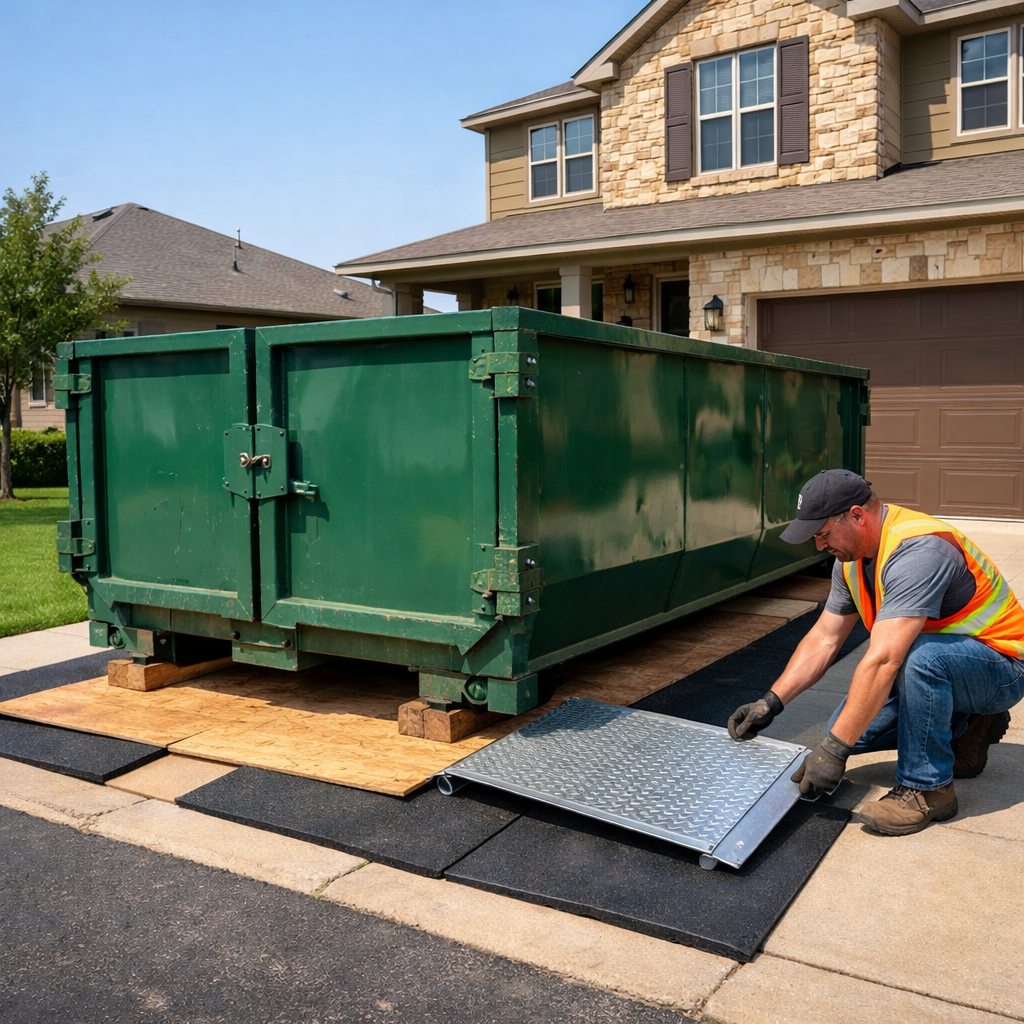
A driveway‑safe dumpster is delivered with protective measures—pads or plywood under rails or wheels, lighter containers, and sometimes rubber or pneumatic wheels—plus careful placement with compact trucks. These steps spread weight, reduce point loading, and help prevent scrapes, cracks, or rutting on concrete, asphalt, or pavers.
City permits versus HOA rules in Austin
If a dumpster sits on a public street or right‑of‑way, the City of Austin typically requires a Transportation Department permit; plan for about 3–5 business days and roughly $25–$50 in fees based on local guidance shared by Austin haulers. No city permit is needed when the container remains entirely on private property, such as your driveway or backyard (per Austin provider guidance).
Always check HOA rules. Many HOAs restrict placement, size, duration, and visibility. Review your documents and secure written approval—dates, hours, and placement—before booking to avoid violations.
- City permit: Needed for street/right‑of‑way; processing time and fee apply.
- Private property: No city permit required.
- HOA rules: Separate layer; may limit size, duration, screening, and street placement.
Driveway-safe container features to request
Ask for features that cut surface pressure and keep neighbors happy:
- Protective plywood or composite pads under rails or wheels.
- Rubber‑wheeled or pneumatic‑wheeled delivery options.
- Lightweight container construction to reduce axle and point loads.
- Smaller, more maneuverable delivery trucks for precise placement (a common driveway‑safe practice among compact‑container providers).
Quick checklist to ask providers:
- Do you place protective boards or pads under all contact points?
- Can you deliver with smaller trucks or rubber‑wheeled units?
- Will you maintain at least 3 feet of clearance from structures and landscaping?
Surface pressure is the force per unit area applied to pavement by the container and truck. Lower surface pressure—achieved through lighter containers, wider contact points, and pads—reduces scraping, cracking, and paver movement.
Optimal sizes for tight residential driveways
For most Austin homes, a 10‑yard roll‑off—about 12 × 8 × 3½ feet—fits typical driveways and keeps a lower profile that many HOAs prefer. Compact units are ideal for garage cleanouts, bath demos, and small renovations. For load expectations, driveway‑safe providers often cite 3–4 pickup loads for a 10‑yard, while other haulers estimate roughly five—expect variance across operators.
Confirm driveway width and length, overhead clearance (wires/branches), and any HOA screening or visibility rules before you book.
Size and use quick guide (typical ranges; confirm with your hauler):
| Size | Typical exterior (ft) | Included weight (tons) | Common uses | Pickup loads (approx.) |
|---|---|---|---|---|
| 10 yd | 12 × 8 × 3.5 | 2 | Garage cleanouts, bath demo, light remodel debris | 3–5 |
| 15 yd | 14 × 8 × 4.5 | 2–2.5 | Room renovations, roofing tear‑offs (small), decluttering | 5–7 |
| 20 yd | 22 × 8 × 4 | 3 | Kitchen remodels, flooring, medium roofing, yard debris | 8–10 |
Providers also publish per‑ton overage details and weight bands; review these before you load to avoid surprise fees (industry announcements note clear weight tiers and add‑ons in Austin).
Placement planning that prevents surface damage
Step‑by‑step placement flow:
- Mark the drop spot with cones or tape so the driver can line up precisely.
- Check for low wires, tree limbs, and steep slopes.
- Lay plywood or purpose‑built pads under rails or wheels before drop.
- Keep at least 3 feet from garages, fences, gas meters, and sprinklers.
Loading best practices:
- Keep debris below the rim, with nothing overhanging for safe, legal transport.
- Distribute weight evenly—heavier items low and centered.
Driveway material tips:
- Concrete: Use boards under rails; avoid twisting turns by heavy trucks.
- Asphalt (especially in heat): Increase pad thickness to prevent denting and rutting.
- Pavers: Use thicker, wider pads or full sheets; avoid tight pivots and place on the flattest section.
Scheduling and seasonality to avoid delays and fines
Demand spikes during spring cleanouts and pre‑summer renovations—book 1–2 weeks early to lock sizes and windows as availability tightens, a trend echoed by seasonal hauler reports. Many Austin providers offer 24‑hour or same‑day delivery and standard 10‑day rental periods; get your delivery and pickup windows in writing.
For contractors, schedule swaps and extended rentals ahead of each project phase. Recent dumpster market trends show reliability and on‑time service increasingly outrank the lowest price, and local service expansions highlight capacity aimed at meeting commercial and residential timelines.
Transparent pricing, weight limits, and overage policies
Request a line‑item quote that spells out:
- Delivery, pickup, rental window (10 days is common).
- Included tonnage by size.
- Prohibited items list.
- Overage fees and add‑on day rates.
Examples you may see in Austin: clear overage pricing (e.g., about $70 per ton), with common weight bands such as 10 yd = 2 tons, 20 yd = 3 tons, 30 yd = 4 tons, 40 yd = 5 tons, noted in local service updates and provider launches. Always confirm specifics on your quote.
Sample pricing structure (illustrative; verify with your hauler):
| Size | Included tons | Typical uses | Overage per ton | Add‑on days |
|---|---|---|---|---|
| 10 yd | 2 | Small cleanouts, bath demo | ~$70 | ~$10–$25/day |
| 15 yd | 2–2.5 | Room remodels, small roofing | ~$70 | ~$10–$25/day |
| 20 yd | 3 | Kitchen remodels, medium projects | ~$70 | ~$10–$25/day |
Weighing accuracy tips:
- Don’t overfill past the rim; keep weight even.
- Ask how weight is recorded (landfill/transfer station ticketing) and request copies.
Documentation and communication to satisfy HOA requirements
Submit a simple HOA request package:
- Project dates and quiet‑hours compliance.
- Dumpster size and model.
- Driveway placement diagram with distances.
- Surface protection steps (pads/plywood).
- Proof of insurance and contact info.
Attach a one‑page “driveway protection plan” stating: pads under rails/wheels, 3‑foot clearances, debris below rim, and a scheduled pickup window. Notify adjacent neighbors 48 hours before delivery and emphasize driveway—not street—placement when HOAs discourage curbside containers. Recycler Routing Guide’s documentation workflows make it easy to assemble and export this package when your HOA requests it.
Recycling and disposal reporting for project compliance
A construction and demolition recycling report documents the materials generated from a project, the tonnage of each, and where they were sent for reuse, recycling, or disposal. This summary enables permit compliance and supports LEED and ESG reporting by verifying diversion rates and end‑market destinations.
Some contractor programs in Austin bundle C&D recycling reports, customized pickups, and pre‑scheduled swaps to streamline compliance and keep projects moving. Choose providers that furnish weight tickets and load‑by‑load recycling/disposal summaries for municipal or client reporting. Teams using Recycler Routing Guide can generate diversion and GHG reporting exports from weight tickets and facility data for audit‑ready summaries.
How Recycler Routing Guide supports responsible routing and documentation
Recycler Routing Guide is the operational backbone behind HOA‑friendly, driveway‑safe rentals and audit‑ready documentation. We maintain searchable facility and end‑market directories, standardized material specs, contamination guidance, and packaging/baling requirements—to route debris correctly the first time. Our geography‑aware routing rules, diversion and GHG reporting exports, and documentation workflows help municipalities, campuses, and enterprises stay compliant with less back‑and‑forth. New to sizing? See our guide on choosing the right roll‑off dumpster size for yard debris. Planning a quick cleanup? Learn how to rent a residential dumpster for a weekend project.
Frequently asked questions
Do I need a city permit if the dumpster stays in my driveway?
No. If the container stays entirely on private property (like a driveway or backyard), a City of Austin permit isn’t required. Permits are only needed for street or right‑of‑way placement.
How can I prevent cracks or scrapes on concrete, asphalt, or pavers?
Use protective plywood or pads under contact points, request smaller trucks or rubber‑wheeled setups, and maintain at least 3 feet from structures. These practices reduce surface pressure and help prevent scraping and cracking.
What dumpster size fits most Austin driveways without violating HOA rules?
A compact 10‑yard unit—about 12 × 8 × 3½ feet—fits most driveways and keeps a lower profile favored by many HOAs. Recycler Routing Guide’s sizing guidance can help you right‑size before you book.
What items are typically prohibited from residential dumpsters?
Common exclusions include liquids, paints, tires, batteries, electronics, appliances with refrigerants, and hazardous chemicals. Recycler Routing Guide’s material specs clarify what’s allowed and where it should go.
How far in advance should I book during peak season in Austin?
In spring and early summer, book as early as possible—ideally 1–2 weeks ahead—to secure preferred sizes and delivery windows as demand surges. Recycler Routing Guide can help coordinate routing and documentation so those windows are met.