Avoid Fines: Austin Dumpster Permit and Placement Rules Made Simple
Avoid Fines: Austin Dumpster Permit and Placement Rules Made Simple
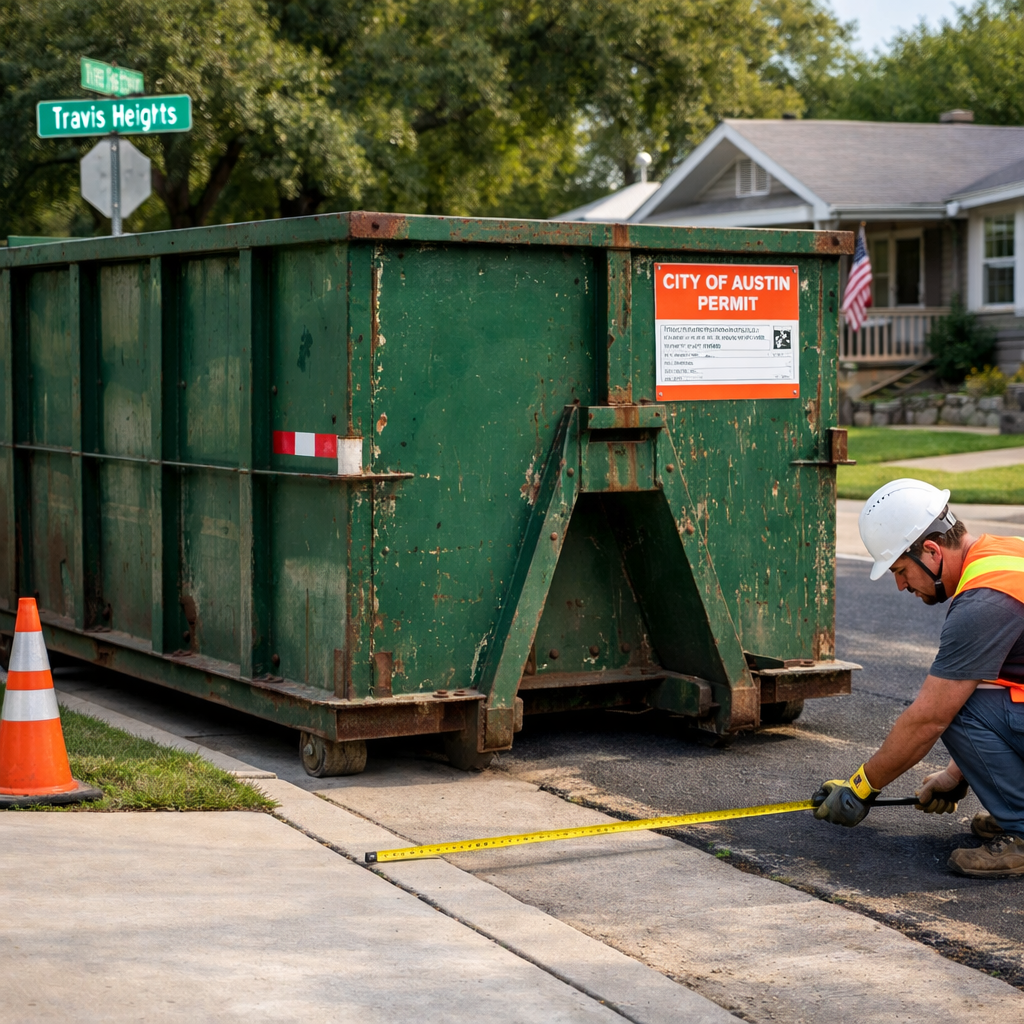
Getting a dumpster in Austin is straightforward if you confirm permit needs early, right-size your bin, and map safe placement. In short: you typically won’t need a permit on private property, but a right-of-way permit is required if any part of the container sits in the street, over a sidewalk, or blocks public access. Choose dumpster sizes based on debris density and lock flat-rate pricing with clear weight caps to avoid overages. Then reserve 2–4 hour delivery windows, stage unobstructed access, and document placement with photos. Follow the steps below to get compliant, predictable Austin dumpster rentals with flat-rate pricing and weight caps. Recycler Routing Guide keeps the process practical and step-by-step.
Confirm if your location requires a right-of-way permit
“Right-of-way (ROW) permits authorize temporary use of city-managed areas—streets, sidewalks, alleys, and parking spaces—so containers don’t obstruct traffic, bikes, or pedestrians.” In Austin, ROW permission typically applies when dumpsters sit on public property or block access. Use logistics-first planning to avoid last-minute permit issues and failed deliveries.
Quick decision checklist:
- Private property vs public ROW: Is every inch of the container on your driveway or yard? If not, assume ROW.
- AB+C/3-1-1 verification: Check the address and proposed placement; confirm via the City’s AB+C portal and by calling 3-1-1.
- Who files: Align with your hauler on permit ownership and timelines to prevent reschedules or fines.
Private property versus public right-of-way
Permits are typically required when a dumpster is placed on public property or blocks a public right-of-way such as a sidewalk or curb lane, whereas private driveways generally do not require ROW approval when fully on private land. The City regulates temporary use of streets, sidewalks, alleys, and parking spaces through ROW-related permits (e.g., Parking Space or Street Event permits) managed by Development Services.
Use this quick decision aid:
- Private driveway/yard: Usually no ROW permit; confirm HOA or landlord rules.
- Any overhang/encroachment on sidewalk or curb lane: Verify the Austin right-of-way permit requirement.
- Busy corridors or metered parking: Expect added steps and possible fees; plan early.
Link: See the City of Austin Development Services – Types of Permits for ROW categories and application pathways via the AB+C portal.
How to verify permit needs through AB+C and 3-1-1
Use the City of Austin AB+C Portal to identify the right ROW or special permit, confirm submittal requirements, and apply online through the appropriate department (Development Services – Types of Permits). If you’re unsure which team handles your scenario, call 3-1-1 for routing and keep notes.
Four-step verification flow:
- Check the exact spot: Is any placement on or over public right-of-way (street, sidewalk, alley, parking space)?
- Confirm permit category in AB+C: Identify the correct ROW permit type and upload required site details.
- If unclear, call 3-1-1: Ask which department owns the permit and what lead times to expect; note names, dates, and guidance.
- Document: Save screenshots of the portal entry and email/call confirmations to your job folder.
Decide who files the permit and lead times to expect
Align responsibilities before you book. Many Austin dumpster providers will help confirm whether a permit is required and may file on your behalf—always verify who owns the application, when it will be submitted, and the target approval date (source: Navigating the Permit Process for Dumpster Rentals in Austin, TX: Tips and Tricks). If your hauler won’t file, you’ll apply through the city’s online process; approvals can vary by location and event schedule, so plan ahead.
Add a simple SLA line item to every quote:
- Permit owner: hauler vs customer
- Submittal date: when the application will be filed
- Expected approval window: realistic range with buffer days
- Backup plan: private placement if the permit is delayed or denied
Right-size your dumpster by debris type and project scope
Flat-rate pricing bundles delivery, pickup, a set rental window, and a defined weight cap. Overages are billed per-ton or per-item beyond the cap, with potential surcharges for prohibited materials or extended days. Right-size by debris density and project duration to avoid surprises.
Comparison guide for dumpster sizes Austin:
| Size (yd³) | Typical uses | Common weight caps | Best for materials |
|---|---|---|---|
| 10-yard | Small cleanouts, bath demo, roofing patches | ~1–2 tons | Household junk, light demo, limited shingles |
| 15-yard | Single-room remodels, garage cleanouts | ~2–3 tons | Mixed remodel debris, wood, drywall |
| 20-yard | Multi-room renovations, light construction | ~3–4 tons | Mixed C&D, bulky furniture, shingles (separated) |
| 30-yard | Larger renovations, office cleanouts | ~4–5 tons | Volume-heavy debris; avoid dense loads like concrete |
Tip: If your estimate is near 80–90% of the weight cap, size up to preserve flat-rate predictability.
Common Austin sizes and use cases
- 10-yard: Ideal for bathroom tear-outs, small roofing patches, or a modest shed cleanout.
- 15-yard: A “sweet spot” for single-room remodels and garage cleanouts with room to spare.
- 20–30-yard: Best for multi-room renovations and light construction; choose 30-yard for bulky but lighter debris.
- Event venues: Multiple smaller bins often outperform one large container by reducing service bottlenecks and crowding near entrances (see this Austin-focused placement guidance).
For more project-specific matching, see Recycler Routing Guide’s quick guide to rent a residential dumpster for a weekend project.
Weight caps, overage risks, and dense-material separation
Overfilled bins may be refused at pickup; dry-run trip fees commonly range $85–$150, and daily rental charges can add $5–$20/day if removal is delayed (source: Avoid Top 7 Dumpster Rental Pitfalls). To stay within caps:
- Separate dense loads: Use dedicated bins for concrete, brick, soil, or shingles to avoid per-ton overages.
- Confirm per-ton rates upfront: Know the dollar amount above the included cap.
- Use a quick calculator prompt: Estimate weights for shingles, drywall, and lumber; cross-check against the cap; right-size upward if you’re within 10–20% of the allowance.
Flat-rate pricing essentials to lock in before booking
Ask for an itemized, flat-rate quote that includes delivery, pickup, rental window, and weight cap—with explicit per-ton overage, contamination fees, fuel/environmental surcharges, and any ROW permit pass-throughs. Confirm operational terms:
- 2–4 hour delivery/pickup windows
- Included days and extension rates
- Swap or relocation fees
- Tarp requirements and door use rules
Capture these in a simple, one-page service SLA and acknowledge via email or your customer portal.
Map safe placement and truck access before scheduling
Approach clearance is the straight-line distance and vertical space a roll-off truck needs to safely position and load a container without hitting obstacles or blocking traffic. Scouting and documenting access prevents failed attempts and citations.
Required approach and vertical clearances
Plan for approximately a 60-foot straight-line approach and about 23 feet of overhead clearance for safe placement and pickup in most Austin neighborhoods (reference: Dumpster Placement Guide for Austin). Walk the path from street to pad and note:
- Overhead: power lines, tree canopies, carports
- Ground: slopes, soft spots, curbs, and tight turns
- Staging: space to swing and set the container
Share photos, a pin-drop, and a simple sketch with arrows showing the truck path and a labeled swing zone.
Keep-outs near hydrants, corners, bike lanes, and sidewalks
Avoid blocking safety-critical or regulated areas: steer clear of fire hydrants, storm drains, loading zones, bus stops, and parking meters, and keep sight lines open—many cities recommend at least 20 feet from turns and corners for visibility and turning radii (guidance: Dumpster Permits in Texas). Do not block bike lane traffic when placing temporary containers (see Austin Resource Recovery’s proper set-out guidelines). Always preserve access for emergency vehicles and service trucks.
Driveway and lawn protection tactics that prevent damage
- Place on firm, level ground; lay 2x10 boards or composite pads under the container rails; avoid soft soil and irrigation lines (best practice in Austin placement guides).
- If lawn placement is unavoidable, use layered plywood mats with a tarp underlayment; mark sprinkler heads and utility boxes.
- For tight sites, add “no-move without call” and “spotter required” notes to the order.
Schedule with defined delivery windows and service SLAs
A service-level agreement (SLA) is a documented commitment on delivery windows, response times, swap/haul timelines, and escalation procedures—defining measurable KPIs for on-time performance and communication.
Set 2–4 hour delivery windows and site contact protocols
Require 2–4 hour delivery/pickup windows, a driver text-on-approach, and a live site contact with phone and email backup. Provide gate codes, after-hours instructions, and a “do not place without confirmation photo” clause for sensitive placements. Track on-time percentage and response time as KPIs in your portal.
Reserve space, coordinate HOA or venue approvals, and avoid dry-run fees
Reserve curb space or on-site stalls ahead of time; for festivals or venues, distribute several small containers near activity nodes to prevent long hauls and bottlenecks. Always check HOA rules—many associations set placement windows, screening requirements, or street-use restrictions. Overfilled or blocked access can trigger dry-run fees of $85–$150 and daily charges of $5–$20/day if removal is delayed; keep lids tarpable and access clear.
Use checklists and portals to track service KPIs
Standardize execution with a pre-delivery, mid-project, and pre-pickup checklist covering permits, space reservations, clearance, and prohibited items. Use a shared portal or sheet to log:
- On-time %
- Missed attempts and reasons
- Weight vs cap and contamination notes
- Photo proof at placement and pickup
Flag exceptions within 24 hours and request credits per SLA if KPIs are missed. For a ready-made template, see Recycler Routing Guide’s step-by-step guide to get multiple dumpster rental quotes locally in minutes.
Load correctly to avoid citations and surcharges
Universal waste in Texas includes widely generated hazardous items—batteries, some pesticides, mercury thermostats, paint, and lamps—managed under streamlined rules but not allowed in standard roll-offs.
Prohibited and special waste in Austin and Texas
Local haulers prohibit hazardous items such as tires, batteries, liquids, paint, oil, fuels, and chemicals; appliances with refrigerants and televisions are commonly banned, and overfilled bins can be refused (regional examples: Avoid Top 7 Dumpster Rental Pitfalls). The Texas Commission on Environmental Quality (TCEQ) oversees classifications and permits for municipal solid, industrial, and hazardous waste—verify universal waste handling before loading (see TCEQ waste permits).
Banned list (typical):
- Liquids, oils, fuels, chemicals, paint
- Batteries, tires, hot ashes
- Refrigerators/freezers (refrigerants), TVs/CRT monitors
- Asbestos and regulated hazardous waste
When in doubt, call 3-1-1 or Austin Resource Recovery for guidance.
Fill level, tarpability, and safe weight distribution
- Keep debris below the top rail; bins loaded above the rim may be refused.
- Make contents level and tarpable; load heavy items low and evenly; break down bulky pieces; avoid point loads against walls.
- Close and latch doors before service; photograph the final load for your records.
Plan alternate disposal for hazardous and universal waste
For hazardous and universal waste, use city-approved channels and retailer take-backs.
| Item type | Where it goes | Prep steps |
|---|---|---|
| Household hazardous waste (paints, solvents) | Austin Resource Recovery Drop-off, 3810 Todd Lane, (512) 974-4373 | Keep in original containers; do not mix liquids |
| Batteries, bulbs, mercury thermostats | Retailer take-back or specialty recycler; follow TCEQ guidance | Tape terminals; bag bulbs separately |
| Appliances with refrigerants | Certified recycler or appliance retailer take-back | Remove doors; confirm refrigerant recovery |
| Electronics | City e-waste events or certified e-recycler | Wipe data; bundle small cords |
Follow TCEQ guidance for universal waste management and permitting considerations where applicable.
Final pre-pickup verification to prevent delays
A dry-run fee is a charge when the hauler cannot service the bin due to issues like overfill, blocked access, or no-permit placement; it often includes the failed trip plus additional daily rental. A short pre-pickup routine prevents these hits.
Confirm clear approach, overhead, and unlocked gates
Reconfirm the ~60-foot approach and ~23-foot overhead clearance; move vehicles and obstacles. Unlock gates, secure pets, and mark hazards with cones or tape. Include “driver calls/texts 15–30 minutes before arrival” in your SLA.
Photo-document placement, load level, and site condition
Take wide shots that show debris below the rim, tarpability, and unobstructed access. Photograph boards/pads under rails and the surface condition before and after haul. Store images in your portal folder tied to the order number.
Update permit status and relocate if site conditions change
If construction phases shift pedestrian or vehicle routes, reassess placement to maintain safety and access and keep the site efficient (see Dumpster rentals and site access planning). If a permit lapses or conditions change, renew via AB+C or relocate the container fully onto private property—never block a bike lane or sidewalk.
Frequently asked questions
Do I need a permit if the dumpster sits partially in a driveway but overhangs the sidewalk or curb?
Yes. Any encroachment into the public right-of-way typically requires a permit; confirm via the AB+C portal or by calling 3-1-1. Recycler Routing Guide’s checklist helps you document the spot for AB+C and 3-1-1.
What garbage bin rental options are available in Austin?
Austin offers mini bins for light junk, 10–15 yard roll-offs for small remodels, and 20–30 yard containers for larger projects; match size to debris density and confirm flat-rate pricing with weight caps. Recycler Routing Guide helps you align size with material weight.
What happens if my dumpster is overfilled or too heavy at pickup?
Overfilled or overweight containers may be refused and incur dry-run and per-day fees; keep debris below the rim, load evenly, and select a size that fits your estimated tonnage. Recycler Routing Guide’s sizing tips help you stay within the cap.
Can I place a dumpster on the street for a weekend project in Austin?
Yes, with the proper right-of-way permit and clearances; stay clear of hydrants, corners, bike lanes, and sidewalks, and reserve space ahead of time. Recycler Routing Guide outlines keep-outs and clearances for street placements.
How do I dispose of paint, electronics, or appliances with refrigerants in Austin?
Do not place them in standard roll-offs; use Austin Resource Recovery’s hazardous waste options and retailer take-backs, and verify universal waste rules with TCEQ. Recycler Routing Guide links to local drop-offs and TCEQ guidance.