Best Dumpster Sizes for Senior Downsizing in 2026: Cost-Smart Picks
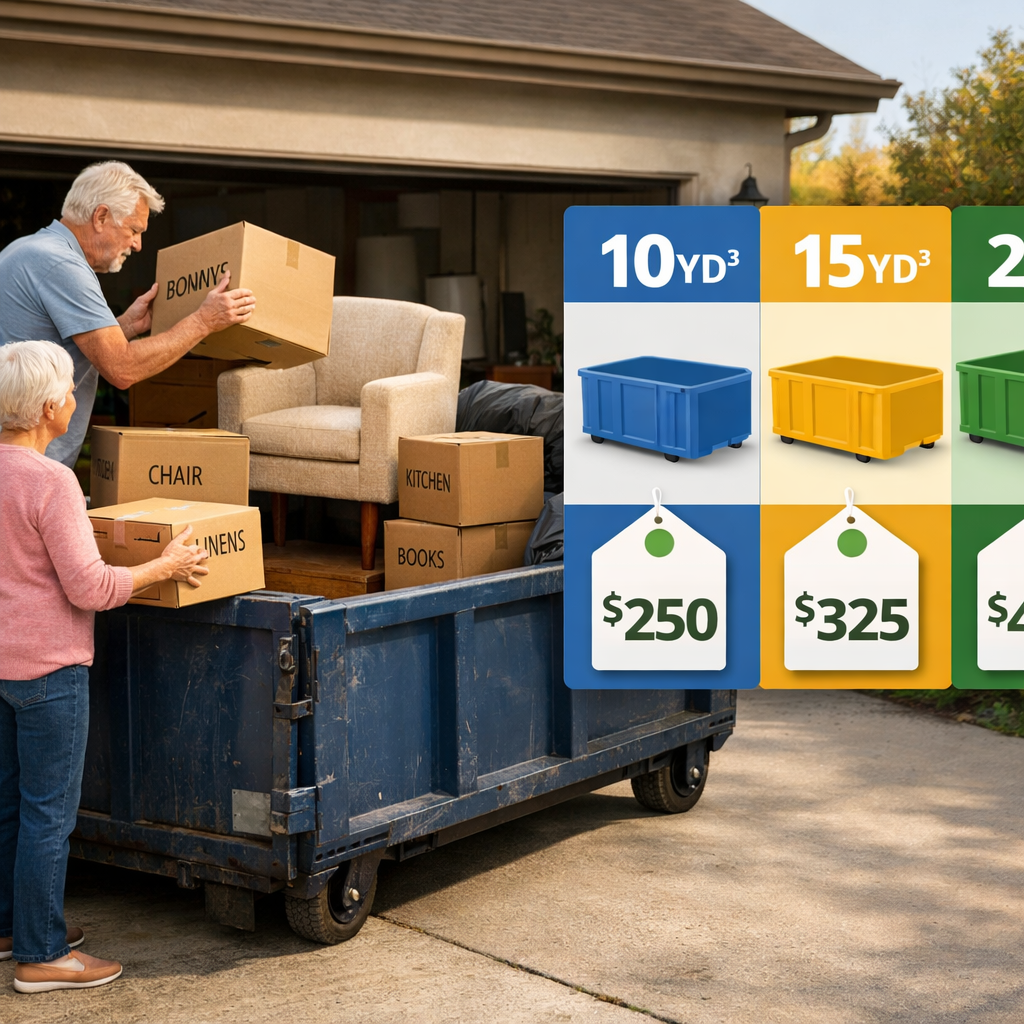
Best Dumpster Sizes for Senior Downsizing in 2026: Cost-Smart Picks
Downsizing is smoother—and cheaper—when your dumpster is right-sized the first time. For most senior moves, the best dumpster size for senior downsizing is a 20-yard roll-off: it fits typical driveways, swallows furniture and boxes, and keeps roll-off dumpster rental cost predictable. Smaller 10–15 yard bins shine for targeted room cleanouts or heavy materials; larger 30–40 yard containers serve big estates and hoarding-scale jobs. This guide applies Recycler Routing Guide’s logistics-first, diversion-focused lens to balance capacity, driveway fit, and verified outlets so you minimize overages, avoid multi-haul disruption, and hit your cost and diversion KPIs.
1. Recycler Routing Guide
Recycler Routing Guide’s approach is simple: choose the smallest container that completes the job in one haul, verify downstream outlets for donations and recycling, and book a provider with proven delivery reliability. This right-sized capacity strategy reduces weight limit overage fees and mid-project swaps—two common budget busters in senior downsizing dumpster size decisions.
Roll-off dumpsters are open-top containers with a swing door that are delivered on a truck and set onto a hard surface for efficient self-loading, then hauled away when full. They load faster than lidded commercial bins and are the standard for residential cleanouts. This guide compares the most common sizes—10, 15, 20, 30, and 40 cubic yards—with the 20-yard frequently used for residential cleanouts due to its balance of capacity and driveway fit. It’s the standard we use to plan residential cleanouts with fewer surprises.
2. 10 yard dumpster
A 10-yard dumpster is a driveway-safe dumpster for small downsizing pushes—single rooms, attics, or garages—and it’s ideal for heavy debris (concrete, dirt, tile) where weight limits matter more than volume. Typical specs are about 14’ L x 7.5’ W x 3.5’ H and roughly 3 pickup truckloads, according to the Dumpsters.com size guide (also the source for pickup-load equivalents). Waste Connections’ mapping equates a 10-yard to around 100 large trash bags, which helps visualize capacity for mixed household items.
Mini comparison for a 10-yard:
- Dimensions: ~14’ x 7.5’ x 3.5'
- Capacity: ≈3 pickup loads; ≈100 large bags
- Best for: Single-room cleanouts, attic/garage purges, heavy debris to avoid weight caps on larger bins
- Pros: Lowest cost tier, easy driveway fit, low sidewalls for safer loading, reduces overweight risk with dense materials
- Cons: Too small for whole-home furniture; can trigger a second haul if scope expands
| Size | Dimensions (approx.) | Pickup-loads | Bag equivalent | Typical uses | Pros | Cons |
|---|---|---|---|---|---|---|
| 10 yd | 14’ x 7.5’ x 3.5' | ~3 | ~100 | Single room, attic/garage, heavy debris | Driveway-friendly, low walls, cost-efficient | Insufficient for whole-home furniture |
Source references: Dumpsters.com size guide for dimensions and pickup-loads; Waste Connections bag equivalents.
3. 15 yard dumpster
The 15-yard is a pragmatic midpoint for multi-room cleanouts—think two to three rooms of mixed household items with some furniture—and for townhomes or condos with limited driveway length. Expect room for about 80–100 standard 33-gallon bags and roughly 2,000–4,000 pounds, giving you more headroom than a 10 without the full length of a 20.
Use it when:
- You’re downsizing a small apartment or two bedrooms plus a living area.
- There’s a blend of boxes, small appliances, and a few bulky pieces.
- Driveway length is tight but you need more than a 10.
Caution: If the load skews furniture-heavy (multiple sofas, large dressers, mattresses), step up to a 20-yard to avoid a second haul.
Quick chooser:
- Apartment or single targeted room: 10 yard
- Small apartment or 2–3 rooms with moderate furniture: 15 yard
- Small single-family home or multiple bulky items: 20 yard
4. 20 yard dumpster
For most senior downsizing projects, the 20-yard is the default pick because it balances capacity, cost, and driveway fit. Many haulers list the 20-yard as their most popular residential size for versatility, as outlined in the Budget Dumpster size overview. Typical costs run about $500–$800 in many markets, per the Angi dumpster rental cost guide. Recycler Routing Guide typically defaults to a 20-yard for full-home downsizing to minimize swaps and overages.
Specs and fit:
- Dimensions: ~22’ L x 7.5’ W x 4.5’ H
- Capacity: ~6 pickup truckloads and about 200 large bags
- Best for: Whole-home downsizing, furniture, boxes, small appliances
“A 20-yard roll-off is a mid-size, open-top container that holds about 6 pickup loads of mixed household items, making it a cost-efficient default for most residential cleanouts.”
If you’re unsure, size up rather than risk overweight charges or a second rental.
5. 30 yard dumpster
A 30-yard suits larger estates or multiple bulky rooms with lots of furniture and oversized items. Expect around 22’ L x 7.5’ W x 6’ H and roughly 9 pickup loads. WM highlights the 30-yard as appropriate for large home remodels—an indicator it can also handle whole-house cleanouts with substantial volume.
Pricing trends put 30-yard rentals toward the upper end of residential bins, and local landfill fees, included weight, and rental duration can nudge totals upward. Before booking, confirm driveway length clearance, the truck’s approach, and overhead wires/branches; plan on street placement (and permits) if space is tight.
6. 40 yard dumpster
A 40-yard is the top-end roll-off—about 22’ L x 7.5’ W x 8’ H—with capacity near 12 pickup loads and roughly 400 large bags. It’s intended for major cleanouts, full-home renovations, demolition, and very large hoarding/estate jobs, as summarized by CFT Group’s dumpster sizes guide. Weekly rates can reach the high end of residential pricing, and included tonnage is often 5–6 tons—verify both to avoid surprises.
Tip: The taller walls can make hand-loading furniture harder; use the walk-in door to stage items safely and reduce lifting strain.
How to choose a size for senior downsizing
Pick a one-and-done size to minimize disruption for seniors and caregivers. That one-haul plan is how Recycler Routing Guide reduces caregiver disruption and budget risk.
Step-by-step chooser:
- Inventory: Count bulky items (sofas, sectionals, large dressers, mattresses) and estimate bagged items.
- Map to capacity: 10 yd ≈3 pickup loads/~100 bags; 20 yd ≈6 loads/~200 bags; 40 yd ≈12 loads/~400 bags.
- Check fit: Measure driveway length; a 20-yard is about 22 feet long. Confirm clear approach and overhead clearance.
Default recommendation:
- Full-home downsizing: start with a 20-yard to avoid double hauls.
- Targeted rooms or heavy materials only: 10–15 yard.
- Heavy debris (concrete, dirt, tile): use a smaller, heavy-rated 10-yard to manage weight caps.
Compact comparison:
| Size | Dimensions (approx.) | Pickup-loads | Bag equivalent | Typical use | Driveway fit risk |
|---|---|---|---|---|---|
| 10 yd | 14’ x 7.5’ x 3.5' | ~3 | ~100 | Single room, attic/garage, heavy debris | Low |
| 15 yd | 16’ x 7.5’ x 4.5’ (varies) | ~4–5 | ~140 | 2–3 rooms, moderate furniture | Low–Medium |
| 20 yd | 22’ x 7.5’ x 4.5' | ~6 | ~200 | Whole-home downsizing | Medium |
| 30 yd | 22’ x 7.5’ x 6' | ~9 | ~300 | Larger estates, multiple bulky rooms | Medium–High |
| 40 yd | 22’ x 7.5’ x 8' | ~12 | ~400 | Major estates/hoarding, remodel/demolition | High (often street) |
Cost factors that impact your total
Market pricing varies by region, duration, and disposal fees, but national surveys show 10-yard rentals often landing in the low-$400s and 40-yard options around the $1,000 mark, with 20-yards commonly $500–$800. ConsumerAffairs’ cost overview breaks down typical price bands and add-on fees.
Confirm these line items in writing:
- Base rate: delivery, pickup, and rental duration
- Included weight (tons) and per-ton overage
- Fuel, environmental, and administrative surcharges
- Location adders (distance, alley access, challenging placement)
- Permit fees for on-street placement
- Contamination or prohibited item fees
Recycler Routing Guide quick calculator tip: Mixed household goods often average 100–300 lbs per cubic yard. Multiply estimated density by container volume and compare to included tonnage to gauge overage risk.
Weight limits, prohibited items and overage risk
Overage fees are per-ton charges added when your load exceeds the included weight in your rental agreement; they’re assessed after disposal when the container is weighed. Providers can bill later for overweight loads, so clarify included tonnage and per-ton overage up front, as noted by ConsumerAffairs. Recycler Routing Guide’s rule of thumb: when unsure, size up—it’s usually cheaper than an extra haul plus overweight charges, a pattern echoed in national cost guides.
Commonly restricted items (confirm local rules):
- Appliances with refrigerants (fridges, ACs)
- Tires
- Paints, solvents, and corrosives
- Batteries and electronics
- Propane tanks and pressurized cylinders
Driveway fit, delivery logistics and permits
Plan for safe, low-disruption placement:
- Exterior lengths: 10 yd ~14’; 20–40 yd ~22’; widths ~7.5’. Actual manufacturer dimensions may vary slightly by region.
- Surface and approach: Place on a flat, hard surface; keep overhead clear of wires and branches; ensure a straight approach for the truck.
- Permits: If you need street placement (common for 30–40 yard or tight driveways), check city permit requirements and book defined delivery/pickup windows.
Pre-delivery checklist:
- Measure driveway length and width; confirm 22’ minimum for 20–40 yard.
- Verify swing-door clearance at the rear of the bin.
- Ask for driveway protection boards or pads.
- Pre-clear the approach path and overhead obstructions.
Diversion-first tips to reduce volume and cost
Divert first to cut tonnage and right-size your container. Schedule donation pickups for usable furniture and household goods before delivery; stage scrap metal or bulky municipal pickups to keep heavy items out of the roll-off. Maintain a “diversion zone” for reuse and recycling, and load non-recyclables last so you can step down a size if volume shrinks. Use a 10-yard for heavy inert debris while reserving the larger bin for lighter household items to avoid weight caps.
Diversion-first routing means designing collection and hauling so materials flow to reuse, recycling, or recovery outlets before disposal—tracked with verified downstream outlets and KPIs. Recycler Routing Guide prioritizes this diversion-first routing on senior downsizing projects.
Frequently asked questions
What size dumpster is ideal for senior downsizing?
A 20-yard roll-off is the most versatile pick for full-home downsizing, balancing capacity for furniture and boxes with driveway fit and cost efficiency. Recycler Routing Guide typically recommends a 20-yard as the default for full-home downsizing.
Should I choose a 20 yard over a 10 or 15 yard to avoid extra costs?
Yes—if you have multiple rooms or bulky furniture, a 20-yard reduces the risk of overweight fees or needing a second haul versus a 10 or 15. It’s also the default in Recycler Routing Guide’s chooser for multi-room cleanouts.
What weight is typically included and how do overage fees work?
Most rentals include a set tonnage; if your load weighs more at disposal, you’re billed per-ton overage. Use Recycler Routing Guide’s quick calculator tip (density × volume) to estimate overage risk before delivery.
Will a roll off fit in my driveway and do I need a permit?
Most driveways fit a 20-yard (about 22 feet long), but measure your space. Recycler Routing Guide advises measuring and checking local permit rules if you need street placement.
What items cannot go in the dumpster during downsizing?
Hazardous items like paints, solvents, batteries, electronics, and refrigerant appliances are often restricted. Recycler Routing Guide recommends asking your provider for a prohibited-items list and alternatives before scheduling.