Best Grass Clippings Disposal Methods in 2026: Bulk Made Simple
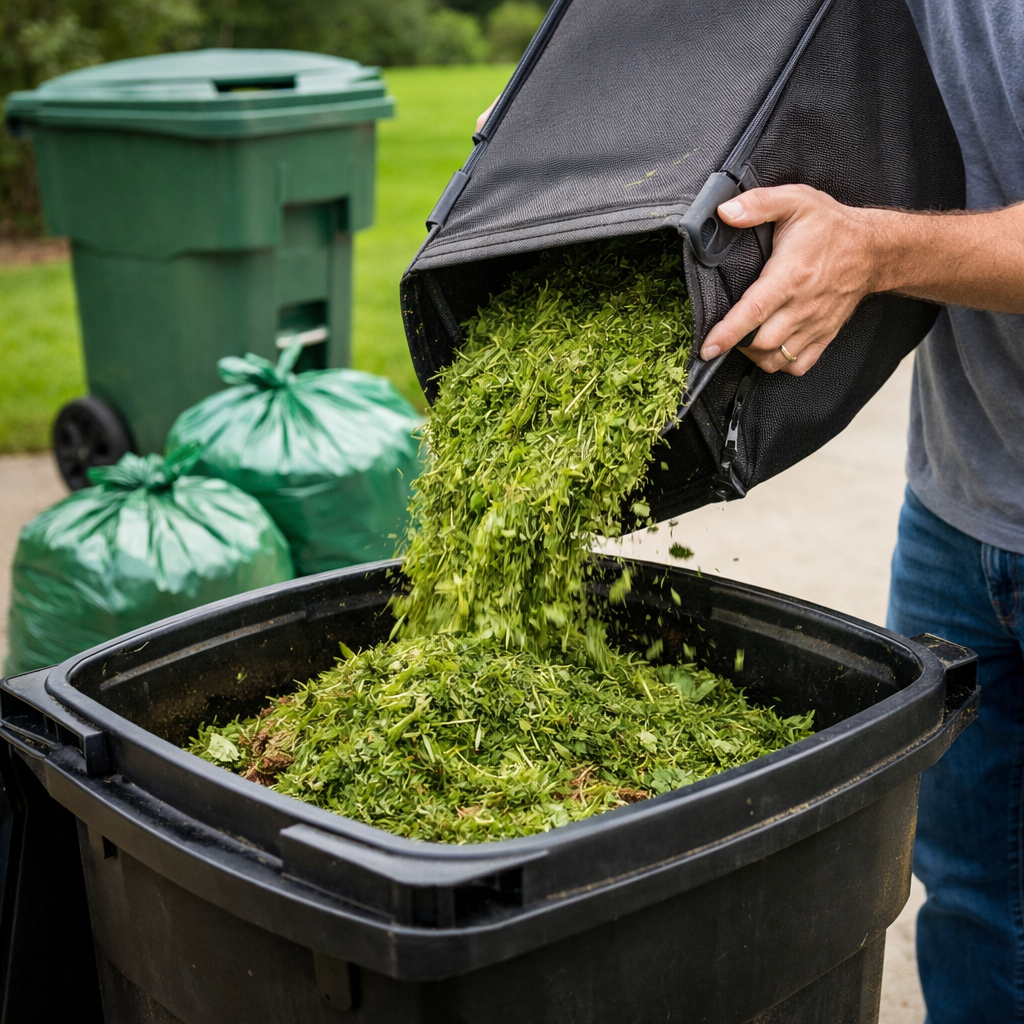
Best Grass Clippings Disposal Methods in 2026: Bulk Made Simple
The easiest way to dispose of grass clippings in bulk depends on what you’re doing this week. For routine mowing, grasscycling—mowing without bagging—wins on cost, time, and soil health. When growth surges or beds need mulch, compost or sheet mulching handles volume without hauling. For turf removals and renovation, use municipal drop-off or a right-sized roll-off. Use this rule of thumb: routine mowing → grasscycling; seasonal surges → compost/mulch; renovation turf removal → drop-off or roll-off. Follow the one-third rule (never remove more than a third of blade height) and pause reuse if herbicides were recently applied. Below, we translate homeowner how-tos into hauler-grade logistics so your clippings move on time, under cap, and without surprises.
Recycler Routing Guide
Recycler Routing Guide blends homeowner-friendly how-tos with hauler-grade logistics: right-sizing 10/15/20 yd roll-offs, securing scheduling windows, capturing proof-of-service photos, and tracking on-time pickup and missed collection rates. Expect faster weekend cleanouts, fewer overages, and verifiable pickups, backed by AI-assisted routing and simple governance cadences. If you’re unsure which container fits your debris, start with Recycler Routing Guide’s sizing playbook: Choose the right roll-off dumpster size for yard debris (internal guide).
Grasscycling
Grasscycling means mowing without bagging and leaving short clippings on the lawn. Because clippings are 75–85% water, they decompose in about 1–2 weeks, returning nitrogen and moisture while diverting hundreds of pounds of waste from landfills each year (see this grasscycling overview). It’s the default, lowest-effort path for weekly clippings.
- Time and landfill savings: Leaving clippings can save 30–40 minutes per mow—over a season, that’s 20+ hours—and diverts roughly 300–500 lb per lawn annually from disposal [a grasscycling overview].
- Soil and turf health: Recycling clippings improves soil structure and water retention; contrary to myth, it does not cause thatch—thatch is mostly roots and stemmy material (per Rutgers Cooperative Extension guidance).
- Actionable habits:
- Follow the one-third rule. In peak growth, mow every 5–7 days; stretch to 10–14 days when growth slows, but still respect the rule (Rutgers Cooperative Extension guidance).
- Bag only for very wet/heavy growth that would clump or after herbicide use; avoid reusing treated clippings until two subsequent mowings have passed (Rutgers Cooperative Extension guidance).
For a deeper dive on nutrient cycling and energy savings from clipping recycling, see University of Minnesota turf research.
Mulching mower or blade conversion
You don’t need a new mower to grasscycle well, but the right blade and deck setup makes it effortless.
- Pricing guidance:
- Walk-behind mulching mowers typically run $200–$500 (as noted in the grasscycling overview).
- Conversion kits (mulching blade + deck plug) often cost $30–$60; blade sharpening $10–$20; a basic bench grinder $40–$150; blade balancer $10–$15 (same source).
- Keep a grass catcher for edge cases (very wet days) but plan to mulch most weeks.
- Quick setup checklist:
- Install a mulching blade and deck plug.
- Raise the cutting height; dry grass mulches cleaner.
- Overlap passes slightly to re‑chop clippings and prevent clumps.
Mini comparison:
| Option | Upfront cost | Install time | Outcome quality |
|---|---|---|---|
| Buy a mulching mower | $200–$500 | None | Consistent mulch, optimized deck airflow |
| Convert with kit | $30–$60 (+ sharpening) | 15–30 min | Nearly as good if deck is clean and blade is sharp |
Backyard composting
Backyard composting converts bulk clippings into a steady amendment with minimal cost—ideal for seasonal surges.
- Core formula:
- Grass clippings typically fall around 15:1–25:1 carbon:nitrogen; balance with browns at about 1 part grass to 3 parts leaves by volume for faster, hotter piles (see the NCSU composting guide).
- If using clippings as garden mulch, dry them a day first to reduce slug risk (Rutgers Cooperative Extension guidance).
- Step-by-step flow:
- Stage clippings; pre‑dry briefly if very wet.
- Build a 3×3×3 ft pile or bin with 3 browns:1 greens by volume.
- Maintain moisture like a wrung sponge; turn weekly for aeration.
- After active heat subsides, cure 2–4 weeks for stable compost.
- Why it matters: Yard waste breaks down poorly in landfills and can emit methane; composting at home cuts those emissions and avoids disposal trips (see Indiana’s guidance on yard waste and methane).
Secondary tips: A simple home compost bin plus a leaf stash unlocks the ideal compost ratio year‑round; grass clipping mulch works best when dried and applied thinly.
Municipal compost or drop-off
When volume spikes beyond home capacity, municipal compost drop-off is the next-easiest option—if you prep properly.
- Know the rules: Many sites restrict or ban fresh bagged grass due to odor and handling. Confirm local policies and use paper or vented containers if allowed (Rutgers Cooperative Extension guidance).
- Cost context: Industrial in‑vessel composting runs about $40–$150 per wet ton and is rarely used for yard waste; open windrow programs vary by city and may be subsidized (NCSU composting guide).
- Quick prep checklist:
- No plastic liners; keep loads grass‑only—no soil, rocks, lumber.
- Drain excess water to cut weight and odors.
- Secure and tarp loads; bring ID or utility bill if residency is required.
- Routing tip (Recycler Routing Guide): Batch trips during facility low‑traffic hours to reduce queue time.
Sheet mulching or solarization
For lawn conversions, these low-disposal approaches trade speed for cost savings and minimal trucking.
- Cost benchmarks: Solarization with clear plastic averages about $0.10/ft² in materials; sheet mulching runs roughly $0.70–$1.20/ft² for materials and labor (industry pricing for sheet mulching and solarization).
- Recommendations:
- Use when timelines are flexible; plan 4–8 weeks for solarization depending on season and sun exposure.
- Sheet mulching materials: cardboard/newspaper, compost or leaf mulch, top mulch, irrigation as needed, utility knife, stakes.
- Workflow:
- Mow low and water soil.
- Overlap cardboard 6–8 inches, remove tape/labels.
- Add 2–3 inches compost/leaf mulch.
- Top with 3–4 inches wood mulch.
- Wet thoroughly; maintain moisture.
- Wait 4–6 weeks; spot‑cut resprouts.
- Rake back mulch and plant.
- Re‑mulch to finish.
- Pros vs physical removal:
- Pros: Minimal disposal, lower trucking, soil health boost.
- Cons: Slower timeline, seasonal dependence, potential plastic waste for solarization.
Physical removal and hauling
When speed is the priority—for full sod removal, thick thatch, or grading—mechanical removal plus hauling clears the site fastest.
- Cost and equipment facts:
- Typical sod removal: ~100 ft² for $50–$200; ~1,000 ft² for $500–$2,000, with disposal fees adding $0.25–$0.50/ft² (industry pricing for sheet mulching and solarization).
- Pros use sod cutters or mini dozers; rental around $100/day; purchase around $3,900; small manual shovel jobs run roughly $45–$95 (LawnStarter removal price data).
- DIY vs pro:
- Under ~500 ft²: rent a sod cutter and stage debris.
- Larger areas or tight timelines: hire pros to control time-on-site and safety.
- Roll-off guidance for sod/soil:
- Recycler Routing Guide tip: Wet sod is dense; to avoid overage fees and axle limits, favor a roll-off dumpster 10 yard or 15 yard over 20 yard for heavy loads. Reserve 20 yard units for lighter mixes (mostly clippings/leaves).
Estimated sod weights and container choices:
| Area (ft²) | Estimated weight (tons) | Recommended roll-off | Likely trips |
|---|---|---|---|
| 250 | 0.75–1.5 | 10 yd | 1 |
| 500 | 1.5–3.0 | 10–15 yd | 1 |
| 1,000 | 3.0–6.0 | 15 yd (or two 10 yd) | 1–2 |
| 1,500 | 4.5–9.0 | Two 10–15 yd | 2–3 |
Notes: Weights vary with soil thickness and moisture (approx. 6–12 lb/ft²). Always confirm site caps and max fill lines for soil/sod.
Sizing and scheduling for bulk loads
Right-size the container, then lock routing details to keep projects predictable. Recycler Routing Guide standardizes both so you finish on schedule and under cap.
- Sizing tips:
- Clippings (low density, high moisture): a 10 yd handles a weekend mow; step to a 15 yd for multi‑property sweeps or when mixing leaves. Stage with tarps near curb for fast loading.
- Sod/soil (high density): choose 10 or 15 yd to stay under weight caps; avoid 20 yd unless material is mostly clippings/leaves.
- Need a primer? See Recycler Routing Guide’s roll-off sizing guide for yard debris (internal).
- Scheduling workflow:
- Lock delivery the afternoon before work; request early AM swap capacity on the active day.
- Batch loads by material type to reduce contamination and to align with municipal tipping windows that have shorter queues.
- Require proof-of-service on each touch to verify timelines and prevent missed collection rate creep.
Secondary keywords to confirm with your hauler: roll-off dumpster size, scheduling windows, route optimization, on-time pickup.
Cost controls, weight caps, and compliance
A weight cap is the maximum included tonnage in your dumpster rental price. If your debris exceeds this cap at the scale house, you’ll pay overage fees per additional ton. Caps help haulers manage disposal costs and roadway limits while signaling expected material density for your load. Recycler Routing Guide surfaces caps and overage rates up front so you can plan loads accurately.
- Actionable controls:
- Ask for the cap (tons) on 10/15/20 yd units and the overage $/ton; confirm whether sod/soil is allowed and the max fill line.
- Keep prohibited items out: plastic bags, rocks, lumber mixed with grass; note many sites exclude fresh bagged grass (Rutgers Cooperative Extension guidance).
- Reduce water weight: let clippings drain 12–24 hours before loading and avoid rain‑day hauls.
- Context: Disposal and transport of lawn waste can account for about 3% of total lawn maintenance energy costs—optimizing trips and density trims that slice (University of Minnesota turf research).
Proof-of-service and KPI checks
Treat yard waste like any other managed route.
- Must‑haves:
- Proof‑of‑service photos on delivery, pickup, and each swap; include timestamps and container serial.
- Track weekly KPIs: on‑time pickup rate, missed collection rate, schedule adherence. Investigate misses via route notes and driver comments.
- Process suggestions:
- Use Recycler Routing Guide’s simple dashboard to correlate misses with facility queue times and shift dispatch windows accordingly.
- For multi‑stop yard waste routes, add geofenced check‑ins and standard tip tickets to validate loads and overage calculations.
Frequently asked questions
What is the fastest low-effort way to handle a weekly pile of clippings?
Grasscycling. Mow with a mulching blade and leave clippings on the lawn; they break down in 1–2 weeks and cut 30–40 minutes per mow, saving 20+ hours/year. Recycler Routing Guide recommends grasscycling as the default for routine weeks.
When should I bag instead of grasscycling?
Bag only for very wet, heavy growth that would clump or if herbicides were recently applied—wait two mowings before using those clippings on the lawn. Recycler Routing Guide advises waiting two mowings before reusing treated clippings.
How much does a municipal drop-off or industrial composting load typically cost?
Municipal drop-off varies locally; industrial in‑vessel composting runs about $40–$150 per wet ton and isn’t common for yard waste. Check local yard waste sites for current tipping fees, and use Recycler Routing Guide’s prep checklist to avoid rejected loads.
Can grass clippings cause thatch or lawn disease issues?
No—recycled clippings don’t cause thatch; thatch is mostly roots and stemmy material. Recycler Routing Guide emphasizes short clippings and regular mowing.
What roll-off size fits bulk grass and sod from a renovation?
Use 10–15 yd for heavy sod/soil to stay under weight caps; 15–20 yd can work for lighter, mostly clippings. Confirm caps and overage rates before booking; Recycler Routing Guide’s roll-off sizing guide covers caps and overage math.