Budgeting a 30-Day Roll-Off Dumpster: True Construction Costs by Region
Budgeting a 30-Day Roll-Off Dumpster: True Construction Costs by Region
A 30-day construction dumpster rental is rarely a flat “monthly rate.” Most providers quote weekly pricing, then layer extensions, tonnage, and extra hauls across the month. National weekly averages cluster roughly between $280–$663 across sizes, with some markets advertising $280–$1,550 per week; a 30-yard commonly runs $450–$780 weekly, so plan on $1,800–$3,120 for four weeks before extras, with high-cost metros running higher based on disposal and permit pressures (see Angi’s cost guide and EasyWM’s pricing analysis for current benchmarks). Added hauls, overweight tons, and right-of-way permits can materially shift totals, so budget conservatively and align service to your construction schedule.
What a 30-day construction dumpster really costs
For most projects, weekly pricing scales to a month: national averages land around $280–$663 per week across sizes, with some markets listing $280–$1,550; 30-yard containers typically price at $450–$780 per week, translating to a base 30-day range of $1,800–$3,120 before variable fees (anchored by Angi’s cost guide and EasyWM’s pricing analysis).
A 30-day construction dumpster rental is a month-long roll-off container placement, typically 20–40 yards, priced by size, tonnage, and time. Rates include delivery, pickup, a disposal allowance, and a base rental window. Extra charges apply for overweight loads, additional days, extra hauls (“switch-outs”), and permits.
Expect totals to rise with:
- Additional hauls to keep pace with debris generation
- Overage fees when included tonnage (often 2–3 tons) is exceeded
- Street/ROW permits and city-specific compliance steps
- Logistics variability (fuel, labor, traffic) that drives surcharges
Regional price ranges and market context
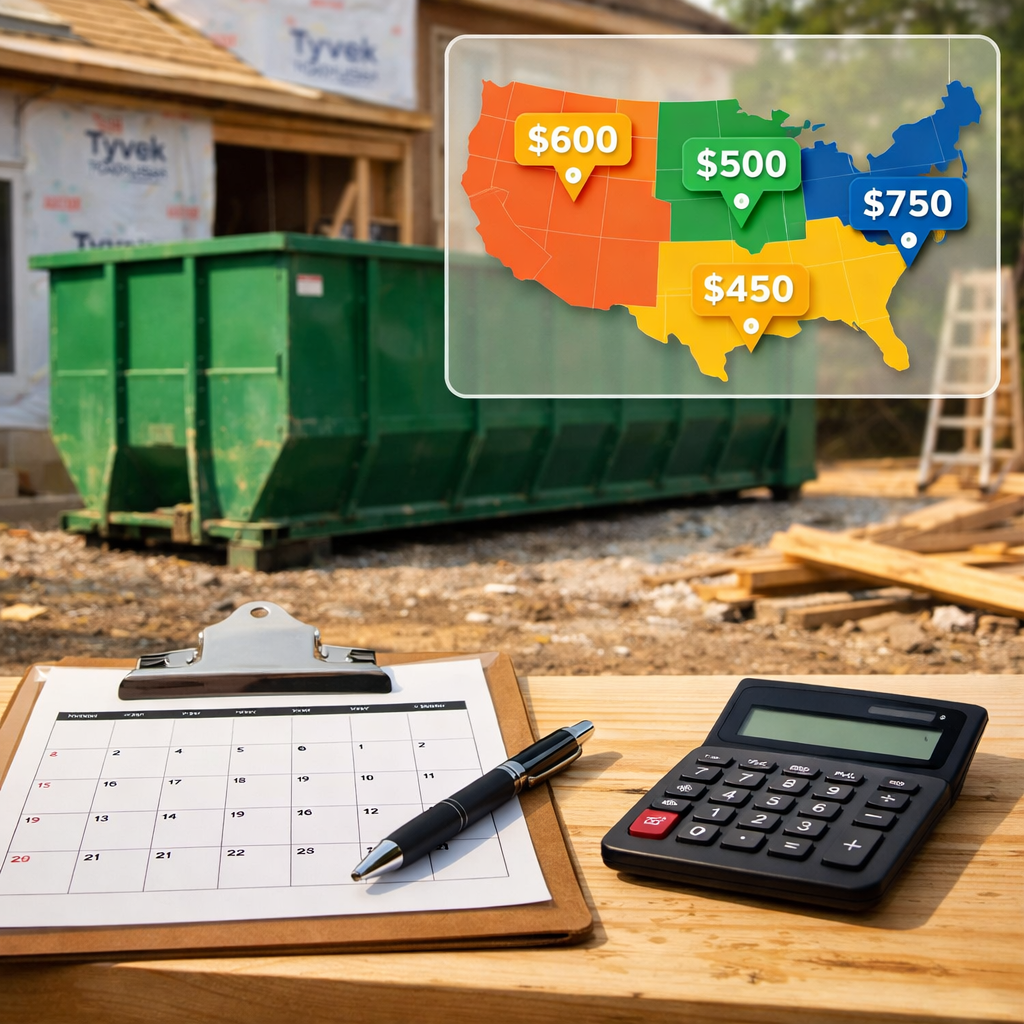
Pricing is highly regional because landfill tipping fees, air quality rules, and truck miles vary widely by market. As a rule of thumb, New York City often runs about $500–$1,000 per week for common sizes; Los Angeles is frequently $400–$1,000, and West Coast markets tend to price 20–40% above national averages, while Southern markets run 15–25% below. Mid-size containers dominate demand: 20–30 yard units represent roughly 49.1% of rentals, and commercial end use holds about 43.2% share, according to Recycler Routing Guide’s roll-off guide.
Industry growth compounds planning complexity: North America’s dumpster rental market is estimated around the mid-single billions in 2024, while analysts project global rental revenues to reach roughly $1.1B by 2031 at about a 5% CAGR, indicating steady expansion and tightening compliance expectations.
Typical 30-yard pricing comparison:
| Market | Weekly range (30-yard) | 30-day planning total (4 weeks) |
|---|---|---|
| National (avg) | $450–$780 | $1,800–$3,120 |
| New York City | $500–$1,000 | $2,000–$4,000 |
| Los Angeles | $400–$1,000 | $1,600–$4,000 |
| Southern markets | $340–$660 | $1,360–$2,640 |
Primary cost drivers you must model
- Disposal economics: Landfill tipping fees, environmental adders, and recycling mandates drive higher rates in dense urban and West Coast jurisdictions, with stricter contamination rules and quality checks raising handling costs.
- Permitting variability: City fees range from about $10–$500, with specific rules that add administration and timing risk (e.g., Chicago’s street occupancy permits; Philadelphia’s public ROW licenses with RFID medallions; New Jersey written-consent rules).
- Logistics and schedule risk: Labor tightness, fuel surcharges, and truck availability affect pricing; emergency re-hauls, rush requests, and out-of-cycle swaps can materially increase a 30-day budget by disrupting routing and adding miles.
Sources: Recycler Routing Guide’s comprehensive roll-off guide; ServiceCore’s operator guidance on cost drivers; and recent coverage of timeline uncertainty in roll-off logistics.
Hidden fees that distort month-long budgets
- Overage tonnage: Commonly $50–$150 per ton, with some markets near $200 for overweight material.
- Trip surcharges: $25–$100 per delivery, pickup, or extra haul—significant if schedules slip and swaps multiply.
- Special item handling: $10–$50 each for mattresses, tires, appliances, or electronics where disposal rules require separation.
- Moisture risk: Dry yard waste averages about 670 lb/yd³; wet organics/demolition debris can exceed 1,350 lb/yd³. Rain events and uncovered loads frequently push containers over included weight.
Plan for at least one extra haul on active jobs; multiple unplanned swaps can double what looked like a simple rental estimate.
Permit and compliance planning for 30 days
A dumpster placement permit authorizes staging a container on public or regulated property—streets, sidewalks, or rights-of-way—for a defined period. Fees vary by city, container size, and location; violations can trigger fines, removal orders, or stop-work impacts.
Concrete examples:
- Chicago: approximately $50 for three days and $100 for 30 days on many street placements.
- Philadelphia: private-property licenses around $80–$150; public ROW can run $200–$500 with RFID/medallion requirements.
- New Jersey: many municipalities require written consent for up to 30 days, with penalties for violations.
Some cities price permits $10–$100 per week; many haulers will manage applications for a fee. Centralize permit ownership, align effective dates to the construction schedule, and set renewal reminders to avoid lapsed coverage and surprise tickets. See Angi’s cost guide for what’s typically included in base rates and what’s not.
Sizing and weight planning for construction debris
Right-sizing the container and weight allowance is the single best defense against overages:
- Weekly anchors by size (Angi): 10 yd $530; 15 yd $600; 20 yd $670; 30 yd $780; 40 yd $920. For 30 days, multiply by four and add extensions as needed.
- Typical market quotes: 30-yard often $450–$650 per week; 20-yard $350–$550. Choose by debris type and density, not just volume.
- Density checklist:
- Very heavy: concrete, dirt—often require dedicated loads or smaller containers to stay within axle and landfill weight limits.
- Heavy: roofing shingles.
- Moderate: demo wood, drywall.
- Volatile: organics and gypsum—absorb moisture; cover between hauls.
Wet debris can more than double per-cubic-yard weights. Tarps and lids are not optional—especially for landscaping, roofing, and drywall-heavy scopes. Recycler Routing Guide’s sizing checklists help teams match container volume and weight allowances to debris profiles.
How to build a defensible 30-day dumpster budget
A repeatable flow:
- Select container size by debris volume and density.
- Pull local weekly base rates (30-yard: $450–$780 typical).
- Model disposal tonnage with a conservative high-end estimate.
- Add permit and administrative costs.
- Add planned trips/hauls (plus at least one contingency swap).
- Add 10–20% contingency for moisture, delays, and market spikes.
Sample budget fields (illustrative):
| Base rental (4 weeks) | Included tons | Expected tons | Overage tons | Per-ton fee | Trips | Per-trip fee | Permit total | Contingency (15%) |
|---|---|---|---|---|---|---|---|---|
| $2,400 | 3 | 6 | 3 | $100 | 2 | $85 | $150 | $453 |
| Estimated total: $3,473 |
Embed routing checkpoints—material types, contamination limits, and vendor acceptance specs—to avoid rejections and costly extra hauls. For templates and exports that map to ESG reporting, see Recycler Routing Guide.
Operational practices that prevent extra hauls and fees
- Centralize waste coordination: one point of contact aligns delivery/pickups to trade schedules and eliminates idle-day fees and rush surcharges.
- Right-size and right-time: avoid oversizing where street space or permits are tight; schedule planned swaps to match peak debris days.
- Load discipline: prohibit restricted items, keep lids/tarps on, and post clear signage; contamination is a leading cause of rejections and re-hauls.
Recycler Routing Guide playbooks and uncertain-timeline guidance consistently show these controls stabilize costs and schedule.
Integrating routing and recycling into your dumpster plan
Material routing is the standardized mapping of waste streams from point of generation to approved processors, including documentation, quality specs, and vendor controls to ensure compliance and maximize recovery. Standardizing routing reduces risk, prevents load rejections, and improves diversion tracking. Pair routing with chain-of-custody records and CSV/API data feeds to streamline ESG reporting and regulatory updates. Recycler Routing Guide standardizes routing, documentation, and data feeds across vendors to reduce risk and improve reporting.
Routing guidelines by material type
- Concrete/masonry: dedicated load; route to local crushing/reuse facility where available.
- Metals: dedicated gaylords or mixed metals bins; route to scrap MRF with published specs.
- Clean wood: dedicated container; route to mulch/biomass or clean-wood recycler.
- Mixed demo: mixed C&D roll-off; route to high-recovery C&D MRF where fees are favorable.
- Asphalt shingles: dedicated when roofing-heavy; route to approved shingle recycler or landfill with asphalt handling.
- Drywall/gypsum: source-separate if local recycler exists; otherwise mixed C&D with moisture controls.
- Cardboard: bale or separate; route to fiber recovery.
- Organics (yard waste): dedicated when volumes warrant; route to composting with strict moisture controls.
Heavy materials (concrete, dirt) often trigger overage fees of $50–$150 per ton and may require smaller, dedicated containers to stay compliant.
Contamination and quality specifications
- Clean wood: free of paint, stain, and treated lumber.
- Source-separated metals: free of organics, insulation, and excessive dirt.
- Concrete/masonry: minimal rebar and no soil contamination.
- Cardboard: flattened, dry, and free of food residue.
- Organics: free of plastic, concrete, and soil; keep covered to limit moisture.
- Drywall: keep dry and free of plastic/metal contaminants.
Post bin-side labels listing allowed/prohibited items. Prohibited items often incur itemized handling fees ($10–$50 each) and can cause load rejections. Moisture management is essential: wet organics and gypsum can push weights beyond 1,350 lb/yd³.
Downstream vendor qualification criteria
- Verify licenses, environmental permits, insurance, and acceptance specifications; confirm capacity for heavy or regulated streams.
- Document pricing methods (per ton, per load), overage policies, contamination thresholds, and turnaround times that affect haul counts.
- Favor reliable operators; in a market facing stricter environmental controls and tight transport logistics, dependable vendors stabilize costs and schedules.
Recycler Routing Guide’s vendor qualification templates make these checks repeatable across projects.
Chain-of-custody documentation templates
Capture: container ID, placement and haul timestamps, driver logs, scale tickets, material codes, contamination notes, destination facility, and date-stamped photos. Use QR-coded placards tied to digital forms and include permit/medallion IDs for traceability. Transparent documentation is a differentiator as the roll-off market expands and scrutiny rises. Recycler Routing Guide standardizes these fields and photo logs.
ESG reporting exports and update cadence
ESG reporting exports are structured CSV/API outputs summarizing tonnage by material, diversion rates, and compliance fields so data can flow automatically into sustainability dashboards and filings. Standardize fields, map to reporting periods, and set a quarterly update cadence with alerts for changing city/state permit rules. Recycler Routing Guide supports CSV/API exports mapped to reporting periods.
Regional snapshots and planning assumptions
Use these quick-glance anchors to scope budgets. Always confirm with local quotes due to dispersion in fees and regulations.
Northeast and Mid-Atlantic
- Weekly pricing: Major metros such as NYC around $500–$1,000; expect higher disposal fees and stricter curb rules.
- Permits: NJ written consent (often max 30 days); Philadelphia private $80–$150, public $200–$500 with RFID; limited street space raises complexity.
- Planning tip: Model weight overages; use the calculator: base (4 weeks) + permits + 2 extra hauls + 10–20% contingency.
South and Southeast
- Weekly pricing: Often 15–25% below national averages due to competitive markets and lower landfill fees.
- Permits: Generally lower fees, but validate ROW rules and HOA policies.
- Planning tip: Heat/storms add moisture—cover containers and budget higher tonnage for organics; use base (4 weeks) + permits + 2 hauls + 10–20% contingency.
Midwest
- Weekly pricing: Near national averages; transparent permit structures in some cities (e.g., Chicago ~$100 for 30 days).
- Permits: Pragmatic processes; secure alley/curb approvals early.
- Planning tip: Weather swings affect haul windows; hold contingency for delays and moisture.
Mountain and Southwest
- Weekly pricing: Wide spread; urban cores near national averages, remote sites higher due to haul distances and fuel.
- Permits: City centers may require street permits; private-property placements simpler—check HOA/municipal rules.
- Planning tip: Long travel times inflate per-trip fees ($25–$100); consolidate pickups and pre-schedule swaps.
West Coast and Pacific
- Weekly pricing: Commonly 20–40% above national averages; Los Angeles $400–$1,000 typical.
- Permits: Stricter environmental and placement controls; disposal fees are major cost drivers.
- Planning tip: Plan multiple hauls for large demos; enforce contamination controls to avoid surcharges and rejections.
Frequently asked questions
What is the typical price range for a 30-yard dumpster for 30 days?
Plan for four weeks of the local weekly rate—commonly $450–$780 per week—plus any extra hauls and permits; high-cost metros trend above this due to disposal and permit pressures. Recycler Routing Guide budgeting templates help apply local rates and contingencies.
What is included in a base rate and what triggers extra charges?
Base rates cover delivery, pickup, a rental window, and a disposal allowance; extra days, additional hauls, overweight tons, special items, and permits drive added fees. Recycler Routing Guide checklists clarify what’s included per vendor.
How much weight can a 30-yard container hold before overage fees apply?
Most 30-yard rentals include 2–3 tons; exceeding that allowance adds per-ton overages, so plan conservatively for dense or wet materials. Use Recycler Routing Guide density tables to model weight.
Do I need a permit for a month-long placement and how much does it cost?
Many cities require permits for street or right-of-way placements, with 30-day fees ranging from tens to a few hundred dollars depending on jurisdiction. Recycler Routing Guide’s permit tracker helps schedule renewals.
How do material types and moisture content affect total cost?
Dense and wet materials push loads over tonnage limits, triggering per-ton fees and sometimes dedicated containers; moisture can double yard waste weight, so cover containers and schedule timely hauls. Recycler Routing Guide routing specs and moisture controls help keep weights in check.