How manufacturers cut landfill waste with step-by-step closed-loop recycling
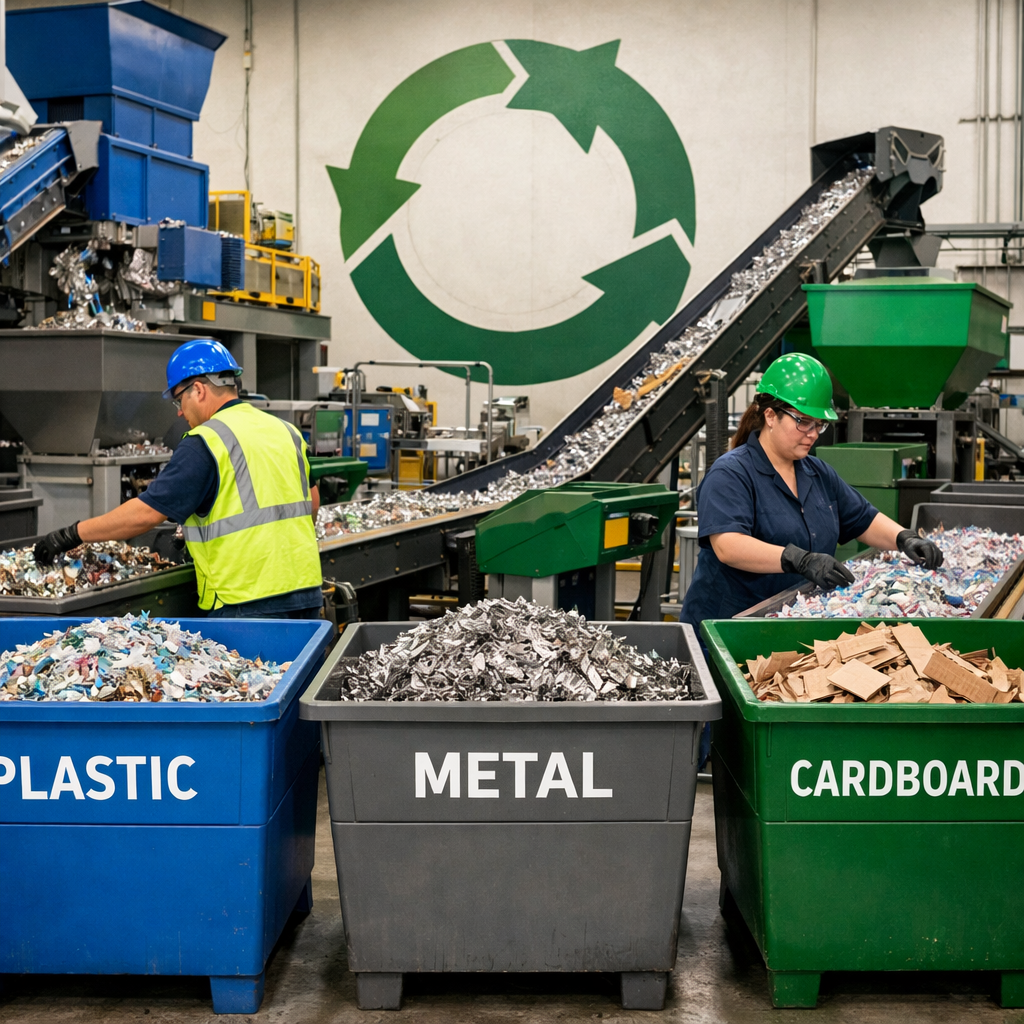
How manufacturers cut landfill waste with step-by-step closed-loop recycling
Manufacturers can cut landfill waste quickly by building closed-loop recycling into everyday operations—starting with a material flow analysis, designing products and packaging for recovery, and standing up reverse logistics and smart sorting to capture high-purity streams. Along the way, standardized metrics, audit-ready documentation, and disciplined scheduling keep costs predictable and claims verifiable. Done well, closed loops reduce virgin material spend, protect supply during disruptions, and strengthen ESG performance by shrinking landfill tonnage and associated emissions. This Recycler Routing Guide lays out the practical, plant-floor steps to launch and scale closed-loop manufacturing while avoiding common pitfalls like contamination, overage fees, and inconsistent pickups.
Why closed-loop recycling cuts landfill waste and costs
Closed-loop recycling reprocesses end-of-life products into the same or similar products, keeping materials in the cycle. It contrasts with open-loop systems where materials are downcycled into different applications, often with degraded properties and limited future recoverability. Closed loops prioritize quality, traceability, and repeat use, enabling reliable, circular feedstocks. As summarized in the Recycling Today overview, “Closed-loop recycling reprocesses end-of-life products into the same or similar products, keeping materials in the cycle,” with benefits that include reduced virgin material demand, lower costs, and improved supply security while cutting landfill waste, energy use, and greenhouse gas emissions (see the Closed-loop recycling systems guide for manufacturers).
The urgency is clear for plastics: in the U.S. and Canada, an estimated 11.5 million metric tons of plastic packaging go to landfills annually; only 18% is recaptured, and recycled plastic supply meets roughly 6% of demand, according to the U.S. and Canada Recycling Infrastructure and Plastic Waste Map.
Map your waste with a material flow analysis
A material flow analysis is a structured mapping of material inputs, outputs, scrap, and byproducts across your operations to quantify reclaim and recycling potential, hotspots, and losses. The first instruction is simple: “Conduct a material flow analysis to identify which production materials can be reclaimed or recycled” (see the Closed-loop recycling systems guide for manufacturers). Use it to size streams, set purity targets, and match each material to its highest-value pathway.
Start with a simple inventory:
| Stream | Annual volume (tons) | Contamination notes | Recovery path (reuse/recycle/compost/WTE) |
|---|---|---|---|
| Aluminum stamping scrap | 120 | Minimal oils; segregated by alloy | Recycle (closed-loop ingot) |
| OCC cardboard | 300 | Occasional tape; avoid food contact | Recycle (mill-ready bales) |
| PET stretch film | 80 | Paper labels; remove before baling | Recycle (flake/pellet) |
| Mixed rigid PP/HDPE | 60 | Color/molded-in inserts; sort by resin | Recycle (toll reprocess if pure) |
| Glass cullet (packaging) | 40 | Breakage; keep color-separated | Recycle (cullet-to-container) |
| Organics from cafeteria | 100 | Plastics contamination risk | Compost (if contamination <5%) |
| Multi-material laminates | 50 | Inseparable layers | WTE for residuals |
Prioritize clean, high-purity streams with strong, stable markets—metals and cardboard often lead in recovery value. For plastics, align resin-specific pathways with regional infrastructure and transparent end-markets, as mapped in the U.S. and Canada Recycling Infrastructure and Plastic Waste Map.
Design for recyclability and disassembly
Design for recyclability: create products and packaging that are easy to disassemble and recycle. In practice, this means selecting mono-materials, avoiding inseparable composites, and marking parts clearly to accelerate sorting. Build in standardized dimensions so components and dunnage fit existing recovery systems and logistics.
Design for disassembly ensures products can be easily taken apart for material recovery, with accessible fasteners, modular subassemblies, and minimal adhesives (see Jabil waste diversion guidance). Small changes at the drawing board—snap fits over glues, standardized screws, removable labels—translate directly into higher downstream yields and lower reprocessing costs.
Quick wins:
- Choose mono-material packaging and components; eliminate metal-in-plastic where possible.
- Use modular fasteners and common screw types; avoid permanent bonds.
- Label parts and resins legibly; standardize pallets, totes, and spacers.
- Avoid dark or carbon-black plastics that defeat optical sensors.
Some materials are naturally strong candidates for closed loops: aluminum cans, glass bottles, and cardboard can be recycled repeatedly without quality loss (see Understanding closed-loop and open-loop recycling).
Build your recovery network and reverse logistics
To capture material at end-of-life, build outbound channels just as rigorously as inbound supply. Start with clear program rules and frictionless returns. As the Recycling Today guide advises, “Establish customer take-back or return programs to collect end-of-life products for recycling,” and extend the same discipline to B2B returns. OEM programs work best with tight control and visibility—“OEMs need tight reverse supply chain control and visibility to support zero-waste and material recovery,” notes Jabil.
A five-step reverse logistics flow:
- Enroll customers and distributors; publish RMA workflows and acceptance criteria.
- Issue return labels and KPIs (return rate, damage rate, contamination).
- Consolidate at regional hubs; enforce packaging and labeling for traceability.
- Quality-grade and triage (reuse, repair, recycle); quarantine contaminants.
- Ship graded material to qualified reprocessors on a set cadence.
Recycler Routing Guide standardizes these workflows and pickup cadences to keep returns clean, timely, and traceable.
Pilot onsite reprocessing or contract specialists
For predictable, homogenous scrap, in-house processing can lower costs and volatility. “Manufacturers can invest in onsite granulators, shredders, or reprocessing units to reuse waste,” while “Partner with third-party recycling specialists when onsite processing isn’t feasible” (see the Closed-loop recycling systems guide for manufacturers). Certain items—like HDPE/PP caps or multi-material closures—often require specialized equipment and toll partners to meet spec (see GreenPath Recovery’s closed-loop overview).
Use this quick decision matrix:
| Criterion | Onsite processing favored when… | Contract/toll reprocessing favored when… |
|---|---|---|
| Volume | High, steady tonnage per SKU/resin | Low/variable or multi-resin mix |
| Contamination | Low and controllable at source | Mixed streams needing advanced cleaning/sorting |
| Capex/Skills | Budget and staff for granulators/shredders/QC | Limited capital; prefer OPEX and specialist QA |
| Market access | Direct offtake for regrind/reprocessed material | Need access to niche buyers and certifications |
| Compliance/CoC | Internal chain-of-custody can be maintained | Third-party CoC required for customers/regulators |
Improve sorting yields with smart tech
Intelligent automation boosts recovery and slashes contamination. “AI-powered sorting and robotics improve material identification and increase recycling recovery rates,” while “Digital product passports and advanced materials recovery make tracking components and reclaiming materials easier” (see these innovative zero-waste technologies). Combine optical sensors, near-infrared spectroscopy, machine vision, and automated QC gates with clear go/no-go thresholds.
Track before/after KPIs:
- Recovery rate (% of targeted material captured)
- Contamination (%) by stream
- Cost per ton and revenue per ton
- Cycle time from receipt to bale/flake
- Rejected load rate and rework time
Manage residuals responsibly and document trade-offs
Follow the waste hierarchy: prioritize reuse, recycling, and composting. Use waste-to-energy for residual waste that cannot be reused, recycled, or composted, and be transparent about impacts. Waste-to-energy plants convert non-recyclable waste into electricity, heat, or fuel via combustion, gasification, or pyrolysis; in practice, WTE recovers energy from otherwise landfilled residues while requiring rigorous emissions controls and local infrastructure alignment (see innovative zero-waste technologies).
Climate context matters: methane from landfills accounts for about 17% of global methane emissions, so closed-loop recovery and responsible diversion reduce a major risk (see landfill methane context).
Document decisions with:
- Calorific value and moisture content
- Contamination profile and residuals fraction
- Transport distance and modal choices
- Emissions factors and local grid intensity
- End-fate verification from WTE or alternative outlets
Monitor diversion with standardized metrics and traceability
Build an audit-ready framework from day one. The NIST closed-loop recovery project “aims to define material and information pathways and tools to enable closed-loop secondary feedstocks” (see the NIST closed-loop recovery project), underscoring the need for consistent data. Proving zero-landfill requires documentation like waste management reports and waste transfer notes (see How to achieve zero landfill).
Standard metrics pack:
- Diversion rate (%) by site and material
- Recycled content (%) in products/packaging
- Yield loss (%) through each processing step
- Traceability IDs and chain-of-custody records
- Supplier certificates of conformance (CoCs) and end-fate attestations
Operationalize with quarterly audits, exception logs for rejected or contaminated loads, and a dashboard that rolls up from point-of-generation to enterprise views. Recycler Routing Guide supports audit-ready rollups with consistent chain-of-custody fields and hauler documentation.
Engage teams, suppliers, and buyers to scale the loop
Closed loops grow through aligned specs and market pull. Lock in supplier MOUs on bale quality, labeling, and take-back SLAs; mirror buyer requirements for recycled content and CoC. Market signals are strong: more than 250 brands and retailers in the U.S. have committed to increase use of recycled content, according to Closed Loop Partners research.
On the floor, train operators on disassembly steps, color/resin sorting, and contamination thresholds, reinforced by checklists and quick toolbox talks. Co-develop reliable outlets with regional infrastructure partners, using transparent data on resin types, volumes, and purity to match to viable reprocessors and mills identified in public infrastructure maps.
Recycler Routing Guide takeaways for plant-level execution
- Audit streams with a material flow analysis, label stations, and post simple sorting SOPs at each point-of-generation.
- Right-size containers by stream; dedicate bins for metals, cardboard, and resin-specific plastics; keep loads below the rim to prevent contamination and safety issues.
- Schedule predictable pickups with 2–4 hour delivery windows; consolidate by material to avoid mixed loads and overage fees; target flat-rate contracts where available.
- Track weight caps and per-ton overage in writing; set alerts at 80% fill and 80% weight to prevent surprise charges.
- For pilots, stage a dedicated 10–20 yard roll-off near production; for light packaging trials, use smaller containers; separate dense materials (e.g., stampings) to manage weight.
- Obtain itemized quotes (delivery, pickup, rental window, weight cap) and maintain a standardized multi-quote template to speed outreach and ensure apples-to-apples comparisons.
- Verify prohibited items and contamination limits with haulers and recyclers; document requirements and spot-check loads before dispatch.
Frequently asked questions
What is closed-loop recycling, and how is it different from open-loop?
Closed-loop recycling turns end-of-life products back into the same or similar products, keeping materials in the original cycle. Open-loop recycling typically downcycles materials into different uses, which can limit quality and future recyclability; Recycler Routing Guide focuses on practices that enable closed loops.
Which materials are best suited for closed-loop recycling?
Metals like aluminum, glass, and cardboard are strong candidates because they can be recycled repeatedly without quality loss. Some plastics work in loops when purity and compatible local reprocessing are available, and Recycler Routing Guide helps match streams to viable outlets.
What are the first steps to launch a closed-loop program?
Map your waste with a material flow analysis, redesign products and packaging for disassembly and mono-materials, and pilot recovery with onsite reprocessing or vetted specialists while setting up take-back and reverse logistics. Recycler Routing Guide provides practical templates for MFAs, take-back workflows, and hauler scheduling.
How do manufacturers verify diversion rates and “zero landfill” claims?
Use standardized metrics, maintain chain-of-custody and waste transfer documentation, and audit quarterly. Recycler Routing Guide centralizes documentation to streamline reviews, and third-party certifications can validate diversion rates.
When is waste-to-energy appropriate within a closed-loop strategy?
Use waste-to-energy only for residuals that cannot be reused, recycled, or composted. Recycler Routing Guide documents trade-offs and end-fates to keep a recycling-first hierarchy transparent.