How to Choose a HIPAA-Compliant Shredding and Disposal Vendor
How to Choose a HIPAA-Compliant Shredding and Disposal Vendor
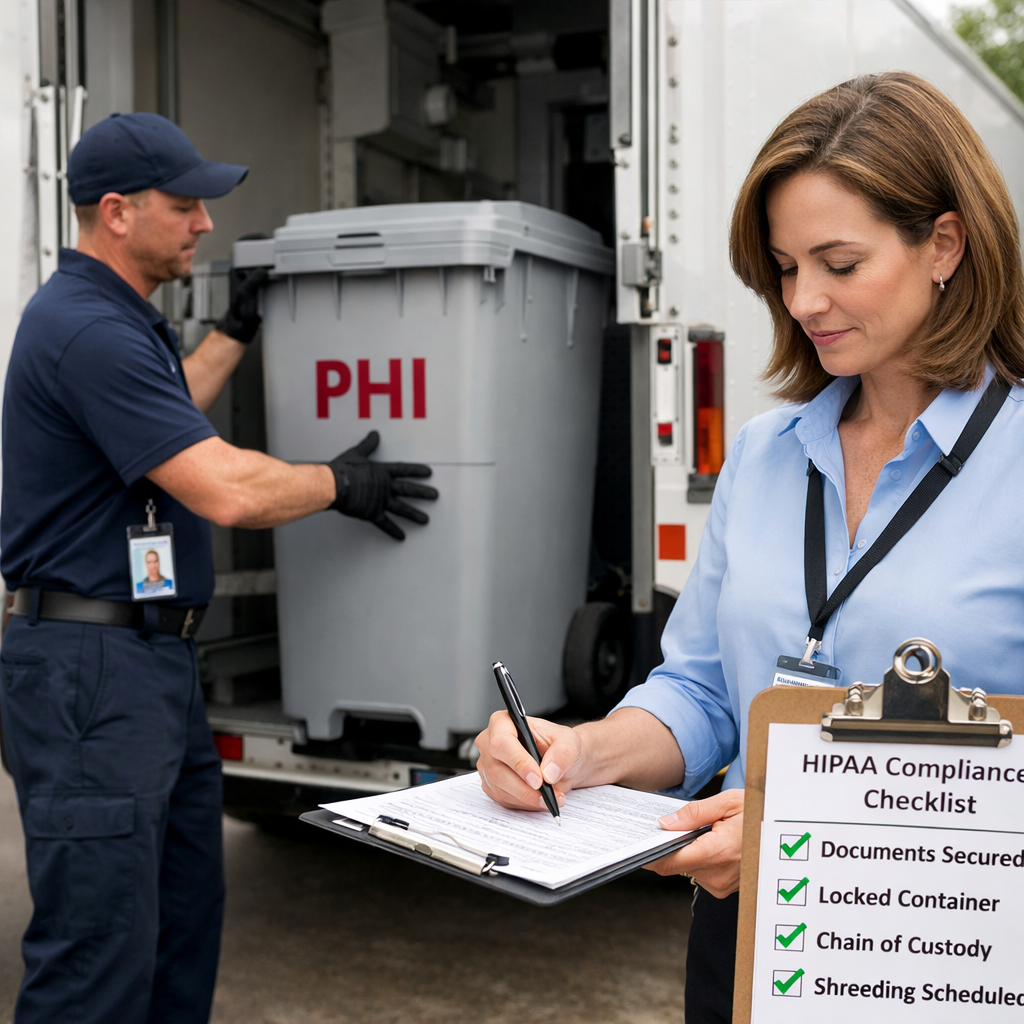
A HIPAA-compliant shredding and disposal vendor is a control in your privacy program—not a convenience purchase. Choosing well means demanding documented security, verifiable chain of custody, and audit-ready records. Below, we show exactly what to require, how to validate it, and how to right-size services so PHI never backlogs. We also map verification to sustainability reporting and share Recycler Routing Guide’s logistics-first tools that standardize pricing, scheduling, and proof of service. If you’re short on time: prioritize a signed BAA, NAID AAA certification, sealed collection with GPS-logged custody, Certificates of Destruction for every event, and destruction methods that render PHI unreadable and irretrievable.
Treat vendor selection as part of your PHI disposal policy and risk assessment
Protected Health Information (PHI) includes any individually identifiable health data—paper or electronic—tied to care, billing, or operations. HIPAA requires PHI be disposed so it is unreadable, indecipherable, and irretrievable, using secure methods appropriate to the medium, a standard that applies equally to paper and ePHI. AccountableHQ’s HIPAA shredder guide
Penalties frame the stakes: civil fines typically range from $100 to $50,000 per violation, with an annual cap up to $1.5 million for repeat offenders, underscoring the need for due diligence. All Ways Shred’s HIPAA disposal explainer
Bake vendor evaluation into your written PHI disposal policy and risk assessment. Require a signed Business Associate Agreement (BAA) before any PHI leaves your control, define clear procedures, document destruction events, and schedule periodic audits and role-based staff training to keep controls effective over time. MedPro Disposal’s PHI shredding rules Recycler Routing Guide’s checklists and quote templates align these policy controls with enforceable, auditable requirements.
Define scope and service model
Start with a quick inventory of what you discard and where it’s generated. Capture media types (paper charts, imaging, hard drives, tapes, backup media) and generation points (front desk, billing, records room, HIM, IT). This clarifies the number and size of locked consoles and the service frequency needed to prevent PHI accumulation. MedPro Disposal’s PHI shredding rules Recycler Routing Guide’s photo-based assessment accelerates this sizing and helps prevent backlog.
Two common models cover most needs:
- Recurring service uses locked consoles with scheduled pickups, minimizing staff handling and backlog risk.
- One-time purge covers archive cleanouts or IT refreshes, often with higher-capacity bins and dedicated trucks. MedPro Disposal’s PHI shredding rules
Comparison at a glance:
| Model | Best triggers | Typical bin counts | Staff handling time | Documentation produced |
|---|---|---|---|---|
| Recurring shredding service | Steady paper flow; multi-site clinics; compliance-driven cadence | 1–3 consoles per department | Minimal—drop into locked slots | Certificate of Destruction per pickup; chain-of-custody log |
| One-time purge shredding | Archive reductions; M&A; IT decommissioning | Bulk totes; gaylords; IT cages | Moderate—staged prep and supervision | Event-level Certificate of Destruction; end-to-end custody record |
Robust custody and documentation systems—including digital logs and tamper-proof records—simplify audits and reduce risk. Censinet guidance on secure PHI disposal tools All Ways Shred’s HIPAA disposal explainer
Specify chain of custody and tracking requirements
Treat every handoff as a security event you can prove later:
- Require barcode or RFID bin IDs with GPS-logged scans at pickup, transfer, and destruction. Some providers use enterprise platforms or even blockchain to create tamper-resistant audit trails from collection through destruction. Censinet guidance on secure PHI disposal tools
- Insist on GPS-tracked vehicles and uniformed, background-checked staff with photo ID. This protects custody in transit and supports incident reconstruction if needed. All Ways Shred’s HIPAA disposal explainer
- Define closed-loop events to capture in auto-generated, tamper-proof PDFs: pickup time and location, bin IDs, seals, custody transfers, destruction timestamp, destruction method, and the signer of the Certificate of Destruction. Store these in a secure repository. Censinet guidance on secure PHI disposal tools
Recycler Routing Guide standardizes capture and naming for these custody data points, making storage and retrieval straightforward at audit time.
Require documentation and legal safeguards
Make these non-negotiable:
- Signed BAA: Include a sample BAA in your RFP. Verify liability insurance, breach notification obligations, subcontractor controls, and your audit rights before service starts. MedPro Disposal’s PHI shredding rules
- Certificate of Destruction for every event: A Certificate of Destruction lists media type, destruction method, date/time, and relevant accreditations; many vendors auto-generate tamper-proof PDFs and store them in the cloud for easy retrieval. Censinet guidance on secure PHI disposal tools
- Witnessed destruction options: For highly sensitive sets (VIPs, legal holds), permit on-site witnessing or video capture.
- Record retention: Define how long to keep destruction records and custody logs in your policy; align with your broader record-retention schedule and litigation hold processes.
Recycler Routing Guide’s quote templates make BAA execution, custody logging, and certificates part of base pricing—so safeguards aren’t optional line items.
Verify security controls and certifications
Use objective markers of maturity:
- NAID AAA certification: Confirms rigorous security across people, facilities, and processes, with unannounced audits and multi-level background checks—significantly reducing your due diligence burden. MedPro’s clinic shredding guide TrueShred on HIPAA-ready companies
- Baseline operational controls: Secure, locked containers; documented procedures from intake to destruction; ongoing employee training on PHI handling and incident response. All Ways Shred’s HIPAA disposal explainer
- Physical and transit security: Controlled facility access with surveillance, GPS-tracked vehicles, and visible, ID-checked personnel. All Ways Shred’s HIPAA disposal explainer
Match destruction methods to media types
HIPAA does not mandate one shred size; it requires PHI be rendered unreadable, indecipherable, and irretrievable. For paper, P‑4 cross-cut is a practical baseline, with micro-cut for higher sensitivity. AccountableHQ’s HIPAA shredder guide
- Paper: Strip-cut creates long ribbons that are easier to reconstruct. Cross-cut produces confetti-like fragments that resist reassembly. DIN 66399 levels P‑4 to P‑7 define particle sizes; industrial systems can reach particles as small as 2.4 mm, aligning with stringent information destruction targets and NIST 800‑88’s emphasis on irrecoverability. Censinet guidance on secure PHI disposal tools
- Electronic media: Never use paper shredders. Require certified data wiping per NIST 800‑88 (clear/purge) or physical destruction such as drive shredding, crushing, or pulverizing. Deleting files or reformatting is insufficient for ePHI. AccountableHQ’s HIPAA shredder guide MedPro Disposal’s PHI shredding rules
Test on-site vs off-site operations
Choose the mode that fits your risk tolerance, footprint, and budget:
- On-site mobile shredding: A truck shreds at your location. Teams can witness destruction and receive immediate Certificates of Destruction. Shred Nations’ overview of HIPAA-compliant destruction
- Off-site shredding: Sealed, locked bins are transported under chain of custody to a secure plant for high-throughput destruction with certificates issued post-processing. Shred Nations’ overview of HIPAA-compliant destruction
Decision tips: go on-site for highly sensitive or VIP records; choose off-site for cost efficiency with strong custody controls and sealed containers. AccountableHQ’s HIPAA shredder guide
| Factor | On-site mobile shredding | Off-site plant shredding |
|---|---|---|
| Witnessing | Yes, at the truck | Typically no; video or audit logs |
| Cost | Higher per visit | Lower per pound/visit |
| Throughput | Moderate (truck capacity) | High (industrial systems) |
| Site constraints | Requires parking and safe staging | Minimal; needs dock/elevator access |
| Disruption | Short window, visible truck | Quick pickup; shredding offsite |
| Documentation flow | Secure collection → on-truck cross-cut → certificate issued on-site → recycling where appropriate | Secure collection → GPS-tracked transport → plant cross-cut → certificate issued → recycling where appropriate |
Collect proofs during demos: custody scans, GPS pings, seal photos, shred particle samples, and a sample Certificate of Destruction. All Ways Shred’s HIPAA disposal explainer Recycler Routing Guide supports either mode and validates artifacts with GPS and certificate matching.
Pilot service, audit results, and train staff
Run a 30–60 day pilot at a few representative sites. Validate custody logs, sample Certificates of Destruction, GPS data, bin integrity, seal numbers, and actual staff handling time. Score results against your RFP checkpoints.
Train staff to recognize PHI/ePHI, use locked consoles properly, and report exceptions; maintain signed training records to support audits and reinforce culture. MedPro Disposal’s PHI shredding rules
Mini audit checklist:
- Background-check evidence and ID protocols
- Facility access controls and CCTV coverage
- Console lock checks and seal-change procedures
- Truck GPS screenshots mapped to pickup IDs
- Certificate storage/retrieval test across a sample period
Recycler Routing Guide’s verification protocols streamline evidence collection during pilots and ongoing audits.
Formalize agreements and retention of destruction records
After the pilot, finalize the BAA and embed the vendor’s steps into your written PHI destruction policy and SOPs. Define retention rules for Certificates of Destruction and custody logs. MedPro Disposal’s PHI shredding rules
Retain certificates and custody records in a secure repository with role-based access and periodic spot-checks. Many vendors host tamper-proof certificates in the cloud for easy audit retrieval—verify access and export options. Censinet guidance on secure PHI disposal tools
Schedule annual reviews to re-verify certifications (e.g., NAID AAA), insurance, training completions, and performance against SLAs. Recycler Routing Guide recommends consistent naming (site-date-binID) to keep certificates and custody logs aligned and easy to retrieve.
Integrate verification and reporting with sustainability platforms
Capture vendor documentation—Certificates of Destruction and material weights—and map them to ENERGY STAR Portfolio Manager and Re‑TRAC Connect so you can normalize by occupant or square foot across sites.
Where paper is securely recycled after destruction, note that privacy and environmental goals can be advanced together; call this out in ESG reporting. All Ways Shred’s HIPAA disposal explainer
Standardize data fields to streamline rollups:
- Pickup date/time and site ID
- Weight and media type
- Destination (recycle/disposal) and MRF name if applicable
- Certificate URL and custody log ID
With Recycler Routing Guide or your internal system, keep these fields export-ready to simplify quarterly ESG reporting.
Use Recycler Routing Guide tools to standardize quotes and prevent overages
Recycler Routing Guide is a logistics-first workflow that reduces cost variance and strengthens audit trails for HIPAA-compliant shredding and disposal. We provide flat-rate quote templates with defined weight caps, itemized fees, and BAA/certificate requirements—so pricing is predictable and audit-ready. Our photo-based assessment right-sizes consoles, bin placement, and pickup frequency by department. And our protocols lock 2–4 hour delivery windows and verify completion via weighbridge/MRF evidence cross-checked against Certificates of Destruction.
Right-sized recommendations via photo assessments
- Submit photos of records rooms, intake points, nursing stations, and IT cages. Estimate weekly PHI volume and media mix; we translate this into the right count of locked consoles and swap cadence.
- Separate dense media (drives, tapes) from paper to avoid capacity issues and ensure the correct destruction method is dispatched.
- Photo assessments reduce surprise overflow pickups and inform staffing at collection points.
Flat-rate quote templates with defined weight caps
- Use our template to fix per-visit rates, define weight caps by media type, include container rental, and pre-list surcharges for extra bins or after-hours service.
- Require BAA execution, Certificates of Destruction, and chain-of-custody logging in base pricing to prevent nickel-and-diming.
Example comparison:
| Item | Quote A (RRG template-aligned) | Quote B (open-ended pricing) |
|---|---|---|
| Per-visit rate | $X fixed | $Y + variable line items |
| Weight caps | Paper: 500 lb; Drives: 50 units | Not specified |
| Inclusions | Containers, BAA, custody logs, Certificates of Destruction | Containers only |
| Overage triggers | Clear per-lb or per-drive adders | Vague “market rate” surcharges |
Lock 2–4 hour delivery windows and confirm placement permits
- Schedule within 2–4 hour windows to minimize clinic disruption and preserve custody integrity; confirm elevator access, dock height, and route constraints in advance.
- Verify any municipal or facility permits for curbside/mobile truck staging and pre-clear security check-in procedures.
- Capture arrival/departure timestamps and truck GPS pings to validate SLA compliance.
Verification protocols using weighbridge and MRF evidence
- Require weighbridge tickets or calibrated scale readouts matched to pickup IDs and Certificates of Destruction.
- For paper routed to recycling, request MRF intake confirmations to corroborate chain of custody and diversion outcomes.
- Store all artifacts with consistent naming (site-date-binID) and link them to your sustainability platforms for quarterly reporting.
Frequently asked questions
What makes a shredding vendor HIPAA compliant?
A compliant vendor signs a BAA, maintains secure chain of custody, renders PHI unreadable and irretrievable, and issues Certificates of Destruction with audit-ready logs. Recycler Routing Guide helps enforce these requirements with standardized templates and custody checks.
Do I need NAID AAA certification from my vendor?
It’s not legally required, but NAID AAA signals strong security, audits, and screening—easing due diligence. Recycler Routing Guide can prioritize NAID AAA providers during sourcing.
What is a Certificate of Destruction and how long should I keep it?
It documents what was destroyed, how, and when. Retain certificates per your record-retention policy; Recycler Routing Guide keeps certificate links organized for quick audits.
Should I choose on-site mobile shredding or off-site processing?
Choose on-site if you need to witness destruction; select off-site for lower costs with sealed containers and robust custody controls. Recycler Routing Guide supports either mode and validates proofs.
Can one vendor handle PHI shredding and regulated medical waste together?
Yes—many bundle services, simplifying scheduling and compliance as long as each waste stream follows its specific rules and documentation. Recycler Routing Guide can consolidate scheduling while keeping records separate.