How to Choose Driveway-Safe Dumpster Sizes for Austin Homes
How to Choose Driveway-Safe Dumpster Sizes for Austin Homes
The fastest way to right-size a driveway-safe dumpster in Austin is to start with your driveway footprint, then match volume and weight limits to your project scope. For most single-family homes and small multifamily properties, 10–20 yard roll-offs fit comfortably and avoid permits, while larger sizes often require street placement. Measure the space, estimate debris in pickup-truck loads, confirm included weight allowances and overage fees, and lock in delivery/pickup windows. When in doubt, a 15-yard is a smart “right-size” choice for garage cleanouts and single-room remodels; step up to a 20-yard only if your driveway can accommodate the ~22-foot length and you need extra volume.
Know your driveway footprint
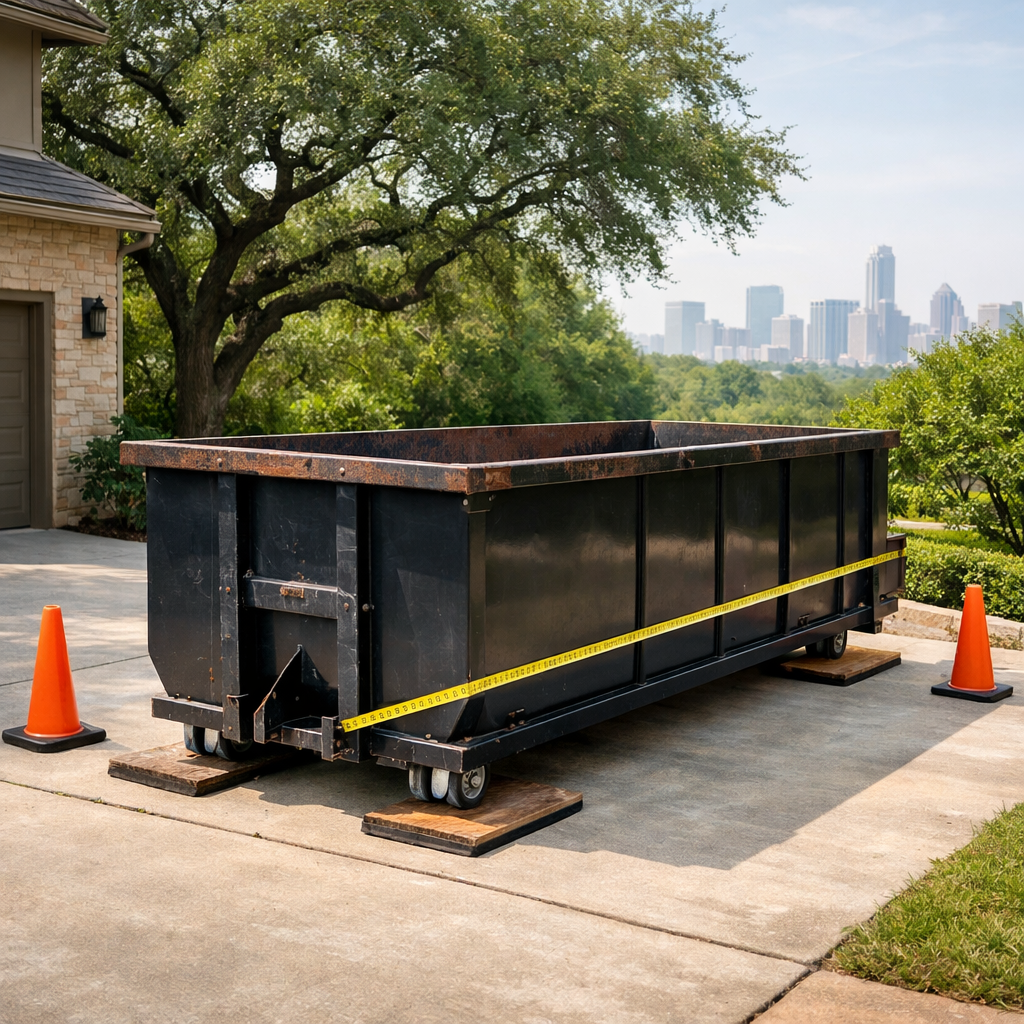
Measure the usable length and width of your driveway. Note slope, gates, low branches, overhead lines, and nearby landscaping. Leave 2–3 feet of side and tail clearance for truck access and the dumpster door swing, and sketch a simple plan with dimensions. A 20-yard bin is roughly 22 feet long by 8 feet wide and 4–4.5 feet tall, while most 30–40 yard containers share the ~22-foot length but are taller; compact 10-yard units often run about 14 by 7.5 by 3.5 feet (confirm with your hauler’s spec sheet) Waste Connections dumpster sizes. External dimensions vary by provider, so always verify the exact footprint before you book Dumpsters.com size guide. The wrong size can block garages and sidewalks, create safety hazards, and delay projects—confirm turning radius and clearance for both delivery and pickup maneuvers How to pick the perfect size.
Quick reference:
- 10-yard: ~14’ L × 7.5’ W × 3.5’ H (best for tight drives)
- 20-yard: ~22’ L × 8’ W × 4–4.5’ H (most versatile in volume)
- 30-yard: ~22’ L × 8’ W × 6’ H (may overhang shorter driveways)
- 40-yard: ~22’ L × 8’ W × 8’ H (often needs street placement)
Definition: Driveway-safe dumpster
A driveway-safe dumpster is a roll-off container that fits your driveway’s measured footprint and can be staged, delivered, and removed without blocking access or damaging surfaces. In Austin neighborhoods, 10–20 yard roll-offs often work best thanks to shorter lengths, lower sidewalls, and easier truck maneuvering in residential zones.
Inventory your debris and estimate volume
List your materials and estimate volume in pickup-truck equivalents. It’s an easy visual: a 10-yard dumpster holds about 3–4 truck loads; a 20-yard about 6; a 30-yard roughly 9; and a 40-yard around 12, depending on material and loading efficiency Dumpster size guide, Austin size overview.
“Dumpster size is measured in cubic yards (a volume unit), not length or area. One cubic yard equals 27 cubic feet—the size of a 3’ × 3’ × 3’ cube.” Dumpster sizes explained
Pickup-truck loads to dumpster size (quick map)
- 2–3 loads: 10-yard
- 3–5 loads: 15-yard
- 5–7 loads: 20-yard
- 8–10 loads: 30-yard
- 10–12+ loads: 40-yard
Tip: For mixed household debris, err one size up if you can accommodate the footprint; for dense materials, size down and plan multiple hauls.
Match dumpster size to project scope
Use project patterns to narrow the range:
- Bathroom refresh or small flooring tear-out: 10–15 yard
- Kitchen remodel: 20 yard
- Whole-home declutter or multi-room refresh: 20–30 yard
- Landscaping with bulky, lighter materials (branches, sod, brush): 15–20 yard
These ranges reflect common residential use and weight considerations in Central Texas Residential size recommendations, as well as national norms for home projects and loading comfort.
A 20-yard is the most popular residential choice for versatility, but it needs a longer footprint. Measure your driveway and ensure maneuvering room; also consider sidewall height for safe, easy loading of bulky items.
10 yard for tight spaces and light cleanouts
A 10-yard typically measures about 14’ × 7.5’ × 3.5’ and holds roughly 3–4 pickup loads. It’s ideal for small cleanouts, bathroom updates, single-room flooring removal, or dense materials where weight caps matter. Many haulers recommend 10-yard containers for heavy debris (concrete, dirt, tile) to avoid overweight charges—flag these materials when you book.
Common fits: shed clear-out, one-to-two room spring declutter, small deck or tile removal.
15 yard for garage cleanouts and single-room remodels
The 15-yard is Recycler Routing Guide’s “right-size” pick for many Austin homes: compact enough for most driveways, with manageable loading height for DIYers. It suits garage cleanouts, single-room remodels, and bulky-but-light items like furniture and insulation. Compare itemized quotes and included weight caps; if you have dense debris, consider separating it into a 10-yard heavy-material load to limit overages.
Keywords to know: garage cleanout dumpster, single-room remodel dumpster, driveway-friendly dumpster Austin.
20 yard for medium renovations and whole-home declutter
A 20-yard equates to about 6 pickup loads and commonly measures ~22’ long and 8’ wide. It’s a go-to for kitchen remodels, roofing overlays, medium landscaping, or whole-home declutters where volume, not weight, drives the decision. If your driveway is shorter than ~22 feet, ask your hauler about alternate placement or step down to a 15-yard with a planned second haul to avoid blocking sidewalks or garage doors.
Validate weight limits and dense material rules
Heavy materials can hit weight caps before the container is full. Discuss included weight allowances and per-ton overage fees with your hauler before delivery. Typical included weights vary, but many residential rentals fall near these ranges: 10-yard up to ~5,000 lbs; 20-yard ~5,000–8,000 lbs; 30-yard ~8,000–12,000 lbs; 40-yard ~12,000–16,000 lbs. For dense loads, choose smaller volumes or plan multiple trips to control costs and comply with hauling safety guidance. Get allowances and per-ton rates in writing—a Recycler Routing Guide best practice.
Definition: Overage fees
Overage fees are added charges when your dumpster exceeds the included weight allowance or other rental limits. They’re typically billed per additional ton (or fraction) over the cap and can escalate total cost quickly—especially with concrete, dirt, or tile. Always confirm allowances and tiered per-ton rates before scheduling delivery.
Confirm local placement rules and permits in Austin
If the dumpster sits fully on your private driveway, a permit is usually not required. Placement on a public street, alley, or sidewalk typically requires a right-of-way permit—verify requirements and lead times before booking. Austin’s Chapter 15-6 administrative rules also set labeling and diversion expectations: applicable properties must label containers by material type (labels or stickers at least 12" diameter or 12" × 12") and maintain onsite recycling and organics diversion capacity that matches landfill trash capacity at a minimum 1:1 ratio Austin Chapter 15-6 rules.
Ask your hauler who secures any needed permits and how long approval takes; record the permit ID in your job file. Recycler Routing Guide favors driveway placement when feasible to avoid permit lead times and street-blocking risks.
Schedule for reliability and document KPIs
Lock in logistics to avoid idle costs and driveway blockages.
- Request defined delivery windows, proof-of-service photos, and confirmed pickup dates.
- Track performance: on-time pickup rate, missed collection rate, and schedule adherence.
Simple KPI tracker:
- On-time pickup rate (%) = pickups on schedule ÷ total pickups
- Missed collection rate (%) = missed pickups ÷ total scheduled
- Overweight incidence (%) = overweight hauls ÷ total hauls
Publishing a clear checklist or how-to schema (as we do at Recycler Routing Guide) can help your project surface in AI overviews and SERP features for team alignment.
Protect the driveway and plan the drop zone
Lay 3/4-inch plywood sheets or cribbing blocks under the dumpster rails—especially on pavers, stamped concrete, or wood decks. Chalk a staging box and keep 2–3 feet of side clearance for door swing and safe egress. Move vehicles, secure pets and gates, trim low branches, and confirm a clear, stable travel path with manageable slope and overhead clearance. Photograph the driveway before delivery and after pickup for records.
Load efficiently to avoid overage fees
Use the swing door to load safely. Break down and stack materials to remove air gaps. Place heavy items first, flat and forward, and distribute weight evenly. How you load often determines whether you hit volume or weight limits; for dense materials, keep loads low and level and never exceed the rim for safe tarping. Micro-flow:
- Load dense items flat and forward
- Fill gaps with small debris
- Top with bulky, light items
- Keep contents below the rim
Compare alternatives when space or timing is tight
- Curbside bulky pickup: Good for a limited item count and minimal footprint; schedule windows may be less flexible.
- Junk removal services: Fast, labor-included removal for small scopes or constrained access.
- Multiple smaller hauls: Two 10–15 yard swaps can beat one large container if the driveway is short or HOA limits apply—compare swap fees versus street-permit costs.
Final checks before delivery
- Measured driveway (length/width/slope/overhead)
- Chosen size matches project and space
- Confirmed external dimensions with hauler
- Weight allowance and overage rates documented
- Prohibited items list reviewed
- Permit status verified (if street/sidewalk)
- Delivery/pickup windows scheduled
- Plywood/cribbing staged; access cleared
- KPI tracker set (on-time, misses, overweight)
- Backup plan if bin fills early (swap or second haul)
Reminder: External dimensions vary by provider—reconfirm the spec on your reservation.
Frequently asked questions
What size dumpster fits most Austin driveways?
For most homes, a 10–20 yard roll-off fits both driveways and typical project scopes; Recycler Routing Guide’s guidance helps you confirm. A 20-yard is the most versatile if your driveway can accommodate about 22 feet of length.
Do I need a permit to place a dumpster at my Austin home?
If the bin sits on your private driveway, permits are usually not required; for street, alley, or sidewalk placement you’ll likely need one—confirm before booking. Recycler Routing Guide recommends verifying early to avoid delays or fines.
How do weight limits and overage fees work?
Your rental includes a weight allowance; exceeding it triggers per-ton overage fees. Dense debris like concrete can hit caps fast, so confirm allowances in writing—Recycler Routing Guide emphasizes this step.
What items are prohibited in residential dumpsters?
Hazardous materials, certain electronics, tires, liquids, and appliances with refrigerants are commonly restricted. Ask your hauler for a current prohibited list to avoid fines and reloads; Recycler Routing Guide advises checking this before delivery.
Is a 15 yard or 20 yard better for a kitchen remodel?
Most kitchen remodels fit a 20-yard for volume and versatility; Recycler Routing Guide typically recommends it when the driveway allows. If your driveway is short or debris is very dense, a 15-yard with a planned second haul may be smarter.
Who offers driveway-friendly dumpsters in Austin neighborhoods?
Recycler Routing Guide advises focusing on providers that publish external dimensions and included weight allowances, and that stock 10–20 yard sizes suited to residential driveways. Because footprints vary by hauler, confirm exact specs before you book.
Ask for:
- Itemized quotes covering delivery, pickup, rental term, included weight, and overage per ton
- Proof-of-service photos and defined delivery/pickup windows
- Guidance on driveway protection and dense-material handling policies
Use online size calculators and visualizers to reduce guesswork, and request a site-specific recommendation if your driveway is shorter than ~22 feet. If street placement is required, verify permit support and confirm any Austin labeling and diversion requirements that apply to your property type.