How to Choose the Right Remodeling Dumpster Size in Atlanta
How to Choose the Right Remodeling Dumpster Size in Atlanta
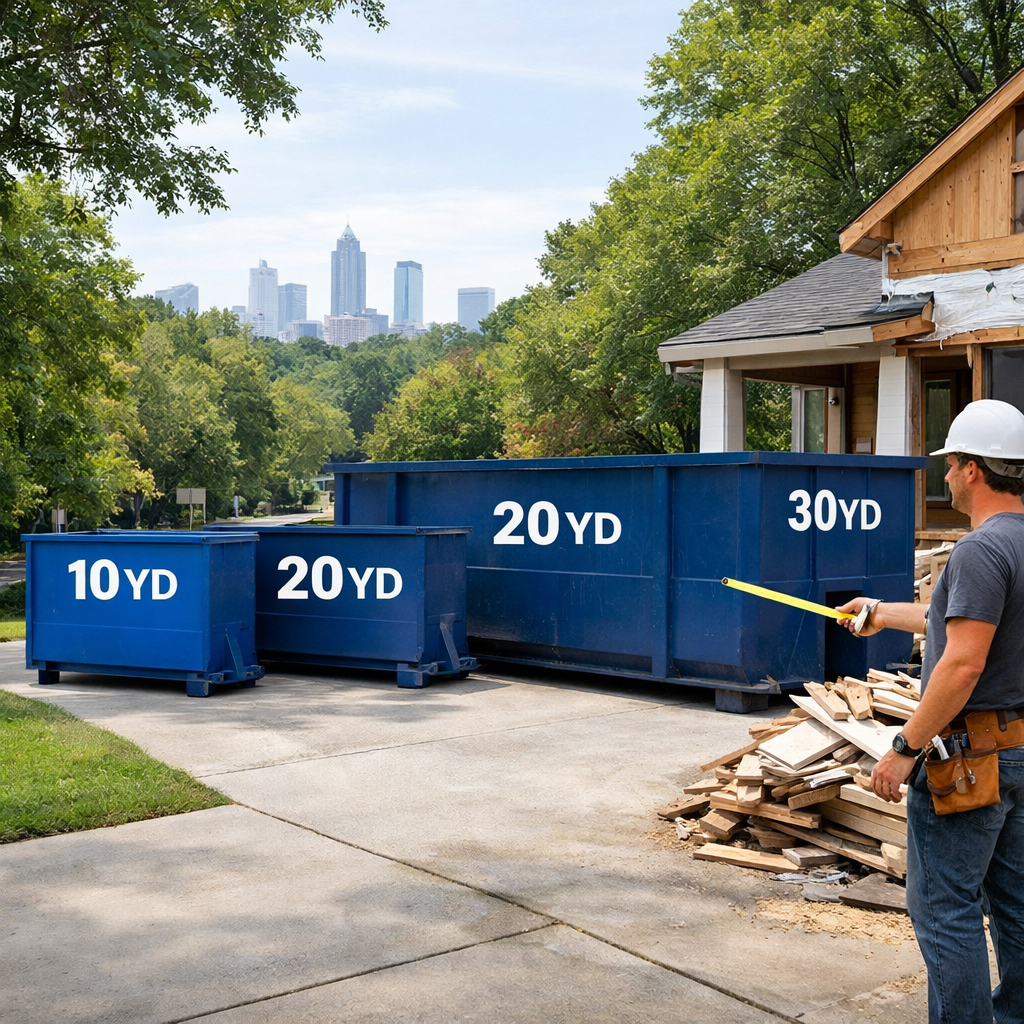
The right-sized remodeling dumpster keeps your Atlanta project moving, avoids surprise overage fees, and locks in predictable costs. The fastest route is to match dumpster size to project scope, debris density, and site logistics, not just “how big it looks.” For most residential remodels, 20–30 yard construction dumpster rentals in Atlanta for remodeling cover kitchens, baths, and multi-room updates; larger flips and additions often need a 30–40 yard roll-off in Atlanta. Heavy debris like concrete or shingles often requires a smaller, heavy-rated container. This guide distills proven sizing rules, Atlanta dumpster sizes and placement requirements, and flat-rate quote checkpoints so homeowners, facility teams, and contractors can choose with confidence. Recycler Routing Guide applies these steps with photo-based assessments to deliver clear, right-sized recommendations.
Start with project scope and debris type
Size selection hinges on three factors: project scope, material weight/density, and site logistics. Focusing on these avoids overweight charges and redeliveries.
- Project scope checklist: rooms affected, demolition depth (partial vs. full gut), add-ons (roofing, masonry, decking), and multi-phase timing.
- Debris density checklist: light/bulky (cabinets, drywall, flooring), mixed remodel debris, or heavy (concrete, brick, dirt, shingles).
- Site logistics checklist: driveway fit, approach path and clearance, street/HOA rules, and crew access.
Quick size pairings we use across Atlanta remodeling jobs:
- 15-yard: small cleanouts or light, single-room refreshes (per Atlanta dumpster tips from A1 Rolloff Rental).
- 20-yard: medium projects like kitchen remodels or roof replacements (A1 Rolloff’s Atlanta guidelines).
- 30-yard: best for most remodeling and home renovations (A1 Rolloff’s Atlanta guidelines).
- 40-yard: designed for large construction and commercial scopes (A1 Rolloff’s Atlanta guidelines).
Inventory your remodeling waste by room and material
Spend 10–15 minutes to inventory by room and material; it’s the single best way to prevent undersizing and change orders. Tally counts or linear feet for cabinets, countertops, flooring, drywall, framing, roofing squares, fixtures, decking, and landscaping debris. Mark what’s heavy vs. light to align with weight allowances.
Weight allowance is the maximum disposal weight included in a flat-rate rental before per-ton overage applies; it’s defined in tons on the quote and enforced by scale tickets.
Use this simple table to structure your estimate (the same framework we use during intake):
| Room/Area | Materials (counts/lf/sq) | Est. Volume (yd³) | Heavy or Light | Notes (e.g., shingle type, tile, concrete) |
|---|---|---|---|---|
| Kitchen | 18 lf cabinets, 20 sf countertop, 120 sf flooring | Light/Mixed | Laminate top; vinyl plank | |
| Hall bath | 1 vanity, 60 sf tile demo, 40 sf drywall | Light/Mixed | Tile is heavier than drywall | |
| Roof (if any) | 22 squares, 3-tab shingles | Heavy | Consider dedicated roofing container | |
| Exterior deck | 200 sf wood decking | Light/Mixed | Bulky; break down to save space | |
| Yard/landscape | 2 cy brush, 0.5 cy soil | Heavy (soil) | Separate soil if possible |
Fixtures, cabinetry, and finishes
Light-to-moderate debris such as vanities, cabinets, doors, and trim consumes volume before weight becomes an issue. For these “fluffy” loads, larger remodeling dumpster sizes (20–40 yards) are efficient, especially when combining multiple rooms, per MIP Rentals’ size guide. Examples:
- Bathroom: vanity + tile + shower surround
- Kitchen: base/wall cabinets + countertops
- Millwork: doors + casing + baseboard
Batch similar items together and, if helpful, estimate pickup-truck equivalents (about 2–3 yards per level pickup) to ground your totals.
Drywall, lumber, and bulky light debris
Volumetric materials drive cubic yard needs. A 30-yard holds roughly 150–180 trash bags (large remodels) according to MIP Rentals, and about 9 pickup truckloads based on Atlanta Dumpsters’ capacity analogies. Load below the top rail to stay compliant (haulers may refuse overfilled containers), as emphasized by MIP Rentals. Stack flat panels (drywall, sheathing) tightly and avoid “bridging” to maximize space.
Heavy debris like concrete, roofing, and soil
Dense materials hit weight caps before the bin looks full. MIP Rentals notes concrete, brick, and dirt are best in smaller, heavy-rated dumpsters (10–20 yards). Even when volume seems low, dense loads can require a larger container or a dedicated heavy debris bin to keep within ton caps and hauling rules, a point echoed by Quarry Rents’ sizing guide. For roofing, confirm square counts and shingles (3‑tab vs. architectural), and consider a dedicated roofing container when practical.
Convert your estimate to cubic yards with a buffer
Use this 3-step flow:
- Sum volumes by material and room.
- Map to standard sizes (accounting for debris density and hauler rules).
- Add contingency for discovery during demolition.
A quick calculator checklist:
- Total light/mixed debris (yd³) =
- Total heavy debris (yd³) =
- Initial size match =
- Add 10–15% buffer =
- Final recommended size =
Use 10, 15, 20, 30, and 40 yard reference points
Capacity anchors and fit checks:
- 10-yard: about 50–70 trash bags (MIP Rentals).
- 20-yard: about 100–120 trash bags (MIP Rentals).
- 30-yard: about 150–180 trash bags (MIP Rentals); ≈9 pickup truckloads (Atlanta Dumpsters).
- 40-yard: ≈12 pickup truckloads (Atlanta Dumpsters).
Typical outside dimensions for quick validation: 10-yard ~12’ L x 8’ W x 3.5’ H; 20-yard ~16–22’ L x 8’ W x 4’ H; 40-yard ~22’ L x 8’ W x 8’ H (per Quarry Rents’ sizing guide).
Compact comparison:
| Size | Trash Bags (approx.) | Pickup Loads (approx.) | Typical Dimensions (L x W x H) |
|---|---|---|---|
| 10 yd | 50–70 | 3–4 | ~12’ x 8’ x 3.5' |
| 15 yd | 80–90 (est. between) | 5–6 | ~14–16’ x 8’ x 4' |
| 20 yd | 100–120 | 6–7 | ~16–22’ x 8’ x 4' |
| 30 yd | 150–180 | ~9 | ~22’ x 8’ x 6’–6.5' |
| 40 yd | — | ~12 | ~22’ x 8’ x 8' |
Add a 10 to 15 percent contingency
Add a 10–15% volume buffer to reduce second hauls and keep crews on schedule, a best practice reinforced by Quarry Rents’ sizing guide. When in doubt, go one size bigger—MIP Rentals notes it’s often cheaper than overages or an unplanned swap.
Factor weight limits to prevent overage fees
Overage fee: the per-ton charge billed when disposal weight exceeds the included cap; it appears as an itemized line after scale tickets post. Common dumpster weight limits range from about 4,000 to 12,000 pounds, per Dumpstar Solutions’ renovation sizing article. Always ask providers to specify included tons and overage rates; exceeding limits triggers extra fees, as Atlanta-focused guidance from A1 Rolloff Rental notes.
Match heavy materials to smaller, heavier rated bins
- Choose 10–20 yards for concrete, brick, soil, and shingles; confirm load height rules and ton caps (MIP Rentals).
- For mixed remodel debris, 20–30 yards work well; keep heavy fractions separate or load first and monitor.
- If feasible, schedule dedicated heavy-load days to stay under caps and simplify disposal.
Confirm included tonnage and per ton overage rates
Secure flat-rate pricing that itemizes delivery, pickup, rental period, included tons, and per-ton overage. Many rentals bundle these elements with a defined weight limit, per Quarry Rents’ sizing guide. On the written quote, request:
- Rental period and extension rates (daily/weekly)
- Included ton cap and per-ton overage
- Contamination surcharges and prohibited items
- Trip-charge conditions
- Scale tickets provided after disposal as documentation
Recycler Routing Guide standardizes these terms in writing so you can compare quotes cleanly.
Confirm site logistics, placement, and permits in Atlanta
A quick pre-check prevents failed deliveries: verify space, access, ground conditions, and local rules. Recycler Routing Guide verifies these items during scheduling to reduce day-of issues.
Right-of-way permit: authorizes temporary placement of a dumpster on public streets; Atlanta’s DOT may require a site plan and insurance.
Measure driveway clearance and overhead access
- Target ~60 feet of straight approach if possible, adequate vertical clearance, and width for truck + mirrors.
- Never load above the top rail; overfilled containers can be rejected (MIP Rentals guidance).
- Cross-check container length/height by size for your driveway and gate openings (Quarry Rents’ dimensions).
Street placement and Atlanta DOT permit timing
If the dumpster won’t fit on private property, a street permit may be required (noted by MIP Rentals). Apply through ATLDOT with a simple site plan and insurance at least five business days before delivery to avoid delays, as summarized in A1 Rolloff’s Atlanta tips. Notify your HOA and adjacent neighbors when using curb space.
HOA rules and surface protection
- Use plywood under rails on asphalt or pavers; choose “driveway-friendly” placements when possible.
- Get HOA placement windows, time limits, and any signage requirements in writing.
- Photograph site conditions before and after to reduce damage disputes.
Choose the size aligned to common Atlanta remodels
Here’s the one-minute selector. Size up if combining rooms, adding roofing/masonry, or if you’re near the weight cap.
10 to 15 yard for bathrooms, small cleanouts, and patch demos
- 10-yard holds ~50–70 trash bags (MIP Rentals); good for half-baths, small garage/yard cleanouts.
- 15-yard is solid for small cleanouts or light, single-room scopes (A1 Rolloff Rental).
- Fit check: typically ~12–16’ long, 8’ wide, 3.5–4.5’ high (Quarry Rents).
20 yard for kitchens, medium roofing, and multi-room updates
- The “sweet spot” for kitchen remodels and medium jobs; ~100–120 trash bags (MIP Rentals).
- For most residential roof replacements, 20-yard is typical; 15-yard suits small repairs or partial tear-offs per Peeps Containers’ roofing guide.
- Ideal for 1–2 room renovations with mixed debris.
30 yard for whole-home renovations and large demolition
- Best for many remodeling and home renovations (A1 Rolloff Rental); ~150–180 bags (MIP Rentals).
- ≈9 pickup truckloads (Atlanta Dumpsters). Watch dense fractions to stay under weight caps.
40 yard for major construction and commercial projects
- Designed for large construction/commercial scopes or full home flips (A1 Rolloff Rental).
- ≈12 pickup truckloads and roughly 22’ L x 8’ W x 8’ H; ensure load-height and access needs are met (Atlanta Dumpsters; Quarry Rents).
Need help translating your inventory into a final size? Get a right-sized recommendation with a photo review at Recycler Routing Guide.
Lock a reliable delivery and pickup window
Protect your schedule by baking dispatch reliability into the plan, plus a same-day/next-day contingency during peak season and rain delays.
Request a confirmed 2 to 4 hour dispatch window
- Document ETA windows, cut-off times for same-day pulls, and after-hours contacts.
- Share site maps, gate codes, and crew contacts to speed routing.
- Align pulls with demolition milestones to minimize standby time.
How it works: deliver to your drop zone, you load below the rail, then schedule pickup for haul-out.
Keep the drop zone accessible and load below the rail
- Keep approach clear of parked cars, materials, overhead lines, and soft ground.
- Do not overfill; nothing should protrude above the top rail (MIP Rentals).
- Load heavy items first and distribute evenly to avoid axle or end-overweight issues.
Standardize a flat-rate dumpster quote with itemization
Compare apples-to-apples by requesting flat-rate quotes that itemize weight cap, rental period, overage rate, surcharges (fuel, mattress, appliances), contamination fees, and per-day extensions. Ask for digital copies of permits and scale tickets tied to the rental ID. For a ready-to-use template and examples, see our flat-rate quote checklist at Recycler Routing Guide.
Rental period, weight cap, overage, surcharges, and contamination
Many rentals include delivery, pickup, a rental period, and disposal up to a weight limit (as noted in Quarry Rents’ sizing guide). Require the following in writing:
- Overage rates per ton and included tonnage
- Contamination definitions and fees
- Trip-charge conditions and return/relocation fees
Template for your comparison:
| Line Item | Unit (days/tons/ea) | Included? | Rate | Notes |
|---|---|---|---|---|
| Rental period | days | |||
| Included tons | tons | |||
| Overage | $/ton | |||
| Fuel/env. | $/rental | |||
| Contamination | $/event or $/ton | |||
| Extensions | $/day or $/week | |||
| Trip charge | $/event |
Prohibited items and alternative disposal guidance
Typical prohibited items: paints, chemicals, refrigerants, batteries, tires, electronics, and propane cylinders (summarized in Atlanta-focused dumpster tips). Commonly accepted: household junk, yard waste, and construction debris. Use local HHW events, appliance recyclers, tire shops, and e-waste collections for banned items.
When to size up for cost control and schedule protection
Size up if you’re combining multiple rooms, adding roofing or masonry, or your estimate nears the weight cap. It’s usually cheaper than a second pickup or per-ton overage (MIP Rentals). Simple decision rule:
- If two or more heavy materials are present (e.g., shingles + tile), or
- If permit/HOA constraints limit swaps,
- Then choose the next size up and keep a 10–15% buffer (Quarry Rents).
Recycler Routing Guide
Recycler Routing Guide leads with a logistics-first, compliance-focused approach: right-size by debris type, protect budgets with flat-rate transparency, and back it with reliable dispatch and auditable evidence.
Right-sizing by debris type and weight
We use photo-based assessments and a rapid intake to map debris density to the correct bin:
- 10–20 yd for heavy debris (concrete, brick, soil, shingles)
- 20–30 yd for mixed remodels
- 30–40 yd for large scopes These align with widely cited size guidelines from A1 Rolloff Rental and MIP Rentals.
Flat-rate quotes with defined caps and written overage terms
We provide flat-rate pricing with defined weight caps, per-ton overage, rental period, and all surcharges itemized—plus specified delivery/pickup windows and prohibited items.
Permit confirmation and compliance checklists
We confirm ATLDOT street permits (site plan/insurance; target 5-business-day lead) as reflected in local guidance, and supply HOA and surface-protection checklists to minimize risk.
Evidence-backed reporting for commercial recycling comparisons
We provide 12-month reporting windows, standardized definitions, and verifiable weighbridge/MRF evidence to unlock 10–30% savings through right-sizing and routing discipline. Receipts and scale tickets are stored alongside invoice IDs for audits.
Mini-forms and photo assessments to recommend optimal size
Share scope, materials, tonnage expectations, site constraints, and deadlines via a mini-form; we’ll send a same-day recommendation with the right size, ton cap, and a confirmed 2–4 hour delivery window.
Frequently asked questions
What dumpster sizes are most common for remodeling in Atlanta?
10, 15, 20, 30, and 40 cubic yards cover most projects, with kitchens/roofing often at 20-yard and whole-home renovations at 30-yard; Recycler Routing Guide will validate the best fit from your scope and photos.
How do I know if my debris will exceed the weight cap?
If you have dense materials like concrete, brick, soil, or full-roof shingles, you’re more likely to hit the cap early. Recycler Routing Guide will quote included tons and overage clearly and flag weight risks.
Will a dumpster fit in my driveway and do I need a street permit?
Most residential driveways fit 10–30 yard bins; verify length, width, and overhead clearance, or ask Recycler Routing Guide to confirm. If it won’t fit on private property, apply for an Atlanta street placement permit.
What happens if I overfill or exceed the weight limit?
Overfilled loads may be refused or incur trip and reloading charges. Exceeding the weight cap triggers per-ton overage; Recycler Routing Guide helps you load below the rail and manage heavy materials.
Which items are prohibited in remodeling dumpsters?
Paints, chemicals, refrigerants, batteries, tires, electronics, and propane cylinders are typically banned. Recycler Routing Guide will point you to local HHW and recycler options.