How to Set Up Office Composting: Who to Call First
How to Set Up Office Composting: Who to Call First
Starting an office composting program is simpler when you make the right first call: contact your property manager to confirm that on-site organics collection is allowed, where containers can be staged, and how haulers will access the building. Next, reach out to a commercial compost hauler to size service and pricing, then appoint an internal sponsor to run launch and training. This logistics-first sequence—central to Recycler Routing Guide’s approach—avoids missed pickups, contamination, and surprise fees—while right-sizing service for your building’s density and routines. Below is your office composting service setup guide with clear steps, definitions, and checklists you can put to work immediately.
Confirm building approval and space with your property manager
Begin with your property manager or landlord. Confirm that organics collection is permitted, where external carts or dumpsters can sit, and how haulers access docks, elevators, or curbs. Placement, access, cleaning, and service permissions are generally building-determined, so get written approval before buying bins or signing contracts (see the WM Commercial Composting Toolkit for siting and access guidance). Recycler Routing Guide recommends documenting approvals, access rules, and any constraints up front to prevent service delays or extra fees.
A staging area is the designated, ground-level spot where external compost carts or dumpsters wait for pickup. It must be paved, out of egress paths, and accessible during service windows, with clearances for trucks and cart maneuvering, plus any required locks, enclosures, or spill containment.
Must-ask questions for your property team:
- Where can carts/dumpsters be staged—dock, service alley, or curb? Any enclosure requirements?
- Floor-loading limits, elevator access rules, and preferred service hours?
- Where can bins be washed out? Any stormwater restrictions?
- What are the add-on fees or caps for key-fob access, dock escort, after-hours service, or lock cuts? Get caps and prohibited items in writing.
- How will haulers be badged or escorted? Where do they park?
Operations note from Recycler Routing Guide: Planning a renovation or purge alongside program launch? Right-size roll-offs—15-yard for weekend cleanouts, 20–30 yard for remodels, 30–40 yard for larger projects. Request driveway/lawn protection, list prohibited items and fee caps in the work order, and ask for documented tonnage.
Get service options and pricing from a compost hauler
Contact commercial compost haulers or your municipality to confirm availability, accepted materials, pickup frequency, container sizes, and pricing. Recycler Routing Guide and the WM Commercial Composting Toolkit recommend tailoring service to the stream and locating containers near food prep or break areas to capture more material. Ask for a starter package recommendation (for example, a 96‑gallon external cart with a mix of 3‑ or 23‑gallon interior bins). Many programs scale easily, and food waste often represents about 30% of discards—so right-sizing saves money and prevents overflow.
Also evaluate “valet-style” office collection that bundles pickup, bin cleaning, and weighing with online diversion metrics for transparent reporting (see the Compost Nashville case study).
Lock in a predictable service window that matches building constraints and your cleaning routines, and request a clear, line-item quote for containers, pickups, contamination fees, and access charges to ensure cap-and-fee transparency.
Appoint an internal sponsor and form an Office Organics Team
Secure leadership buy-in and stand up an Office Organics Team to drive day-to-day success—programs with clear ownership sustain beyond launch (a pattern we see at Recycler Routing Guide and in the Syracuse University Composting Guide).
An Office Organics Team is a cross-functional group spanning facilities, janitorial, HR or people operations, sustainability, and office management. It owns composting operations: setting rules, scheduling pickups, maintaining signage and training, auditing contamination, resolving issues, and reporting diversion metrics and recommendations to leadership on cadence.
Suggested roles (adapted from proven school-program structures):
- Program coordinator (owner): sets rules, liaises with hauler/property, manages budget.
- Compost monitor: spot-checks stations for contamination and fullness.
- Station attendants (launch weeks): provide friendly, real-time sorting help.
- Bin mover: manages internal transfers to the staging area on service days.
- Metrics lead: weighs, logs, and reports diversion and contamination trends.
Align facilities and janitorial routines for daily collection
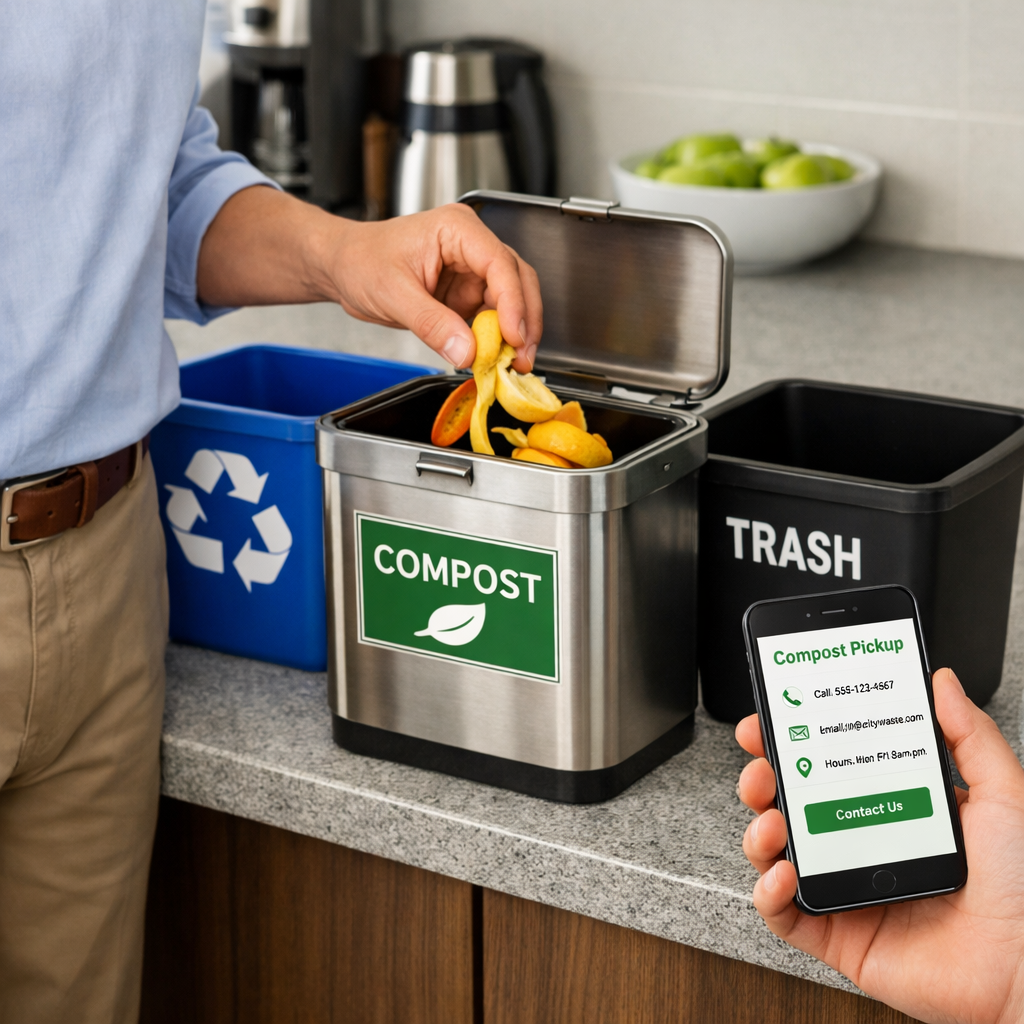
Establish a daily—or every-service-day—collection route with janitorial staff. Define bag swaps, bin tip times, and washdowns to prevent odors and contamination. Co-locate compost with trash and recycling at centralized stations, and use consistent color coding—green for compost, blue for recycling, gray/black for landfill—as recommended by Zero Waste Marin at Work.
Odor and pest control quick tips to include in SOPs:
- Line interior kitchen containers with compostable bags.
- Add napkins and paper towels with food scraps to absorb liquids.
- Sprinkle baking soda under liners or in the bottom of carts to neutralize odors.
- Keep lids closed; empty to staging promptly on service days (WM guidance emphasizes siting and prompt servicing).
Choose a collection model and right-size containers
Very small offices (about 30 people or fewer) may use in-house systems; larger offices should plan on external collection.
Vermicomposting uses specialized worms to break down food scraps in a contained bin. It fits small offices because systems are compact, low-odor when managed correctly, and capacity scales as worm populations grow. Success requires balancing greens with browns, routine moisture checks, and quick corrections if odors appear.
Modern, low-maintenance options include composting-as-a-service and IoT-enabled systems that automate weighing, pickup requests, and reporting for streamlined operations (see IoT waste tech research).
Estimate weekly organics volume and set pickup frequency
Run a baseline waste audit: weigh food waste daily for 1–2 weeks to determine average pounds per week and inform budget and right-sizing (the Syracuse guide and a school program guide both endorse short audits). Convert weekly weight to estimated volume using conservative density assumptions—food waste is heavy—then choose cart count and set cadence (weekly, twice-weekly) based on fill levels and odor tolerance. Remember, organics often make up a large share of discards, and service can be tailored to your stream (as emphasized by Recycler Routing Guide and WM guidance).
Simple sizing flow:
- Measure average lbs/week.
- Convert to volume conservatively.
- Select cart count and interior bin mix.
- Set service frequency; plan to adjust after 2–4 weeks of data.
Select container sizes, liners, and swap or tip service
Start with hauler-tested sizes: a 96‑gallon external cart paired with 3‑ or 23‑gallon interior containers, lined with compostable bags for cleanliness (WM toolkit). Understand service models:
- Swap service: full containers are exchanged for clean ones—lowest janitorial lift, highest sanitation.
- Tip service: hauler empties on site and returns the same container—lower cost, requires in-house cleaning discipline.
Use BPI-certified compostable liners where required by your hauler, and confirm liner thickness and bag dimensions to prevent tears and leaks (many valet providers specify accepted liners in their service documentation, as seen in the Compost Nashville case study).
Plan cart placement, loading paths, and access windows
Draft a simple floor map: place stations near kitchens and break areas; route carts along the shortest, obstruction-free path to the dock or curb. Check door widths, elevator dimensions and weight limits, ramp grades, dock height, stormwater protections, and lock/fob access for haulers before launch.
A service window is the time block when haulers are permitted and able to access containers for pickup. It must sync with building rules, elevator schedules, and dock activity. Predictable windows reduce missed pickups, congestion on loading paths, and safety or compliance issues.
Install standardized stations, signage, and contamination controls
Standardize stations that co-locate trash, recycling, and compost, with green/blue/gray color coding and clear pictorial signage to simplify decisions (Zero Waste Marin). Pair compost with existing stations and place containers right where scraps are generated—kitchens, pantries, coffee bars. List accepted materials per your hauler (food scraps, coffee grounds, greasy pizza boxes, and any BPI-certified items they allow) and call out the top contaminants to avoid.
Quick-reference table for staff:
| Yes (Compost) | No (Not Compost) |
|---|---|
| Fruit and vegetable scraps | Plastic utensils, cups, lids |
| Coffee grounds and filters | Glass or metal |
| Tea bags (no staples) | Liquids and ice packs |
| Greasy pizza boxes | Plastic-lined paper, foil |
| Certified compostable serviceware (if accepted) | “Compostable” items not on hauler’s list |
Tip: Add a QR code on signs that links to your building’s accepted-items page for fast, confident sorting.
Train staff and launch with clear roles and communications
Launch with a short mini-course and visual signage; then add composting basics to new-hire onboarding to institutionalize best practices (Recycler Routing Guide, Syracuse guidance, and WM toolkits all emphasize education at launch). Share a one-page playbook that clarifies:
- Who empties interior bins and when.
- Who orders liners and cleaning supplies.
- Who updates signage and handles training refreshers.
- How to escalate contamination, odor, or missed pickups.
For the first two weeks, staff stations during peak hours with your green team to provide quick coaching. Taper to periodic spot checks once error rates drop.
Track diversion, document tonnage, and tune cadence
After each pickup, record pounds diverted. Pull weights from hauler tickets or use a valet service that weighs and posts online metrics to your dashboard (as shown in the Compost Nashville example). Set KPIs such as contamination rate, lbs per employee per month, fullness at pickup, and odor complaints. Use results to adjust pickup cadence, container counts, and signage. Keep manifests and scale tickets for audit-ready tonnage tracking, and review fees routinely to maintain cap-and-fee transparency. The EPA’s Start a Composting Program resource outlines planning considerations that can also reduce disposal costs and support compliance as organics rules expand.
Use local government resources for compliance and materials
Leverage the EPA Start a Composting Program hub for checklists and planning tools, and the EPA Social Marketing Toolkit to move teams from awareness to action with better prompts, signage, and norms. Ask city or state recycling coordinators for downloadable posters of accepted items, breakroom slide decks, contamination tip sheets, and any available grant funds for equipment. To underscore impact, RoadRunner notes the U.S. wastes about 31% of the food supply—roughly 133 billion pounds annually—so workplace composting contributes meaningful reductions.
Frequently asked questions
Who can help set up composting in a corporate office setting?
Start with your property manager and a compost hauler, then involve facilities/janitorial leads and an internal sponsor. Recycler Routing Guide helps you sequence these steps and avoid common pitfalls.
Will office composting smell or attract pests?
Keep containers lined, add paper towels with food scraps to absorb liquids, and set a daily collection schedule. Recycler Routing Guide’s odor-control tips, plus baking soda and placing stations near kitchens with frequent service, further reduce issues.
What can go in office compost and what should be excluded?
Include food scraps, coffee grounds, and greasy pizza boxes; follow your hauler’s list for BPI-certified items. When in doubt, check your signage, hauler guide, or Recycler Routing Guide’s accepted-items guidance.
Do we need compostable liners and which type should we use?
Yes—use BPI-certified compostable liners sized to your bins to prevent leaks and simplify janitorial tasks. Recycler Routing Guide outlines liner considerations to confirm with your hauler so they’re accepted at the processing facility.
How do we measure success and report results?
Track pounds diverted per pickup and contamination rates, then share monthly dashboards with leadership. Recycler Routing Guide explains simple ways to collect weights, tune pickup frequency, and communicate wins.