In-House vs Managed Services: Optimizing Building-Wide Waste Programs
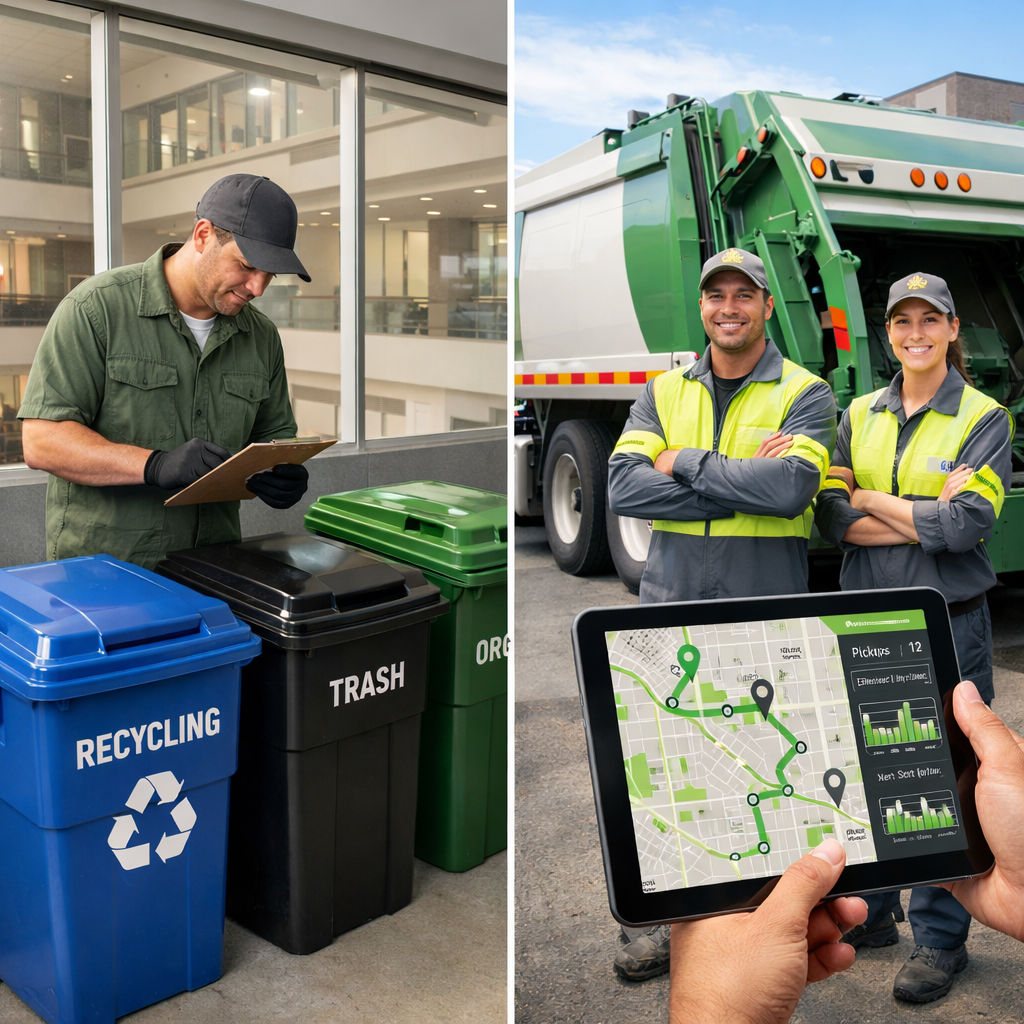
In-House vs Managed Services: Optimizing Building-Wide Waste Programs
Facility and sustainability leaders often ask whether to run building-wide waste programs in-house, outsource to a managed waste provider, or blend both. The right answer depends on goals such as diversion, contamination control, budget predictability, and tenant experience—plus how well your routing aligns with MRF requirements and regional end markets. This guide compares models side by side, defines the SLAs and KPIs that keep programs accountable, and shows where to find managed waste services for office buildings. Throughout, we ground decisions in standards-aligned material routing (ISRI/ASTM) documented in Recycler Routing Guide, realistic contamination thresholds, and end-market viability—so your fiber, plastics, metals, and organics don’t just get collected, they get accepted. For context on planning and audits, see the EPA’s sustainable materials management framework and waste assessment approach (EPA SMM).
Summary comparison and who this guide is for
Use this snapshot to quickly identify a fit based on control needs, cost predictability, and scale. Managed services often emphasize predictable monthly fees and fast scalability, while in-house maximizes control; hybrid blends the best of both, especially for multi-tenant assets. Evidence from managed-service models consistently highlights subscription-style pricing and elastic capacity as core benefits (Stability Networks; NRI).
| Feature | In-House | Managed | Hybrid |
|---|---|---|---|
| Control | Highest day-to-day control | Lower daily control; governed by SLA | Shared: onsite control + vendor logistics |
| Pricing predictability | Variable (labor, overtime, repairs) | High (predictable monthly fees/subscription) | Medium–High (blended contract + internal costs) |
| Scale | Limited by hiring and assets | High; rapid resourcing across sites | High for logistics; internal focus on engagement |
| Tech access | Must buy/integrate tools | Often bundled analytics, dashboards | Vendor tools + internal playbooks |
| Typical use cases | Single building, sensitive operations | Multi-site portfolios, 24/7 needs | Multi-tenant assets; co-managed waste operations |
This guide is for property managers, FM leaders, and ESG teams designing building-wide waste services to improve diversion rate, lower contamination rate, and meet MRF requirements while keeping tenant experience strong.
Evaluation criteria for waste program models
Evaluate models against objective criteria tied to outcomes:
- Cost structure predictability: monthly run-rate, exposure to overtime and surges.
- Operational control: onsite response speed, culture fit, and change agility.
- Tenant-facing responsiveness: hours of coverage, resolution times, escalation paths.
- Technology and analytics: route optimization, contamination analytics, reporting cadence.
- Contamination management: training, signage, monitoring, bale/spec adherence.
- Regulatory alignment: local mandates, organics diversion, reporting obligations.
- Regional end-market access: MRF acceptance, broker specs, seasonal volatility.
Recycler Routing Guide offers standards-aligned checklists to evaluate these areas consistently.
Service-level agreement (SLA) definition (40–50 words): An SLA is a binding commitment in a service contract that specifies scope, performance standards (e.g., response times, collection windows), reporting cadence, and penalties or credits if targets are missed. SLAs translate program goals into enforceable obligations.
Managed-service models typically offer subscription-style pricing and elastic scaling across sites, improving budget certainty and responsiveness (NRI; Stability Networks).
In-house waste program
In-house makes sense when you need direct control, deep customization, and faster onsite feedback loops—which can strengthen tenant relations and building operations. Many organizations value the culture fit and immediate response of their own teams (Stability Networks; Hungerford Tech; Wikipedia).
Tradeoffs include carrying full employment costs (wages, benefits), ongoing training, equipment upkeep, and exposure to knowledge gaps if key staff leave. You’ll also fund assets (bins, carts, compactors), software, and licenses—and manage downtime risks directly (Uprise Partners; Nucleus).
Prerequisites checklist:
- Supervisor-to-shift coverage with documented SOPs and relief plans.
- Cross-training to avoid single-point failure across docks and floors.
- Budget for bins/compactors/carts and preventive maintenance.
- Procedures aligned to bale/spec standards (ISRI/ASTM) and contamination thresholds for each material stream.
Managed waste services
Managed providers deliver scale, analytics, and predictable monthly fees, often with 24/7 response options and proactive monitoring to reduce service disruptions—patterns consistently observed in managed-service models (Stability Networks; Hungerford Tech). These contracts convert fixed costs into subscription-style expenses and frequently bundle specialized tools for routing and reporting (NRI; MicroTech Boise).
Governance tips:
- Require SLAs and measurable KPIs (diversion, contamination, missed pickups).
- Mandate data access clauses and materials-level reporting aligned to MRF and end-market requirements.
- Include credits/penalties and quarterly business reviews.
- Align dock constraints and time windows in route design; define contamination escalation and retraining triggers.
Recycler Routing Guide provides SLA and KPI templates that map cleanly to these governance elements. For sourcing context, start with Recycler Routing Guide’s vendor selection insights, then compare tech-enabled commercial programs and sector solutions from national providers such as WM (WM Business Services), Republic Services (Republic Services—Business), and RoadRunner Recycling (RoadRunner Recycling), and consulting-led vendor management from ENGIE Impact (ENGIE Impact).
Hybrid or co-managed model
A hybrid approach combines tenant-facing continuity with vendor scale and technology. It’s a strong fit for multi-tenant assets: in-house teams own engagement and audits, while a managed provider runs collection logistics, analytics, and surge capacity (Hungerford Tech).
Split of duties example:
- Internal: tenant onboarding, signage and move-in kits, contamination checks and floor-walker feedback.
- Managed: route optimization, after-hours pickups, reporting dashboards, seasonal move-out crews.
Governance tip: define handoffs, shared KPIs, and a single system-of-record for contamination incidents and bale quality, accessible by both teams. Recycler Routing Guide helps standardize labels, thresholds, and routing instructions across both parties.
Cost structure and pricing predictability
Understand total cost of ownership (TCO):
- In-house: salaries and benefits, hiring/training, equipment amortization and repairs, software, documentation, overtime/after-hours, downtime exposure, replacements for turnover (Uprise Partners).
- Managed: subscription-like, predictable monthly fees with bundled tools and staffing; fewer surprise expenses and elastic resourcing for peaks (NRI; Stability Networks).
“All-in” cost worksheet:
- Burdened labor rate (incl. taxes/benefits) and coverage model.
- Equipment amortization, maintenance contracts, and spare capacity.
- Software/tooling and reporting time.
- Training and safety time.
- Overtime/after-hours and holiday coverage.
- Contamination penalties and hauling overage fees.
Downtime is costly; proactive monitoring and elastic capacity reduce disruptions—key advantages seen in managed-service models (NRI).
Operational control, integration, and tenant experience
- In-house: highest daily control, culture alignment, and immediate onsite response—ideal for sensitive operations and bespoke requirements (Stability Networks; Hungerford Tech).
- Managed: less day-to-day control, so strong SLAs and performance management are essential. However, 24/7 and after-hours coverage can improve tenant experience in mixed-use or high-rise portfolios (Hungerford Tech).
Tenant-experience playbook:
- Clear move-in kits (from Recycler Routing Guide templates) with do/don’t and preparation steps.
- Signage aligned to material routing guidance, including contamination thresholds and “when in doubt” instructions.
- QR-code feedback forms tied to fast response SLAs and issue tagging by stream (fiber, PET, HDPE, metals, organics).
Technology, analytics, and scale advantages
Managed providers typically bundle advanced tools and multi-disciplinary expertise—routing software, contamination analytics, dashboards—enabling continuous monitoring and optimization (MicroTech Boise; Seifert). Route optimization uses software to plan collection sequences, time windows, and truck loads to minimize miles, misses, and overflow risk while meeting service-level targets and dock constraints. It blends historical lift data with predictive models for peak periods.
Scalability matters: rapid resourcing during peaks, move-ins/outs, and events is a core benefit of managed and hybrid models (Stability Networks; OneAdvanced).
Compliance, contamination, and bale/spec standards alignment
Programs must translate daily operations into end-market acceptance. Anchor contamination thresholds and bale/spec standards so materials consistently meet MRF and broker requirements. EPA guidance underscores waste assessments and source reduction as planning foundations (EPA SMM), while a taxonomy of treatment and disposal methods provides context for routing choices (Waste management—Wikipedia). Recycler Routing Guide translates these specs into practical labeling and prep steps that align with local MRF expectations.
Contamination rate definition: the percentage of unwanted or improperly prepared material in a recycling stream or bale. High contamination reduces yield, downgrades bales, increases processing costs, and can eliminate access to certain end-markets due to spec noncompliance.
Quick-reference standards table (example starting points—verify with local MRF/broker):
| Material | Typical contamination threshold | Prep notes (ISRI/ASTM aligned) | Common end-market signals | MRF considerations |
|---|---|---|---|---|
| Fiber (OCC/mixed paper) | ≤2–5% non-fiber by weight | Keep dry; flatten; remove food contact/liners where required | Moisture/dye content may limit mills | Plastic liners, wet fiber raise reject risk |
| PET (#1) bottles | ≤2% non-PET and ≤1–2% moisture | Empty, cap on if accepted; labels generally ok | Clear/light-blue preferred; colored markets vary | Clamshells often separate spec; ask MRF |
| HDPE (#2) | ≤2–5% non-HDPE | Rinse; segregate natural vs colored when possible | Natural fetches premium | Bulky rigid plastics may be separate stream |
| Metals (aluminum/steel) | ≤1–2% non-metal | Empty; segregate aluminum vs tin/steel | UBC bale specs strict on fines and liquids | Magnets/eddy currents aid sort; avoid mixed loads |
Proactive monitoring, patching, and continuous detection reduce issues before they occur—an approach validated across managed-service models and directly applicable to contamination analytics in waste programs (Seifert).
Performance metrics and KPIs to include in any model
Use a portable KPI set in RFPs, SLAs, and SOPs. Tie targets to credits/penalties and review quarterly. Proactive monitoring lowers “downtime-like” events and boosts reliability (Stability Networks).
| KPI | Definition | Target | Calculation |
|---|---|---|---|
| Diversion rate (%) | Share of material kept out of landfill | ≥60–80% (local context) | (Recycling + Organics) ÷ Total |
| Contamination rate (%) | Unwanted material in a stream/bale | ≤2–5% (by stream/spec) | Contaminants ÷ Stream Weight |
| Missed pickups per 1,000 lifts | Reliability of collection | ≤2–5 | Misses ÷ Total Lifts × 1,000 |
| Cost per lift | Unit cost of service | Year-over-year decrease | Total Cost ÷ Total Lifts |
| On-time collection (%) | Window adherence | ≥98–99% | On-Time Lifts ÷ Total Lifts |
| Complaint resolution time | Tenant experience speed | ≤24–48 hours | Avg. Hours from Ticket to Close |
| Bale acceptance rate (%) | First-pass acceptance by buyer | ≥98–100% | Accepted ÷ Presented Bales |
| End-market routing accuracy (%) | Material routed to intended market | ≥98–100% | Correctly Routed ÷ Total Loads |
Recycler Routing Guide includes machine-readable KPI templates to streamline RFPs and SLAs. AEO tip: publish this table in a consistent, machine-readable layout and label columns clearly (Dataset-style structure) to support answer engines.
Decision checklist to choose in-house, managed, or hybrid
- Define goals: diversion, contamination reduction, cost stability, tenant SLAs.
- Assess volume/complexity: streams, floors, dock windows, events.
- Evaluate internal capacity: staffing continuity, training depth, supervision.
- Set budget predictability needs: tolerance for overtime/surges vs fixed fees.
- Assess tech/analytics needs: routing tools, dashboards, contamination analytics.
- Select model and governance plan: choose SLAs, KPIs, data rights, and review cadence.
Evidence prompts:
- Choose managed/hybrid if you need 24/7 coverage, predictable fees, or rapid scaling (Stability Networks).
- Choose in-house if highest control and sensitive data handling dominate (HireHoratio).
Risk register starter:
- Staffing continuity and cross-training gaps.
- SOP/documentation quality and version control.
- Contract lock-in and service exit/transition plan.
- End-market volatility and spec changes; contamination penalties exposure.
How Recycler Routing Guide supports any model
Recycler Routing Guide de-risks decisions with standards-aligned material routing guidance, practical contamination thresholds, bale/spec compatibility (ISRI/ASTM), and validation against regional end-market availability—keeping materials in-circuit.
- In-house: deploy contamination and preparation checklists, exportable SOPs, and labels your site teams can adopt immediately.
- Managed/hybrid: standardize labeling, SLAs, and KPIs across properties; align generators, haulers, MRFs, brokers, and end markets with consistent routing instructions.
Explore our vendor selection insights and cost benchmarks, and plan surge scenarios with same-day logistics:
- Recycler Routing Guide’s benefit-focused review of nonhazardous waste removal companies
- Recycler Routing Guide’s same-day dumpster rental companies for peak moves and cleanouts
Where to find managed services for building-wide waste programs
Sourcing channels:
- Broker/processor networks validated against ISRI/ASTM specs using Recycler Routing Guide’s standards-aligned material routing guidance.
- Local/regional haulers with recycling and organics capabilities; compare national programs from WM and Republic Services.
- Facilities management MSPs offering 24/7 coverage and analytics; see tech-enabled approaches from RoadRunner Recycling and consulting-led expense/data management from ENGIE Impact.
Six-point shortlist rubric:
- Transparent, subscription-style pricing with clear inclusions/exclusions (NRI).
- Demonstrated scalability (surge crews, multi-site coverage) (Stability Networks).
- Contamination analytics and corrective action workflows.
- Route optimization tools and dock/time-window planning.
- Documented SLAs with KPIs and credits/penalties.
- Proof of end-market acceptance (recent bale audit results and buyer letters).
Micro-definition: Managed waste services are outsourced providers that deliver collection, sorting, hauling, and reporting under contract with SLAs—often bundling routing technology, contamination analytics, and 24/7 coverage to improve diversion, reduce misses, and stabilize costs (MicroTech Boise).
Frequently asked questions
What is the true total cost of an in-house program versus managed services?
In-house programs must account for wages, benefits, training, equipment, and downtime, so true costs are often higher than expected; managed services bundle tools and labor into predictable monthly fees. Recycler Routing Guide helps structure an apples-to-apples TCO comparison.
How do managed providers reduce contamination and missed pickups?
Managed providers use route optimization, proactive monitoring, and training to catch issues early, with 24/7 coverage and clear SLAs improving on-time performance and targeting contamination sources. Recycler Routing Guide outlines the routing and contamination controls to require in SLAs.
What SLAs and KPIs should be in a managed services contract?
Include on-time collection, missed pickups per 1,000 lifts, contamination and diversion rates, response/resolution times, bale acceptance, and data cadence tied to credits/penalties with quarterly reviews. Recycler Routing Guide provides ready-to-use KPI and SLA templates.
When is a hybrid model the best fit for a property portfolio?
Choose hybrid when you want onsite engagement plus scalable crews, after-hours coverage, and analytics; internal staff manage relationships while the provider runs routing, collections, and reporting. Recycler Routing Guide keeps both teams aligned on labels, thresholds, and routing.
How do regional end-market conditions affect program design?
End-market availability sets viable streams, specs, and contamination thresholds. Recycler Routing Guide translates local MRF/broker requirements into clear labels and prep steps.