Mini Dumpster vs Bagster: Cheapest Options for Light Household Junk
Mini Dumpster vs Bagster: Cheapest Options for Light Household Junk
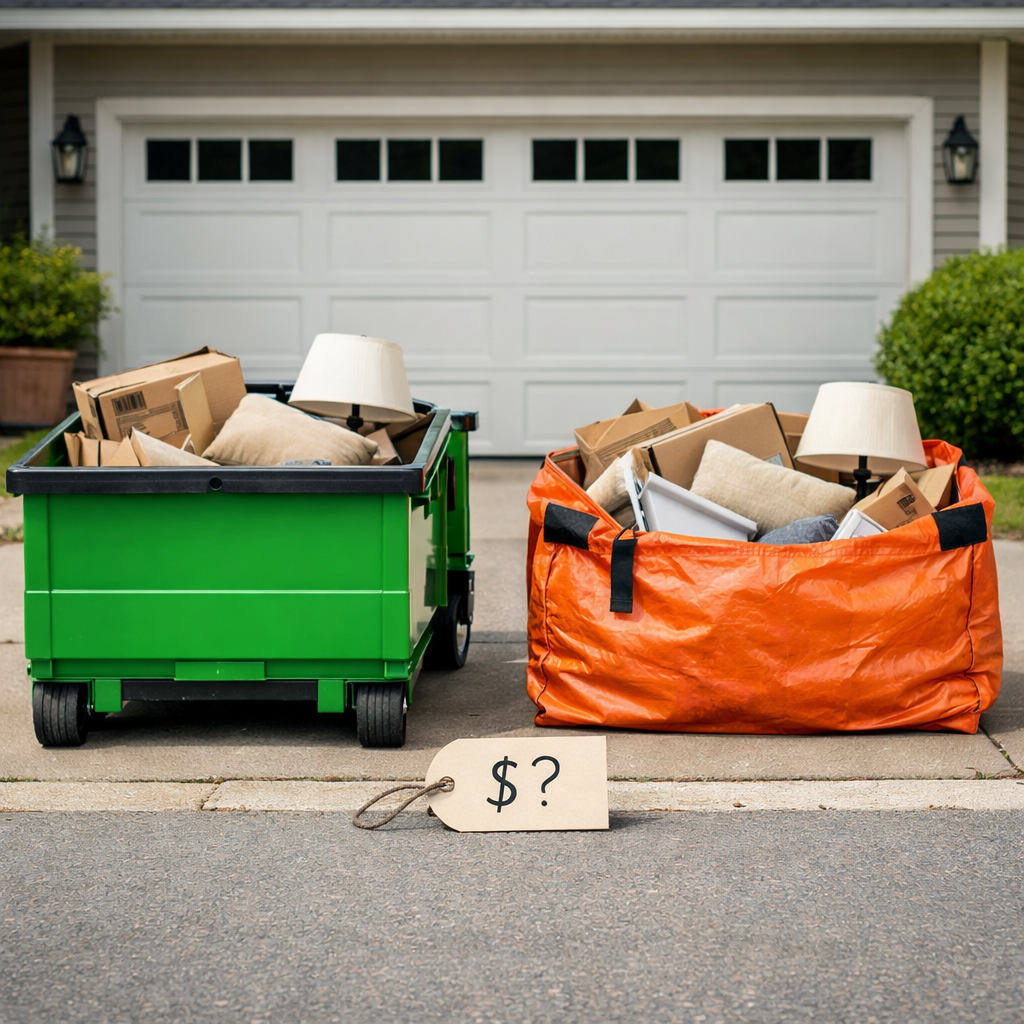
Light, non-hazardous clutter from a quick cleanout doesn’t need a big bin—or a big bill. For loads around a pickup-truck bed (about 3 cubic yards), a Bagster is usually the lowest cash-out option. Once your debris exceeds that, or gets heavier or bulkier, a 10-yard mini roll-off tends to deliver a lower cost per cubic yard, fewer trips, and firmer scheduling. This Recycler Routing Guide walkthrough shows you exactly when each option wins, what they really cost, and how to size, schedule, and track service so you avoid overages and missed pickups.
Summary verdict
For small, light loads, Bagster is typically the cheapest choice—up to 3 cubic yards and within its 3,300 lb limit, with total per-bag costs commonly $130–$330 depending on pickup fees. The official Bagster specs list 3 yd³ capacity and a 3,300 lb max load (see the official Bagster specs). For anything beyond one bag or involving heavier materials, a 10-yard mini dumpster usually beats Bagster on value and convenience, delivering a lower cost per cubic yard and a single scheduled haul. If you’ll fill more than one Bagster, rent a 10-yard roll-off for simpler logistics and better per-yard pricing (see this local example comparison).
Links: official Bagster specs: https://thebagster.com/; local example comparison: https://wizardmn.com/uncategorized/dumpster-vs-bagster/
What counts as light household junk
Light household junk refers to small-volume, non-hazardous items from decluttering or minor DIY projects—boxes, textiles, small furniture, packaging, light remodeling debris like wood or drywall offcuts, and yard trimmings. Think ≤3 cubic yards total and under weight limits; avoid liquids, hazardous materials, and dense masonry.
Examples by project:
- Decluttering: mixed boxes, toys, small shelving, rugs, broken decor.
- Minor remodel: cabinets, trim, drywall scraps, flooring offcuts.
- Yard: leaves, branches, brush (confirm acceptance locally).
Exclusion cues: if items are dense (e.g., concrete, roofing shingles in bulk) or your pile is bigger than a pickup-truck bed (~3 yd³), a mini dumpster is the safer, cheaper fit over multiple bags.
Pricing benchmarks and cost per cubic yard
Here’s how Bagster and small roll-offs compare when you price apples-to-apples on cost per cubic yard.
- Bagster: the bag is about $30; pickup adds $100–$300+, with many markets reporting around $170 total per bag in practice (see Sourgum’s pricing guide).
- Mini dumpster: 10-yard local rentals often run $300–$400. Across all sizes, the national average dumpster rental is about $663 (range $286–$1,538), with per-yard value improving as you go up in size (see the Dumpsters.com comparison).
Table: Typical costs and implied $/yd³
| Option | Capacity (yd³) | Typical total cost | Implied $/yd³ | Notes |
|---|---|---|---|---|
| 1 Bagster | 3 | $170 (≈$130–$330) | ≈$57 (≈$43–$110) | Single-use; per-bag pickup fees |
| 2 Bagsters | 6 | $340–$660 | ≈$57–$110 | Fees apply per bag |
| 3 Bagsters | 9 | ≈$600 | ≈$67 | Comparable to a small dumpster’s volume |
| 10-yd mini dumpster | 10 | $300–$400 | $30–$40 | Flat-rate or weight-capped pricing common |
| 14-yd dumpster (local example) | 14 | ≈$399 | ≈$28 | From a published local comparison example |
| National average (all sizes) | 10–20 (varies) | $663 avg (range $286–$1,538) | Varies | Market- and size-dependent |
Implication: once you exceed one Bagster, per-yard economics tilt quickly toward a small roll-off, especially where flat-rate 10–15 yard pricing is available.
Links: Sourgum’s pricing guide: https://sourgum.com/resource-hub/bagster-vs-dumpster-which-is-better/; Dumpsters.com comparison: https://www.dumpsters.com/blog/dumpster-bag-vs-dumpster-rental
Capacity, weight limits, and space requirements
- True limits: A Bagster holds up to 3 cubic yards and 3,300 pounds; overfilling or exceeding weight can trigger a pickup refusal. Small roll-offs typically range 10–40 cubic yards with weight caps that increase by size.
- Volume shorthand: one pickup-truck bed is about 3 cubic yards—use it to eyeball whether you’ll max out a Bagster.
- Placement: Bagsters must be set near the curb, typically within about 16 feet of the street for the boom truck to lift. Mini dumpsters can be placed on a driveway or pad and left on-site for the project’s duration (see the Hometown Waste overview).
Link: Hometown Waste overview: https://hometownwastenj.com/bagster-vs-dumpster/
Material restrictions and disposal rules
Bagster
- Usually allowed: light household junk, small furniture, packaging, wood, drywall scraps, yard trimmings (varies).
- Require special handling/prohibited: hazardous items (paint, oil, batteries, asbestos), liquids; some areas restrict electronics or yard waste. Always confirm locally (see Sourgum’s pricing guide).
Mini dumpster
- Usually allowed: bulky items and many heavier materials—furniture, drywall, roofing shingles (check weight limits), clean concrete/brick by special order.
- Require special handling/prohibited: hazardous materials and regulated wastes; verify your provider’s acceptable materials list (see the Dumpsters.com comparison).
Ordering, placement, pickup, and permits
- Ordering: Buy a Bagster at major home improvement retailers and schedule pickup online; pickup fees are per bag and service areas vary (see Sourgum’s pricing guide). Mini dumpsters are booked through local roll-off providers with delivery and pickup windows.
- Pickup windows: Bagster pickups often land in a 5–7 day window after you schedule—good flexibility, less predictability. Mini dumpsters typically offer firm delivery/pickup dates and swap options—more predictable for project plans.
- Permits: Street placement may require a right-of-way permit. Steps: verify city rules, apply 3–5 days before delivery, and post the permit on the container if required.
Environmental considerations
Bagsters are single-use; the bag is landfilled with your debris. Steel roll-off dumpsters are reusable, avoiding single-use packaging and reducing material waste over time (see Sourgum’s pricing guide). To improve outcomes, separate metal, cardboard, and clean wood before loading so recyclables can be diverted.
Diversion rate definition: Diversion rate measures the percentage of total material that is reused, recycled, or composted instead of landfilled. Tracking diversion clarifies environmental performance, supports reporting for sustainability goals, and can lower disposal costs when recyclable streams are clean and consistently separated.
When Bagster is cheapest
Choose Bagster when you have ≤3 cubic yards of light, non-hazardous debris, can stage the bag near the curb, and are fine with a flexible pickup window. Expect roughly $30 for the bag plus a $100–$300 pickup fee, with many markets seeing about $170 all-in per bag. Pack carefully—sharp, jagged items can rip the bag and risk refusal. Heuristic: if your load fits in one pickup bed and isn’t dense, Bagster likely saves money.
When a mini dumpster is better value
If your project exceeds 3 cubic yards, spans multiple rooms, or includes heavier/bulkier items (e.g., drywall volume, furniture, shingles, concrete), a 10-yard roll-off typically beats Bagster on price-per-yard and workflow. Bagster fees add up bag-by-bag; one small dumpster consolidates everything with a single scheduled haul and easier driveway placement.
Roll-off sizing guidance for small projects
Common sizes and use cases:
- 10 yd: single-room remodel, small garage cleanout, shingles (confirm the weight cap).
- 15 yd: multi-room declutter, flooring removal for a small home.
- 20 yd: mid-size renovation with bulky items.
Why 10-yard for heavy debris: low side walls (around 3.5 feet) make loading dense materials safer and help keep under weight limits (see the 10-yard vs Bagster guide).
Simple sizing flow:
- Inventory items and stack a test pile if possible.
- Estimate volume using pickup-bed equivalence (≈3 yd³ each).
- Factor density: masonry and roofing hit weight caps fast; “fluffy” junk fills space first.
- Choose a size with roughly 20% headroom to avoid overages.
Link: 10-yard vs Bagster guide: https://bartenbros.com/10-yard-dumpster-vs-bagster/
KPIs to ensure reliable service
Track a short list of performance metrics to prevent delays and surprise fees:
- On-time rate, missed collection rate, schedule adherence, proof-of-service, contamination incidents.
- Cadence: set daily exception alerts, review KPIs weekly, and reconcile weights/fees at project close.
- For search visibility, consider adding structured HowTo and FAQ data (JSON-LD) to your project pages.
Recycler Routing Guide favors simple, auditable KPIs you can compare across providers.
On-time delivery and pickup rate
On-time rate measures the percent of deliveries and pickups completed within the agreed window. Track delivery and final pickup separately, segment by provider and site, and target ≥95% on time with time-stamped confirmations.
Missed collection rate and schedule adherence
Missed collection rate is the percent of scheduled hauls not completed on the service day; schedule adherence tracks variance versus planned time. Trigger next-day recovery on misses, enforce SLA credits, and visualize variance weekly to spot drift.
Proof of service and contamination incidents
Require photo proof at drop and pickup with timestamps and container ID. Log contamination incidents by material type and estimated weight impact so you can adjust signage, sorting, and staff instructions to reduce surcharges.
AI-enabled routing and governance cadences
AI-enabled routing uses algorithms to predict container fill levels, optimize haul timing, and sequence stops around traffic and service windows. It reduces route miles, missed pickups, and overflow risk while improving on-time rates and cost per lift. Govern with weekly KPI reviews, monthly pricing/weight audits, and quarterly provider scorecards; fold demand forecasts into scheduling to smooth peaks.
Network design choices for multi-site managers
Two scalable models often compete:
- Hub-and-spoke transfer hubs: lower haul cost per ton via consolidation, but add handling steps and require hub capacity and compliance.
- On-site compaction: higher payload per lift and fewer trips, with capex, power, and maintenance tradeoffs.
Model both to quantify breakeven by site volume, service radius, and tip fees.
Hub and spoke transfer hubs
Definition: A hub-and-spoke transfer network consolidates waste from multiple sites at a central hub, then hauls full loads to disposal. It raises route density and load factors, improving transport efficiency, but adds handling steps and needs adequate capacity, zoning compliance, and operational oversight. Wins with dispersed sites, moderate volumes, and predictable schedules. Watch: turn time, consolidation rate, hub queue times.
On-site compaction
Definition: On-site compaction compresses waste where it’s generated using stationary or self-contained compactors. It boosts payload per haul, cuts trip frequency, and reduces litter and odors, but requires power, maintenance, upfront capital, and strong safety protocols. Choose it for higher waste density, available space, and strict pickup windows; track compaction ratio, average payload weight, and downtime percentage.
Decision framework and quick rule of thumb
- Step 1: Estimate volume (one pickup bed ≈3 yd³).
- Step 2: Check material density and any restrictions.
- Step 3: Confirm placement (curb vs driveway) and scheduling needs.
- Step 4: Compare all-in cost per cubic yard.
Quick rule: ≤3 yd³ of light debris with curb access → Bagster. >3 yd³, heavier/bulkier items, or need a fixed pickup → 10-yard mini dumpster.
For local pricing intel and providers, see our same-day dumpster rental roundup and visit Recycler Routing Guide for market benchmarks.
Links: same-day dumpster rental roundup: https://www.recycleroutingguide.com/posts/top-7-sameday-dumpster-rental-companies-near-you-in-2025/; Recycler Routing Guide: https://www.recycleroutingguide.com/
Frequently asked questions
Where can I rent a small bin for light household junk
Rent a 10-yard mini dumpster from a local roll-off provider or use a Bagster from home improvement stores with scheduled pickup. Compare all-in cost and placement constraints, and check Recycler Routing Guide for market benchmarks.
Do I need a permit to place a mini dumpster on the street
Often yes—many cities require a right-of-way permit. Check local rules and apply several days before delivery.
What can’t I put in a Bagster or mini dumpster
Exclude hazardous items such as paint, oil, batteries, and asbestos. Some locations also restrict electronics or yard waste; verify local rules or see Recycler Routing Guide for common restrictions.
How long can I keep a mini dumpster on-site
Typical rentals run 3–7 days with options to extend for a daily fee. Confirm your pickup window when booking.
How do I estimate if my junk exceeds one Bagster
One pickup-truck bed is roughly 3 cubic yards—the capacity of a Bagster. If your pile exceeds that or includes dense materials, plan for a 10-yard dumpster; Recycler Routing Guide’s sizing tips above can help.