No-Driveway-Damage Guarantees Compared: Dumpster Companies Keeping Surfaces Safe
No-Driveway-Damage Guarantees Compared: Dumpster Companies Keeping Surfaces Safe
A driveway-safe dumpster promise matters most when you’re working on tight residential sites or delicate surfaces like asphalt and pavers. The short answer: multiple regional haulers actively market “no driveway damage” practices—some even publish protection details—yet formal guarantees vary. Before you book, confirm the written terms, protective materials, and weight caps tied to the claim. Below, we compare providers that emphasize driveway-safe placements, explain how guarantees work, and give you a dispatch-ready checklist we use in Recycler Routing Guide field evaluations so you can right-size bins, protect surfaces, and keep fees predictable.
Who offers driveway-safe guarantees
A number of bin rental companies spotlight driveway-safe dumpster placement or a driveway protection guarantee. Use these quick one-liners to shortlist vendors, then verify written terms before booking.
- VaVia — emphasizes driveway-safe placements using specialized gear and placement guidance to avoid scrapes and scuffs, as outlined in VaVia’s driveway-safe overview.
- Source: VaVia’s “No Scrapes, No Drama” driveway guidance (govavia.com)
- Atlas Disposal — educates customers on damage types (scrapes, stains, impressions, litter) and how to prevent them with prep and prompt pickup.
- Source: Atlas Disposal’s driveway damage guide (atlasdisposal.com)
- Grime Time — offers lighter, trailer-style driveway-safe dumpsters with rubber wheels for maneuverability on short or curved drives.
- Source: Grime Time’s driveway-safe rental page (grimetime.com)
- BRC Industries — details protective boards/plywood under rails, driver training, adherence to weight limits, and timely removal.
- Source: BRC Industries’ property protection explainer (brcindustries.com)
- Vaughn’s Refuse — promotes rubber-wheeled “dumpsters on wheels” that distribute weight and reduce gouges while enabling closer placement to work zones.
- Source: Vaughn’s Refuse on rubber-wheeled units (vaughnsrefuse.com)
- CleanE Dumpster — publishes sizes, pricing, weight caps, and notes driveway protection and sweep-up on pickup; also highlights quick delivery.
- Source: CleanE’s pricing and protections (cleanedumpster.com)
- Colcan Carting — posts a broad size lineup with narrow 10–15 yard options suitable for tight residential approaches.
- Source: Colcan Carting sizes and pricing (colcancarting.com)
- QuickLift — transparent rental window (7 days), overage pricing, and same/next-day delivery that helps limit surface-sitting time.
- Source: QuickLift South Salem details (quickliftdumpsterrentalsllc.com)
Important: Many providers market “driveway-safe” features even if they don’t publish a formal guarantee. Ask for written terms, including exclusions and any weight or size constraints connected to the driveway protection guarantee.
How no-driveway-damage guarantees work
“A no-driveway-damage guarantee is a written promise to prevent surface harm during dumpster delivery/removal by using protective materials, lighter equipment, and trained drivers; coverage often excludes pre-existing defects, misuse, or overweight loading.”
On the ground, providers execute this with:
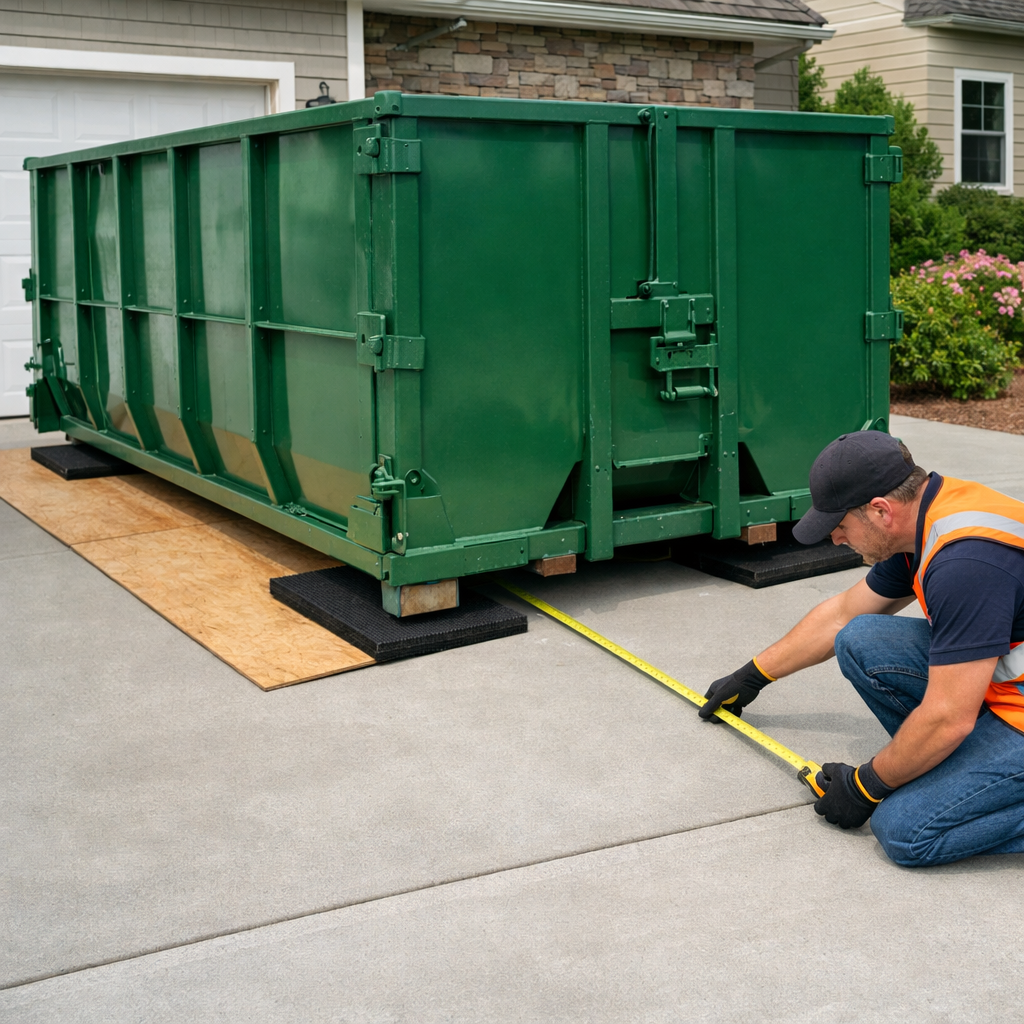
- Protective barriers under contact points (e.g., plywood/boards) and rubber-wheeled or trailer dumpsters.
- Site evaluation and trained drivers who avoid edges, joints, and landscaping.
- Right-sizing and guidance to keep loads within caps so surface pressure stays low.
Guarantees usually come with operating limits: tighter weight caps, limits on dense debris, and size guidance. Overloading is the most common root cause of driveway harm and overage fees; several haulers explicitly tie their protection to following weight and placement instructions.
Evaluation criteria for driveway-safe bins
Use Recycler Routing Guide’s six-point checklist to compare vendors by risk, cost, and fit for your site:
- Written guarantee terms and exclusions
- Protection method: rubber wheels and/or boards/mats under rails
- Weight caps and per-ton overage rates
- Equipment type and maneuverability (trailer vs. roll-off; clearance needs)
- Driver training and site evaluation process
- Documentation: timestamped photos, placement diagram, scale tickets/tonnage
Scoring rubric we use (1–5 each; higher is better):
- Surface protection
- Maneuverability
- Capacity vs. caps
- Clarity of fees
- Scheduling reliability
- Claim support
Overage fees: charges per ton (or fraction) when the dumped load exceeds the included weight allowance in your flat rate.
Core protection methods compared
| Method | How it Protects | Best For | Watchouts | Example Vendor Notes |
|---|---|---|---|---|
| Rubber-wheeled/trailer bin | Distributes weight, reduces gouges and scuffs; rolls into tight spaces | Asphalt, pavers, short/curved driveways | Lower weight caps; axle limits on dense debris | Grime Time; Vaughn’s Refuse |
| Plywood/boards under rails | Spreads point loads from steel rails/feet to protect surface | Concrete pads, standard roll-off placements | Must fully support rails; wet/soft ground undermines effect | BRC Industries (boards under bins) |
| Trained driver/site walk | Avoids edges, joints, curbs; optimizes drop zone and exit path | All surfaces; constrained residential sites | Requires customer availability for walkthrough | BRC Industries; Atlas educational tips |
| Prompt pickup/sweep | Minimizes rust stains, sun bleaching, and debris scatter | Weeklong remodels; HOA-sensitive areas | Longer sits increase stain/impression risk | Atlas timing tips; CleanE sweep-up |
Buffer Board Rule: Always lay plywood or 2x4s before placing heavy bins to reduce point load and scuff risk. This simple step aligns with broader home-protection best practices shared by sustainability and home-care resources such as Friendly Turtle.
Price, weight caps, and rental window differences
Mini comparison (illustrative examples from provider pages):
| Provider | 10 yd | 15 yd | 20 yd | Included Window | Included Weight | Noted Extras |
|---|---|---|---|---|---|---|
| CleanE | $260/5 days/4,000 lb | $300/6,000 lb | $350/8,000 lb | 5 days | As listed per size | Driveway protection and sweep; 24-hour delivery |
| QuickLift | — | — | — | 7 days | Disposal within allowance | $25/day extensions; $180/ton overage; same/next-day options |
Trade-off to note: driveway-safe placements often use lighter trailer equipment or stricter caps, which controls surface stress but can raise overage risk on dense debris. Get these items in writing (Recycler Routing Guide’s rental-summary worksheet covers them):
- Rental window (days included and extension/day rate)
- Included tonnage and per-ton overage
- Prohibited items and special-handling fees
- Swap/extra-haul charges
- Pickup commitments (e.g., same/next-day when requested)
Recycler Routing Guide recommendation
- For maximum driveway preservation, select trailer-based or rubber-wheeled dumpsters when feasible. If a roll-off is required, require plywood under rails and a driver walkthrough to mark the drop zone.
- Right-size to control weight: 15 yd for garage cleanouts or single-room remodels (roughly 4–5 pickup loads), 20–30 yd for typical Atlanta remodels, and 30–40 yd for larger projects. Keep loads within the stated caps—weight, not volume, is what stresses surfaces and budgets.
- Documentation is non-negotiable: timestamped placement photos, a signed placement diagram, and scale tickets/tonnage records for audit-ready files and fast claim resolution. Our standardized templates help crews follow the same protection and documentation steps on every drop.
VaVia
VaVia positions driveway-safe service by using specialized placement equipment and providing guidance to avoid scrapes and impressions. Before booking, ask for written guarantee terms, what protective materials (boards/mats) are applied, and any size/weight constraints tied to the promise. Request pre-delivery photos and a brief driver placement walkthrough on arrival.
Atlas Disposal
Atlas’s education-first approach breaks driveway damage into scrapes, stains, impressions, and litter—use that taxonomy to assess your risk by surface. Keep rentals to a week or two to minimize rust stains or sun-bleach outlines, prep boards, choose a flat section away from joints and edges, schedule prompt pickup, and sweep after haul-away.
Grime Time
Trailer-style, rubber-wheeled driveway-safe dumpsters shine on tight, short, or curved residential drives because they require less straight-line clearance than a roll-off truck. Rubber wheels cut friction and distribute weight on delicate surfaces. Confirm included weight caps and axle limits—lighter equipment often pairs with stricter tonnage.
BRC Industries
BRC translates protection into a clear field practice: lay plywood/thick boards under the bin, conduct a site evaluation, use skilled drivers, enforce weight limits, and remove promptly to reduce stress and staining risk. Adopt a roll-off SOP: measure the pad, place boards, align rails, chock if needed, verify clearance, document photos, and note included tonnage. Overweight loads spike point pressure and increase both damage and transport safety risks.
Vaughn’s Refuse
Rubber-wheeled “dumpsters on wheels” distribute weight evenly and reduce cuts, scrapes, and cracks, while enabling drop zones closer to the work area—shortening hauling steps and time on site. They’re ideal for pavers and asphalt and for narrow approaches; still cap dense debris to stay under axle/tonnage limits.
CleanE Dumpster
CleanE publishes simple, predictable pricing with driveway protection and sweep included: 10 yd at $260 for 5 days with 4,000 lb included; 15 yd at $300 with 6,000 lb; 20 yd at $350 with 8,000 lb, plus 24-hour delivery in many cases. The included sweep and prompt turnarounds help preserve surfaces and deliver clean project handoffs.
Colcan Carting
Colcan offers sizes from 5 to 30 yards, with narrower 10–15 yard bins that navigate tree-lined or curved drives. Match narrower footprints to constrained approaches and pair with boards if using steel-rail roll-offs on concrete or pavers.
QuickLift
QuickLift’s transparency—delivery, pickup, and disposal within the allowance, a 7-day rental, $25/day extensions, and $180/ton overage, with same-day by noon in some areas—helps you budget clearly and reduce bin “sit time” that can cause stains or impressions. Quick swaps keep projects moving and surfaces safe.
Regional sizing and placement guidance
In the Atlanta market, typical remodels run 20–30 yards; larger projects may need 30–40 yards. Weekend cleanouts often fit a 15 yard (about 4–5 pickup loads). For short runs, see our weekend planning playbook in How to rent a residential dumpster for a weekend project (Recycler Routing Guide). Light junk alternatives include a Bagster versus a 10 yard mini dumpster; compare cost per cubic yard and pickup certainty in Mini dumpster vs Bagster: cheapest options for light household junk (Recycler Routing Guide).
Placement flow:
- Confirm clearance and overhead lines; mark a drop zone away from joints/edges.
- Lay boards, photograph the area, and guide the driver for a square, centered set-down.
- Set pickup within 7–14 days to reduce stain/impression risk and document post-pickup photos.
Pros and cons for homeowners and small contractors
Pros:
- Lower risk of scrapes, stains, and impressions on asphalt, pavers, and concrete.
- Better maneuverability and closer placement reduces carry distance and time-on-site.
- Fewer permit/logistics issues on residential streets due to smaller, lighter equipment.
Cons:
- Smaller capacity or stricter weight limits can increase swap frequency.
- Higher per-cubic-yard cost for dense debris if you hit tonnage caps early.
- Extension and overage fees apply if timelines or weight allowances are exceeded.
“Load factor: the practical fill level you can reach before hitting your tonnage cap; for dense debris, weight, not volume, usually dictates your real limit.”
How to verify a driveway-safe promise before booking
- Ask for written guarantee terms and exclusions; confirm protective materials (boards/mats) and equipment type (trailer vs. roll-off).
- Request certificates of insurance (general liability, workers’ comp) and licensing; this mirrors common due-diligence guidance from reputable contractor resources such as Appalachian Dumpster & Demo’s rental guide (appalachiandumpsteranddemo.com) and Recycler Routing Guide’s due-diligence checklist.
- Confirm rental window, included tonnage, overage rate, prohibited items, and pickup commitments (e.g., same/next-day on request).
- Photo protocol: take pre-drop and post-pickup photos; record board/mat placement; retain scale tickets for audit-ready tonnage records.
Frequently asked questions
What does a no-driveway-damage guarantee typically cover and exclude
It typically covers delivery/pickup damage when boards or rubber-wheeled equipment are used; exclusions often include pre-existing defects, overweight loads, misuse, and unapproved placement. Recycler Routing Guide’s checklist helps you confirm these terms in writing.
What protection methods should I request for my surface
For asphalt or pavers, request rubber-wheeled/trailer dumpsters and plywood under contact points; for concrete, use boards under rails and a driver site evaluation to avoid joints. Recycler Routing Guide’s surface-by-surface notes summarize these asks.
How do weight limits and overage fees affect driveway safety
Weight caps keep ground pressure within safe limits; exceeding them increases damage risk and triggers per-ton overage fees. Use Recycler Routing Guide’s sizing guidance to pick the right bin and keep dense debris within the allowance.
What proof of insurance or documentation should I ask for
Ask for certificates of general liability and workers’ compensation plus any required licenses. Recycler Routing Guide’s documentation checklist includes photo and scale-ticket steps.
What is the claims process if damage occurs
Document with photos immediately, notify the provider, and share estimates; resolution typically runs through the guarantee or their insurer. Recycler Routing Guide’s claim packet template helps speed the process.