Reduce Complaints with Consistent Indoor Waste Pickup in Commercial Buildings
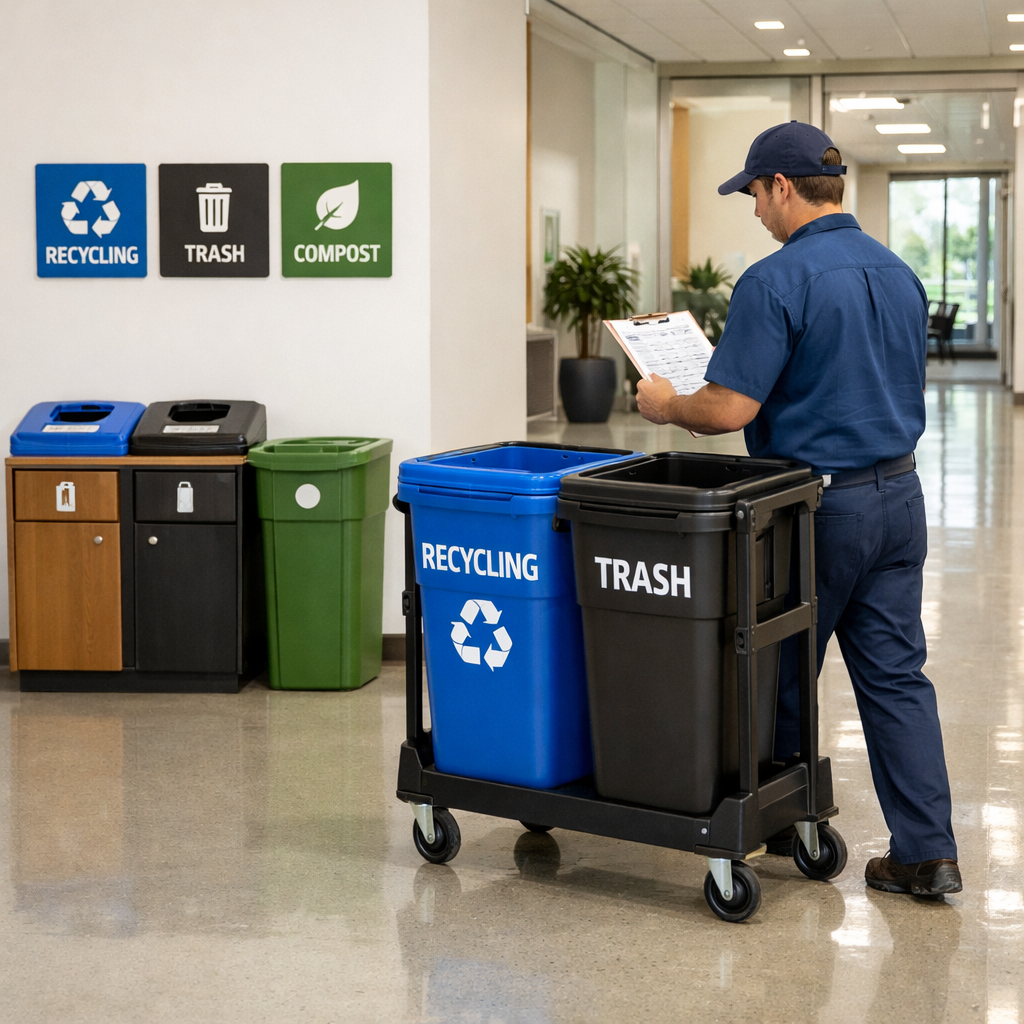
Reduce Complaints with Consistent Indoor Waste Pickup in Commercial Buildings
Consistent indoor waste collection services for commercial buildings reduce odor complaints, prevent overflow, and keep tenants happy. Inside the building, janitorial or facility teams empty interior stations and stage materials; outside, contracted haulers perform scheduled commercial building waste pickup from docks. Most successful programs blend daily janitorial sweeps with time-banded hauler service and on‑demand pickups for food waste or regulated streams. This KPI‑first playbook shows how to right‑size containers and set frequencies, standardize signage and SOPs, and govern providers with itemized quotes, proof‑of‑service, and AI‑assisted routing—so your on‑time pickup rate goes up and missed collections go down. Recycler Routing Guide standardizes these controls so multi‑site teams execute consistently.
Define complaint drivers and KPIs
Odors, overflowed bins, blocked access, pests, health risks, and missed or inconsistent pickup are the top complaint drivers. Frequent removal of food waste is the single most effective way to reduce odors, pests, and health‑code risks, especially in break rooms and food service areas (see Assett Services’ best practices for trash management).
Use these KPI targets and simple formulas to control outcomes:
- “On‑time pickup rate” = services completed within the agreed service window ÷ total scheduled services.
- “Missed collection rate” = scheduled services not completed (provider or access issues) ÷ total scheduled services.
- “Contamination rate” = non‑accepted material weight ÷ total weight in that stream.
- “Complaint rate” = total complaints ÷ (occupants ÷ 100) per month.
Stand up a lightweight KPI dashboard tied to service windows and proof‑of‑service—time‑stamped photos plus RFID/QR scans at docks. For tenant accountability or pay‑as‑you‑throw, RFID/QR‑coded bags and containers can attribute volume by floor or suite (see Zero Waste Design’s best‑practice strategies). Recycler Routing Guide uses these KPI definitions to align providers on service windows and proof‑of‑service.
Audit indoor waste streams and map generator zones
“You can’t manage what you don’t measure.” Start by benchmarking generation and diversion. Use ENERGY STAR Portfolio Manager to track waste across buildings alongside energy and water for a full performance view (see the EPA’s commercial buildings waste guide).
Practical steps to quantify your baseline:
- Weigh streams at docks with platform scales to validate invoices and diversion rates (ZWDesign).
- Use tilt trucks or hampers with integrated scales to log pounds by tenant or floor (ZWDesign).
- Pilot simple digital trackers (e.g., Divertsy) to capture volumes and pickup counts (ZWDesign).
Map “high‑frequency zones” (break rooms, pantries, lobbies, restrooms) and define service bands: daily in food and restroom areas, versus reduced frequency in low‑traffic corridors. This informs route design, labor sizing, and cart movement plans. Recycler Routing Guide shows how to translate these measurements into service bands and cart movement plans.
Right-size containers and set pickup frequencies
Right‑sizing is matching container capacity and pickup intervals to actual generation patterns. It reduces overflow, odors, and unnecessary hauls by placing the right bins in the right locations and scheduling collections at the lowest frequency that still meets cleanliness and safety standards.
Recommendations:
- Select receptacles by size, lid type (tight‑fitting lids in food zones), fire resistance, ADA accessibility, and clear separation for recycling and organics (Assett Services).
- Document removal frequencies; high‑traffic break rooms and restrooms often need daily service (Assett Services).
- Blend intervals: multiple daily sweeps for food/coffee areas; reduced schedules where bins rarely approach two‑thirds full.
Suggested pairings (adjust to measured volumes):
| Floor type | Location/zone | Recommended bin types and lids | Suggested pickup interval |
|---|---|---|---|
| Typical office | Open office, conference rooms | Dual‑stream stations (paper/mixed recycling + trash), no‑lift liners; ADA‑compliant openings | 3–5x/week; align with janitorial |
| Typical office | Break rooms, pantries | Lidded organics + trash; separate mixed recycling; leak‑resistant liners | Daily; add midday sweep if food volume is high |
| Mixed‑use | Lobbies, mail/copy areas | Paper‑focused recycling + trash; clear signage | 3–5x/week; increase during tenant move‑ins |
| Mixed‑use | Restrooms | Covered trash; towel recycling if available | Daily (or multiple times daily for high occupancy) |
| Food‑service floors | Kitchens/servery | Lidded organics, grease containers, back‑of‑house recycling; pest‑resistant carts | Multiple sweeps daily; dock pull daily |
| Food‑service floors | Seating areas | Front‑of‑house tri‑sort stations with lids and baffles | Hourly checks during meal peaks; end‑of‑day pull |
Standardize signage, color codes, and tenant SOPs
Uniform, image‑based signs and consistent color codes dramatically lower contamination. Use blue for mixed recycling, light blue for paper, green for organics, and black for trash to improve recognition across floors (ZWDesign). Many teams use picture‑based labels; EPA’s guidance on managing waste in commercial buildings includes signage resources to standardize across portfolios.
Document tenant‑facing SOPs that spell out:
- What goes where, container prep, and contamination prevention.
- How each stream moves from floors to staging (elevator, timing, dock protocols).
- Who to contact for on‑demand or bulky pickups.
Embed lease language requiring tenants to follow building waste rules, provide space for internal containers, and participate in signage/SOP updates (ZWDesign).
Equip for volume reduction and controlled staging
Volume reduction equipment compresses or densifies waste and recyclables to reduce container changes and dock traffic. Common options include compactors, balers, crushers, and grinders. Properly sized equipment lowers odors, improves hygiene, and can reduce hauling frequency and costs (ZWDesign).
Performance benchmarks and guidance:
- Cardboard compaction up to roughly 8:1; plastics and metals up to about 5:1 (ZWDesign).
- Lease equipment to reduce upfront costs and bundle maintenance.
- In multi‑tenant buildings, share storage/equipment and allocate costs proportionally (ZWDesign).
- For baled OCC, check local limits—e.g., DSNY’s ≤60 lb small‑bale requirement—and size bales accordingly (ZWDesign).
Train teams, pilot routes, and adjust seasonally
Kick off with senior leadership setting goals and expectations so operations, custodial, and tenants align on recycling and waste standards (EPA guide). Train frontline teams on SOPs, color codes, and contamination avoidance. Pilot routes on the busiest floors first, validate KPIs, then scale. Recycler Routing Guide provides practical SOPs and checklists to support training and consistent execution.
Tune seasonally. Occupancy shifts, holidays, and food volumes will change set‑outs; many providers offer seasonal adjustments and staff education to keep programs effective (The Trash Man’s commercial waste tips).
Govern service with itemized contracts and proof of service
Control costs and reliability through transparent contracts:
- Consolidate services or use a single broker where practical to reduce cost and staff time (Great Forest’s cost‑reduction strategies).
- Require itemized invoices by stream and location; verify with dock scales and tilt‑truck weights (ZWDesign).
- Embed proof‑of‑service (time‑stamped photos/scans), on‑time pickup SLAs, and audit rights. Commission third‑party audits periodically to validate hauler data and uncover overbilling or misreported diversion (Great Forest). Recycler Routing Guide provides contract language examples for proof‑of‑service and KPI SLAs to simplify governance.
Optimize docks, access, and odor control
Keep dumpster and loading dock areas clean to deter pests, fires, and illegal dumping (Assett Services). Maintain unobstructed paths to containers; blocked access leads to safety hazards and missed pickups (Arrowaste’s commercial best practices). For odor control, double‑line high‑risk bins, disinfect interiors on a set schedule, and remove food waste frequently to break the odor‑pest cycle (Assett Services).
Use data tools and AI-assisted routing for reliability
At the portfolio level, use ENERGY STAR Portfolio Manager to track waste alongside utilities and benchmark improvement (EPA). On the ground, add RFID/QR container or bag tags to capture service events and weigh‑at‑pickup on tilt trucks for tenant‑level accountability (ZWDesign).
AI‑assisted routing and dispatch optimization can tighten pickup windows, reduce missed collections, and improve schedule adherence—especially when paired with transparent KPIs and proof‑of‑service photos/scans. Recycler Routing Guide centralizes KPI tracking, route design, and proof‑of‑service standards to improve reliability across portfolios.
Integrate roll-off and bulky workflows without disrupting indoor service
Schedule roll‑off swaps and bulky moves outside peak indoor service windows; reserve docks and elevators for daily interior routes. Maintain a prohibited‑items reference and book specialty pickups for e‑waste, appliances, and hazardous or oversized materials rather than using standard dumpsters (Arrowaste). Require roll‑off vendors to meet the same proof‑of‑service and service‑window SLAs so their trucks don’t block dock access needed for indoor collection.
Match 10, 15, and 20 yard roll-offs to debris profiles
- 10‑yard: dense debris, file purges, small office reconfigs; keep under weight caps with paper, fixtures, and limited dense materials.
- 15‑yard: medium renovations, mixed office furniture, light demo where both weight and volume are moderate.
- 20‑yard: larger cleanouts and light construction where volume exceeds weight; ideal for bulky, lighter materials.
Right‑size to stay under weight caps, preserve maneuvering room on docks, and coordinate swap timing so interior routes keep their schedule.
Avoid overage fees, contamination, and permit issues
“Overage fees” are charges when debris exceeds the dumpster’s included weight or volume cap; avoid them by right‑sizing, separating heavy materials, and confirming weight allowances and tipping rates on the itemized quote.
Also:
- Apply contamination‑prevention tactics from your signage and SOPs to avoid cross‑stream charges.
- Verify local permits and placement rules before staging roll‑offs; document responsibilities and proof‑of‑service in vendor agreements.
- Keep roll‑off operations from blocking dock access during indoor service windows.
Implementation checklist and cadence
- Audit and map waste streams and volumes across floors and docks (EPA).
- Right‑size containers and set documented pickup frequencies; high‑traffic zones may need daily service (Assett Services).
- Standardize signage and tenant SOPs; add lease clauses for compliance (ZWDesign).
- Equip for volume reduction (balers/compactors) or lease shared equipment (ZWDesign).
- Train staff, run pilot routes, and adjust seasonally; stand up a green team to drive participation (Texas Disposal Systems’ resource management guidance).
- Consolidate haulers, require transparent reporting, and audit results for accuracy (Great Forest).
Governance cadence:
- Weekly: Review on‑time rate, missed collections, complaints; resolve access issues; perform odor checks.
- Monthly: Run contamination audits; refresh signage and retrain hot‑spot areas.
- Quarterly: Rebalance routes and frequencies, apply seasonal adjustments, scorecard vendors, and spot‑check third‑party data. Recycler Routing Guide mirrors this cadence with ready‑to‑use scorecards.
Frequently asked questions
Which services offer indoor waste collection for commercial buildings?
Indoor collection is typically handled by janitorial or facility teams that empty interior bins and stage materials, while contracted haulers remove docked waste on scheduled routes with optional on‑demand pickups. Recycler Routing Guide helps define roles and service windows between teams and haulers.
How often should indoor bins be serviced in high-traffic areas?
Plan for at least daily service in busy break rooms and restrooms, adding midday sweeps in food‑heavy zones; lower‑traffic areas can run reduced schedules if bins stay well below overflow. Recycler Routing Guide recommends setting frequencies by measured fill levels and complaint data.
What container sizes and types work best for food areas versus offices?
Use lidded, leak‑resistant organics and trash bins with clear labels in food areas, and ADA‑compliant dual‑ or tri‑sort stations with image‑based signage in offices to cut contamination. Recycler Routing Guide’s station standards reinforce low‑contamination setup.
How do I verify on-time pickup and reduce missed collections?
Require proof‑of‑service photos or scans, track on‑time pickup and missed collection rates, add RFID/QR tracking, and keep dock access clear to eliminate avoidable failures. Recycler Routing Guide standardizes these KPIs and proof‑of‑service practices.
When should I lease a compactor or baler instead of adding more pickups?
Lease when dock congestion, odors, or overflow persist despite regular service, or when OCC and recyclables can be densified to cut hauls and stabilize dock operations. Recycler Routing Guide offers decision criteria to compare equipment versus added service.