Same-Day Dumpster Rental Service Near Me: Roll-Off vs. Bagster
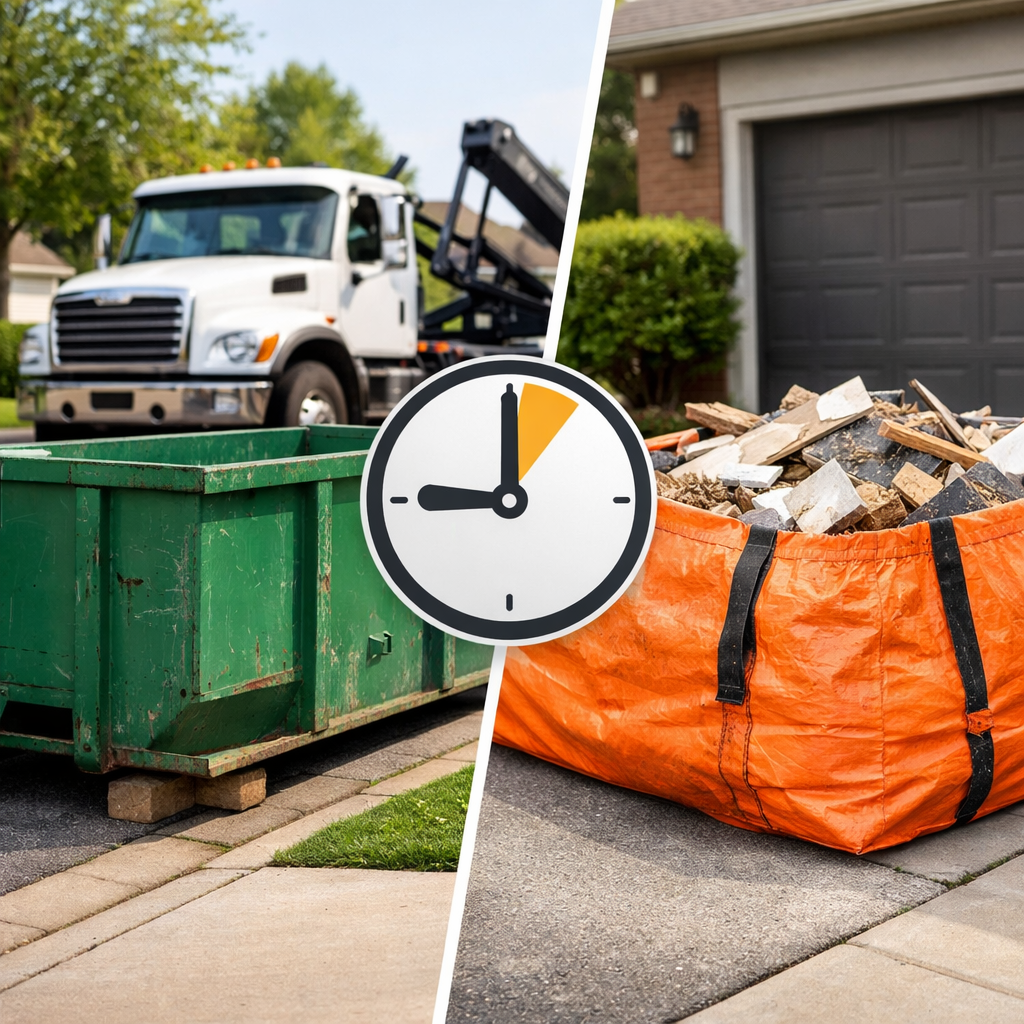
Same-Day Dumpster Rental Service Near Me: Roll-Off vs. Bagster
Looking for a same-day dumpster rental near me? For most urgent home projects, a local roll-off provider can deliver a 10–20 yard steel container the same day when you book early and confirm a 2–4 hour window. Bagster bags can be purchased and filled today, but their pickups are typically scheduled for later in the week. This guide from Recycler Routing Guide explains what “same-day” actually means, when to choose a roll-off vs. a Bagster, and how to lock reliable windows, flat-rate pricing, and driveway-safe placement.
What same-day dumpster rental means
Same-day dumpster rental means delivery of a container to your driveway within the same calendar day, typically secured via a confirmed 2–4 hour arrival window with dispatch text/phone confirmation.
Definitions up front:
- Roll-off dumpster: a steel container delivered by truck, commonly 10–40 cubic yards in size, placed on your driveway or permitted street space (see Budget Dumpster’s comparison of roll-offs vs. dumpster bags).
- Bagster: a soft-sided bag purchased at retail that holds about 3 cubic yards with a manufacturer-stated cap around 3,300 lbs, ordered with a separate pickup (see the Dumpsters.com guide to dumpster bags vs. rentals).
Urgency and scheduling differ: Roll-off drop-offs and pickups are booked to a specific date/time, making them ideal for urgent dumpster rental needs (see Bin There Dump That’s advice on scheduled roll-off windows). By contrast, Bagster pickups are typically completed within several business days after you schedule service (per redbox+’s overview of dumpster bag pickup timing). For true same-day roll-off delivery near me dumpster options, ask providers to lock a 2–4 hour window and get the ETA in writing.
How to choose roll-off vs Bagster for a same-day need
Use this 3-step selector:
- Estimate cubic yards: Light, one-room cleanouts may fit in 3 yards; multi-room or renovation debris often needs 10–20 yards. Roll-offs span 10–40 yards; a Bagster holds ~3 yards.
- Identify heavy debris vs. light junk: Bagsters top out near 3,300 lbs and typically allow only about 1 cubic yard of heavy materials (concrete, brick, tile). Steel roll-offs handle dense, sharp debris more reliably.
- Confirm delivery/pickup timing needs: If you need a guaranteed drop-off/pickup on set dates, choose a roll-off. Bagster’s pickup cadence is generally several business days after scheduling.
Bottom line: For time-sensitive projects and faster disposal turnaround, choose a roll-off with a confirmed time window; for small, flexible jobs in tight spaces, a Bagster can work.
Capacity and weight limits
Right-sizing prevents extra trips and surprise fees. Compare at a glance:
| Option | Volume (yd³) | Typical weight allowance | Typical exterior footprint (L × W × H) | Notes |
|---|---|---|---|---|
| Bagster | ~3 | Up to ~3,300 lbs; about 1 yd max of heavy debris | ~4 ft × 8 ft × 2.5 ft | Soft-sided; requires crane access for pickup |
| 10-yard roll-off | 10 | Often up to ~6,000 lbs (varies by market) | ~11 ft × 8 ft × 3.5 ft | Compact driveway fit; good for dense materials |
| 15-yard roll-off | 15 | Market-specific allowance | ~16 ft × 8 ft × 4.5 ft | Versatile for first-time DIYers |
| 20-yard roll-off | 20 | Market-specific allowance | ~22 ft × 8 ft × 4 ft | Popular for multi-room debris |
| 30-yard roll-off | 30 | Market-specific allowance | ~22 ft × 8 ft × 6 ft | Larger remodels, bulky loads |
| 40-yard roll-off | 40 | Market-specific allowance | ~22 ft × 8 ft × 8 ft | Major renovations/demos |
Notes: Typical allowances and dimensions vary by region and hauler; confirm your local caps and footprints (see Accurate Recycling’s roll-off vs Bagster guide).
Cubic yard, defined: A cubic yard is a 3 ft × 3 ft × 3 ft space measuring material volume. For household junk, 1 cubic yard holds roughly 5–6 standard trash bags. As a rule of thumb, a 10-yard roll-off fits about 50–60 bags; a 3-yard bag fits about 15–18.
Cost per yard and total project cost
Sticker price can mislead; compare cost per cubic yard and your expected tonnage.
- Simple formula: Cost per cubic yard = Total price ÷ Container volume (in cubic yards).
- Example (illustrative): If a Bagster totals $300 for ~3 yards, that’s ~$100 per cubic yard. If a 10-yard roll-off with flat-rate dumpster pricing totals $450, that’s $45 per cubic yard—less than half per yard.
- Reality check: Buying two or more Bagsters often exceeds the price of one small roll-off, especially once pickups are added (noted in Accurate Recycling’s roll-off vs Bagster guide).
- Typical dumpster bag cost: Many retailers list dumpster-bag pricing at about $130–$210 plus pickup, and multiple bags quickly inflate project totals (per redbox+).
- Economics: For larger jobs, roll-offs usually deliver a lower cost per cubic yard and reduce trips and downtime (as discussed by Big John’s Roll-Offs).
Tip: Always request a flat rate with a defined weight cap, included days/mileage, and a written per-ton overage rate. That’s how you compare apples to apples on cost per cubic yard.
Delivery speed, pickup windows, and reliability
For momentum, certainty matters.
- Roll-offs: Providers schedule both drop-off and pickup to specific dates/times and can text dispatch confirmations the day of service (per Bin There Dump That).
- Bagsters: Pickups typically occur within three business days of scheduling; filled bags can sit until a route is available (per redbox+).
Fastest path to same-day:
- Call by 9 a.m.
- Verify inventory on the yard
- Lock a 2–4 hour window
- Text site photos to dispatch (placement and access)
- Confirm pickup date at booking
Recycler Routing Guide’s same-day providers guide walks through these steps.
Placement, access, and surface protection
- Placement basics: Roll-offs need flat, accessible space; street placement commonly requires a permit in many cities (see Dumpster Rental Chandler’s comparison). Bagsters fit tight spaces and can sit where a truck chassis can’t, but they still need curb access (see Budget Dumpster’s comparison).
- Pickup constraints: Bagsters require crane access and overhead clearance to lift the bag; blocked lines or trees can stop service (see Dumpster Rental Crew College Station on crane access). Soft-sided bags can also rip on jagged debris, and water weight from rain can add unexpected pounds that risk overages or non-pickup (see Dumpster Rental Crew Ontario on water-weight and bag risks).
- Protection tips: Request boards under roll-off wheels, use 3/4" plywood on fresh asphalt, mark placement with cones/tape, photograph the site for dispatcher review, and keep 20–25 ft of overhead clearance free of wires/branches.
Keywords to confirm with your hauler: driveway-safe dumpster placement, street permit status, and overhead clearance requirements.
Debris types and restrictions
- Heavy debris handling: Steel roll-offs resist punctures and are better for brick, concrete, roofing, and demolition materials (as highlighted by Big John’s Roll-Offs).
- Bagster limits: Keep heavy debris to about 1 cubic yard due to the ~3,300 lb cap (per the Dumpsters.com guide).
Common restrictions to verify before booking:
- Appliances with refrigerants
- Tires
- Liquids/paints/solvents
- Batteries and electronics
- Hazardous materials
- Dirt, concrete, brick, stone limits
- Roofing material caps (squares/tons)
Pro tip: Use the Recycler Routing Guide quick debris profile—material type, density (light vs. heavy), and estimated cubic yards—when requesting quotes to avoid contamination fees and overages.
When a roll-off is the better same-day choice
Pick a roll-off for multi-room remodels, demolition, roofing tear-offs, garage/attic cleanouts, concrete/masonry removal, or when tonnage is uncertain. With capacities from 10–40 yards and faster, scheduled windows, roll-offs keep projects on time (see Budget Dumpster’s comparison and Dumpster Rental Chandler’s guidance). A 10-yard unit often includes up to ~6,000 lbs, making it suitable for dense materials (per Accurate Recycling). Expect fewer trips, fewer surprises, and more scheduling certainty.
When a Bagster is the better same-day choice
Choose a Bagster when the job is small and light—yard waste, a closet or small shed cleanout, or a modest bathroom demo with limited tile. Capacity is ~3 yards with a ~3,300 lb limit, and many homeowners can purchase the bag and start loading the same day from a nearby home improvement store (per Dumpsters.com and redbox+). Just plan for pickup to take several business days after you schedule.
Same-day providers guide and how to book
- Call 2–3 local haulers by 9–10 a.m.
- Share your debris profile and site photos
- Lock a 2–4 hour delivery window in writing
- Request a flat-rate quote with weight cap, included days/miles, and overage $/ton
- Exchange a placement map and permit status
- Confirm pickup date before you hang up
Dispatch checklist:
- Gate codes and on-site contact
- Backup phone number
- Tarp needs and plywood request
- After-hours pickup contingency
- Clear instructions if you won’t be home
Use the Recycler Routing Guide same-day providers guide to compare availability and lock a window today. For fast, apples-to-apples pricing, pull the Recycler Routing Guide multi-quote template to capture sizes, caps, and overage terms in minutes.
Verify inventory and 2–4 hour windows
Ask directly: “Do you have 10- and 15-yard units on the ground today?” and “What 2–4 hour windows are open?” Require a written ETA via text or email. Roll-offs can be scheduled to specific times; prioritize providers who confirm dispatch in writing (as noted by Bin There Dump That). Before confirming, verify street width, overhead lines, slope, and truck turnaround.
Use our multi-quote request template
Collect, side by side: size, days included, base tonnage, overage $/ton, delivery window, pickup certainty, card-on-file, and contamination fees. Ask for a screenshot of dispatcher board availability and any same-day surcharge. Grab the template in the Recycler Routing Guide guide to getting multiple local dumpster quotes quickly.
Confirm permits and driveway-safe placement
Confirm if street placement requires a permit—many jurisdictions do (per Dumpster Rental Chandler). For driveway-safe placement, request boards under wheels, keep 6–8 ft of side clearance, mark the spot with cones/tape, and send an annotated placement photo with measurements. For Bagster, confirm crane reach and overhead clearance at the curb (see Dumpster Rental Crew College Station). Recycler Routing Guide’s permit checklist streamlines this.
Recommended sizes for common home projects
- 10-yard: Bathroom remodel, small kitchen demo, 12–15 squares of roofing; up to ~6,000 lbs typical allowance.
- 15-yard: Typical garage cleanout, single-room remodel, flooring tear-out across 700–900 sq ft; Recycler Routing Guide’s default for first-time DIYers.
- 20-yard: Multi-room cleanout, small addition framing debris, light demo across 2–3 rooms.
- Bagster: Yard waste, closet or small shed cleanout, small bath demo with limited tile; ~3 yards, ~3,300 lb limit.
How to avoid overage fees and delays
- Control weight: Keep wet materials tarped; soft-sided bags can accumulate water weight that triggers overages or non-pickup.
- Load efficiently: Distribute heavy debris evenly; keep concrete/brick within Bagster’s ~1 yard guidance.
- Protect timelines: Pre-stage debris to load within your delivery window; confirm pickup date at booking so full units don’t sit for days.
- Demand clarity: Ask for itemized, flat-rate pricing with defined weight caps and per-ton overage rates in writing.
Local permit checklist and placement rules
Use this 7-point quick-check:
- Street vs. driveway placement
- HOA approval (if applicable)
- Work hours and noise rules
- No-parking zones and signage
- Sidewalk clearance requirements
- Visibility cones/reflective tape
- Night lighting if required
Street placement of roll-offs often requires a local permit. A right-of-way permit is authorization from your municipality to stage a container on public streets/sidewalks for a defined period; expect an application, insurance proof, and fees.
Final recommendation
For same-day needs, heavier debris, or uncertain volume, book a roll-off: capacities from 10–40 yards, durable steel construction, and scheduled windows keep projects on time and on budget. For light, sub-3-yard jobs with flexible timing, a Bagster works—just account for the ~3,300 lb limit and multi-day pickup. Use the Recycler Routing Guide same-day providers guide, permit checklist, and multi-quote template to lock a 2–4 hour window today with flat-rate terms you can trust.
Frequently asked questions
Who offers same-day dumpster rental near me?
Many local roll-off providers offer same-day delivery on 10–20 yard dumpsters when booked early and inventory allows. Use the Recycler Routing Guide same-day providers guide to compare availability and lock a 2–4 hour window.
Can Bagster be picked up the same day?
No. Bagster pickups are typically scheduled and completed within several business days, not the same day. If you need disposal today, a roll-off with a scheduled time window is the better fit.
Do I need a permit for a same-day roll-off in my city?
You usually need a permit only if placing the dumpster on a public street or sidewalk. Check the Recycler Routing Guide permit checklist and confirm local rules before delivery.
What size roll-off should I choose for a garage cleanout?
A 15-yard roll-off is the sweet spot for most single-garage cleanouts, balancing capacity and driveway fit. If you have a larger volume or bulky furniture, consider a 20-yard.
How do weight limits and overage fees work?
Your flat rate includes a weight cap; if you exceed it, you’ll pay a per-ton overage fee. Keep heavy materials distributed, avoid water weight, and confirm the cap and overage rate in writing before delivery.