Seven Hotel Recycling Services That Improve Guest Satisfaction and ESG Reporting
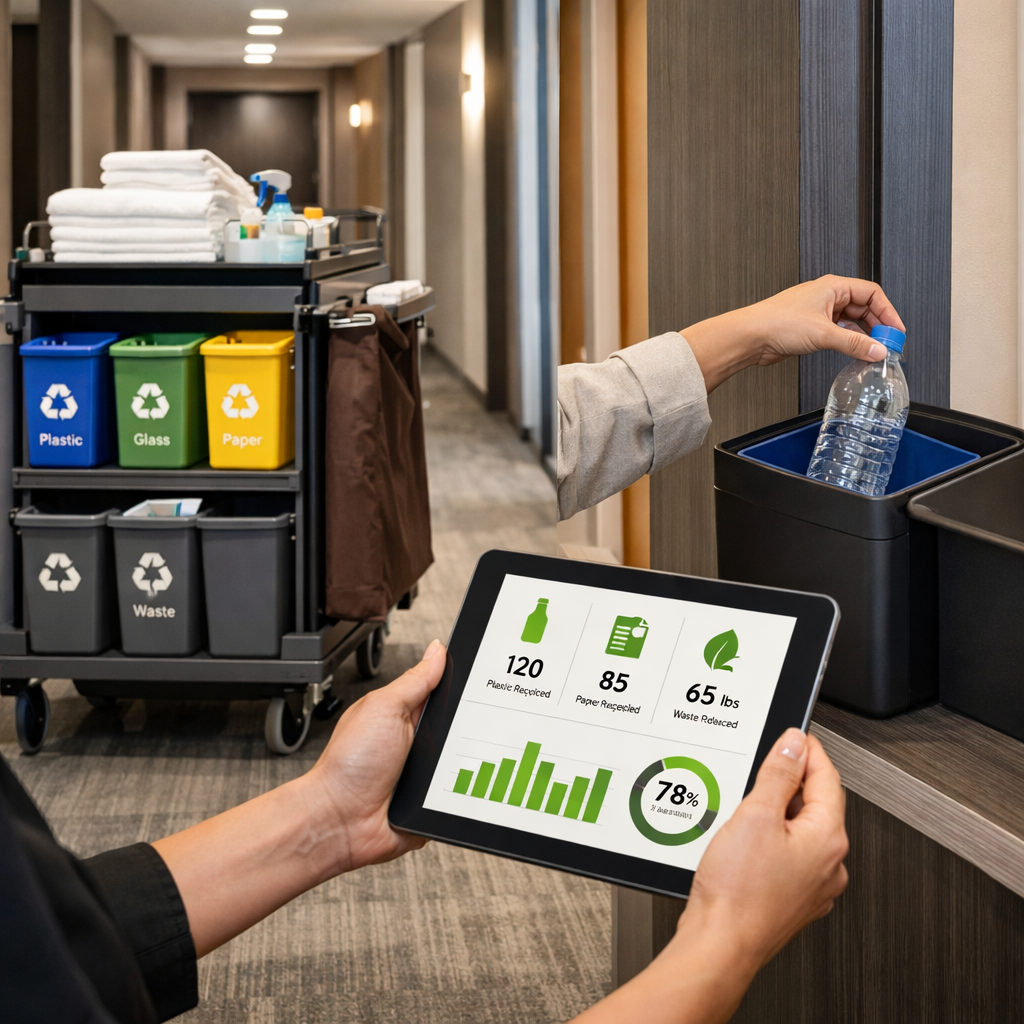
Seven Hotel Recycling Services That Improve Guest Satisfaction and ESG Reporting
Hotels juggle busy operations, brand standards, and rising sustainability expectations. The fastest way to boost guest satisfaction and ESG reporting is to combine visible, guest-friendly recycling touchpoints with back-of-house systems that measure and reduce waste. Below are seven hotel recycling services—spanning toiletries, hard-to-recycle plastics, food analytics, AI sorting, on-site organics, pricing incentives, and managed services—that reliably lift diversion and data quality. Together, they cut costs, reduce emissions, and give guests a cleaner, more responsible stay.
Recycler Routing Guide
Recycler Routing Guide approaches hotel waste programs with logistics-first rigor: practical selection, tight scheduling, and audit-ready measurement that tie diversion to cost and guest experience. We translate residential roll-off best practices—flat-rate pricing with clear weight caps, dependable 2–4 hour delivery windows (same-day in some markets), and standardized intake templates—into hotel-friendly playbooks for pilots, seasonal projects, and renovations.
- What this means for hotel waste management and recycling services for hotels:
- Mini-forms/checklists capture vendor quotes, site mapping, and container right-sizing.
- Bagster versus mini dumpster guidance for small FF&E refreshes; 10–20 yard roll-offs for room remodels, including driveway-safe analogs for tight loading docks.
- Scheduling built around limited dock access and event turnover; predictable windows reduce disruptions and overtime.
- ESG reporting for hotels focuses on clean, verifiable diversion rate tracking. Diversion rate is the percentage of total waste kept out of landfill through recycling, composting, and reuse. It’s a core ESG indicator because it quantifies how well materials are redirected into circular streams that cut emissions and costs.
- We help layer modern tools—AI recycling bins, food waste digester options, and pay-as-you-throw incentives—onto a clear measurement plan so you can prove ROI and scale what works. For multi-property portfolios, Recycler Routing Guide centralizes intake, scheduling, and reporting so results scale cleanly.
Clean the World
Toiletry collection programs make sustainability visible to guests while producing credible diversion data. Clean the World’s Global Hospitality Recycling Program has diverted over 11 million kg of waste since 2009, transforming hotel soaps and bottled amenities into hygiene kits and new products for communities in need, while supplying hotels with pickup and tonnage reports for ESG rollups (see Clean the World’s impact summary on its Hotel Waste Reduction Guide).
Operationally, housekeeping places used soaps and partially filled bottles in caddies on carts, consolidates them by floor or wing, and stages sealed boxes for scheduled pickups. You receive weights and diversion confirmation—data that plugs neatly into a managed-service dashboard for audit trails. Because the program is self-contained, it’s especially valuable in markets where municipal recycling is limited. Guest-facing reinforcement—brief check-in messaging, elevator placards, and a digital folio note—connects the dots and lifts satisfaction scores. Recycler Routing Guide can coordinate pickup windows and map weights to your ESG fields so the program fits smoothly into your broader waste plan.
Clean the World program snapshot
| Attribute | Typical setup for hotels |
|---|---|
| Per-room cost | Low, per-occupied-room fee model; varies by property size and pickup cadence |
| Expected diversion | Consistent capture of soaps and small plastic amenities; steady monthly tonnage |
| Reporting frequency | Pickup confirmations per event; monthly/quarterly diversion summaries |
| Guest-facing assets | In-room cards, lobby signage, and a short digital folio blurb linking toiletries to impact |
TerraCycle
Hard-to-recycle streams—amenity plastics, flexible film, mixed-material sachets, and PPE—often fall outside municipal programs. TerraCycle collects hard-to-recycle hotel items and repurposes plastics into new products, providing a practical outlet where local recycling falls short (see hotel waste reduction strategies from Green Business Benchmark).
- Start by identifying “problem SKUs” at receiving: pump bottles, shrink wrap, refill pouches, gloves, and small-format items.
- Set up labeled, back-of-house stations; train staff on what goes where to prevent contamination.
- Bundle shipments monthly or quarterly; log weights and material categories for ESG notes and supplier scorecards.
- Hard-to-recycle materials are items municipal programs reject due to contamination risk or processing costs—like flexible plastics, mixed-material packaging, and small-format amenities—requiring specialty take-back programs.
- Close the loop with guest touchpoints: a small lobby display of upcycled items and a line on digital folios quantifying plastics diverted.
Winnow
Food waste is typically a hotel’s largest diversion and cost lever. Winnow’s kitchen analytics pair scales and vision AI to track what’s discarded, when, and by whom. In one documented case, Winnow’s smart meter helped cut food waste by 30% in four weeks, saving £5,000 through menu and prep changes (see hotel waste management analytics summarized by SiteMinder).
Implementation roadmap:
- Install scales/cameras on prep lines, banqueting, and buffets; tag waste by station, time, and menu item.
- Run a 30–60 day baseline. Then adjust purchasing, batch sizes, and buffet replenishment frequency.
- Track before/after KPIs:
- Daily food waste (kg)
- Cost per cover
- Buffet return rates
- Top-5 waste drivers by station and item
These food waste analytics create precise, auditable metrics for hotel kitchen waste reduction—key to credible ESG disclosures.
AI sorting bins
AI-enabled bins improve capture rates, reduce contamination, and create an interactive guest touchpoint. Smart AI bins like Bin-e can identify glass, paper, metal, and plastic, compact materials internally, and provide live status—features that reduce human error and injury while streamlining operations (see this overview of innovative AI recycling bins and on-site composters from National Waste & Recycling Association).
Recommendations:
- Place units in high-traffic areas—lobbies, conference foyers, breakfast zones—using simple icons and live fill indicators.
- Connect bins to monitoring for “bin full” alerts; export bin-by-bin capture data to your ESG dashboard.
- Define and target a lower contamination rate—the share of non-recyclables mixed into a recycling stream. Lower contamination preserves material value and ensures more items are actually recycled.
Quick comparison: AI bins vs. standard tri-sort stations
- Capture accuracy: Higher with computer vision vs. reliance on guest judgment
- Staff time: Fewer manual checks; proactive alerts vs. fixed rounds
- Data outputs: Itemized, timestamped feeds vs. none
- Guest interaction: Engaging feedback screens vs. static signage
On-site composters and digesters
On-site organics solutions shrink volume, cut hauling, and support landscaping or compliant disposal. Batch composters can reduce food waste volume within 24 hours, and continuous food waste digester systems (including marine-suited models) are proven fits for high-throughput hospitality environments. Composting organic waste also helps lower greenhouse gas emissions from hotel operations by avoiding methane from landfills (see hotel organics and climate benefits summarized by HomeBiogas).
Guidance for hotel composting and food waste digester deployment:
- Map organics sources—banquets, breakfast, staff dining—to size throughput and select batch vs. continuous systems.
- Confirm local compliance for liquid effluent (digesters) and compost end-use (gardens or municipal partners).
- Track input/output weights and reduced hauling frequency to quantify ROI and organics diversion.
Pay-as-you-throw programs
Pay-as-you-throw (PAYT) charges properties based on the volume or weight of landfill trash set out, creating a strong financial incentive to recycle and compost more. In parts of the Pacific Northwest, programs like Recology’s structure discounts that can approach 50% when properties divert substantial volumes to recycling and organics (as profiled by Green Business Benchmark’s hotel waste guidance).
Recommendations:
- Verify eligibility by ZIP and confirm rate tiers. Right-size landfill carts and maximize recycling/organics set-outs to unlock discounts.
- Standardize color-coded signage and staff SOPs to reduce contamination risk and avoid penalties.
- Use monthly disposal profiles to validate savings and guide container adjustments. Recycler Routing Guide models PAYT scenarios and right-sizes containers to help capture available discounts while maintaining service levels.
Consolidated managed-service providers
When portfolios span multiple cities or complex streams, a managed-service model centralizes vendors, optimizes routes, and unifies ESG data. Providers increasingly use monitoring to track receptacle fullness and equipment status in real time; IoT-driven smart compactor monitoring and cloud-based ERP simplify billing, service verification, and connectivity across locations (see three ways hotel tech transforms waste management in this industry overview from Hotel Technology News). Consolidated reporting supports enterprise ESG metrics and reputation building, especially when properties vary by market constraints (see this playbook on portfolio waste stream coordination from RoadRunner). Recycler Routing Guide can serve as the intake and scheduling layer feeding these provider networks, standardizing SLAs and data definitions across properties.
Brand-agnostic benefits:
- One pane of glass: pickup verification, contamination alerts, and diversion dashboards per property
- Route optimization: fewer emergency hauls, lower emissions, better uptime
- Safety and accuracy: AI sorting and monitoring reduce injury risk and operational errors
Guidance:
- Use standardized intake templates to document site constraints, service levels, dock windows, and historical invoices; request benchmarked pricing and diversion projections. Recycler Routing Guide provides these templates for consistent capture.
- Require audit-ready data exports, material end-market documentation, and location-level scorecards.
- For network design trade-offs, see our hub-and-spoke vs. on-site compaction overview.
How these services boost guest satisfaction and ESG reporting
Front-of-house engagement pairs with back-of-house automation to make sustainability visible and verifiable. Place recycling bins with clear signage inside guest rooms and share simple goals and impact messages to nudge participation (see comprehensive hotel recycling tactics from Cvent). Digital tools reduce paper and plastics while letting guests request linens on demand—conveniences that also shrink waste. A sustainability trends review notes a typical hotel guest generates roughly two pounds of waste per night, so even small behavior shifts compound quickly portfolio-wide (see hotel sustainability insights from EHL).
Why it matters:
- Globally, tourism produces over 35 million tonnes of solid waste annually, underscoring the scale of the opportunity to divert and reduce (see a global review of tourism-related solid waste in ScienceDirect).
- Robust waste data tracking enables benchmarking, smarter vendor bidding, and continuous optimization through an ERP + IoT stack.
Step-by-step flow:
- Map streams and set goals
- Pilot services (Recycler Routing Guide playbooks, Clean the World, Winnow)
- Add AI bins and on-site composters
- Consolidate reporting via managed services
- Publish results and guest stories across touchpoints
Implementation playbook for hotels
Start with a waste map and baseline. Build a property recycling map, SOPs, and a concise waste reduction plan so front-of-house and back-of-house launch in sync (see hotel recycling startup guidance from Cvent). Recycler Routing Guide provides templates to accelerate this step.
Pair guest-facing and BOH best practices:
- Guest-facing: In-room bins and clear signage; short, positive copy; upcycled bottles as centerpieces for events.
- BOH automation: AI bins and monitoring for public areas, food analytics in kitchens, and compactor telemetry where applicable.
RACI at a glance:
- Sustainability lead/program manager: overall governance, ESG rollups, vendor scorecards
- F&B lead: Winnow, prep/buffet SOPs, organics/digester oversight
- Housekeeping: Clean the World and TerraCycle collection, in-room signage
- Engineering: IoT, compactors, dock flow, and uptime monitoring
Readiness checklist
| Item | Ready? | Notes |
|---|---|---|
| PAYT eligibility and rate tiers | Confirm ZIP, discount thresholds, contamination penalties | |
| Storage space and dock access | Map containers, staging, and 2–4 hour service windows | |
| Container right-sizing | Landfill downsize targets; organics/recycling upsizing where justified | |
| Contamination training and signage | Color-coded SOPs and multilingual cues | |
| ERP/data fields and user access | Configure diversion, contamination, pickup verification, and cost centers | |
| Monitoring/IoT for bins/compactors | Set alerts for fullness, outages, and missed pickups | |
| Third-party certification pathway | Identify programs (e.g., Green Business Bureau) to validate performance |
Measurement, data integrity, and audit-ready reporting
Lock in a few high-signal metrics and the practices that keep them defensible.
Core metrics to track
- Diversion rate (%), contamination rate (%)
- Food waste (kg/cover), glass recovery (%)
- Cost per ton diverted, hauling frequency, missed-pickup rate
- Proof points for glass: Recycling 1,000 tonnes of glass can save hundreds of thousands of kWh and over 300 tonnes of CO2, while established markets routinely remake bottles from recovered cullet.
Data systems and governance
- Use IoT and ERP to log fullness, uptime, and verified pickups; export monthly audit files and trend lines. Recycler Routing Guide standardizes this handoff across properties.
- Integrity practices: calibrate scales quarterly; match hauler tickets to ERP logs; conduct surprise contamination checks; store photo evidence at transfer points.
Storytelling and culture
- Brief monthly shout-outs for staff teams that hit contamination and diversion targets build ownership and pride.
- Publish quarterly dashboards and lobby visuals that tie actions (in-room sorting, toiletries, buffet changes) to results guests can see.
Frequently asked questions
How do I choose the right recycling services for my hotel’s waste profile?
Start with a waste map and baseline, then pilot the dominant stream to validate diversion and costs. Recycler Routing Guide provides simple templates and pilot playbooks so you can layer AI bins or specialty take-backs where municipal options are limited.
What metrics should we track for ESG reporting and brand transparency?
Track diversion rate, contamination rate, organics volume, cost per ton diverted, and verified pickup weights. Recycler Routing Guide also aligns program-specific KPIs (e.g., food waste kg/cover, glass recovery) for an audit-ready narrative.
How can we engage guests without adding friction to the stay?
Place in-room bins with clear signage and short, positive messages, and use apps to reduce paper and let guests control linens. Recycler Routing Guide supplies copy/placement guidance and a simple method to share impact stats on digital folios.
What low-cost pilots can we run before a full rollout?
Test a two-floor toiletries collection, add kitchen analytics to breakfast prep for 30 days, or deploy one AI bin in the lobby. Recycler Routing Guide packages SOPs and weekly dashboards so you can measure results before scaling.
How do we validate that materials are truly recycled and not landfilled?
Require weight tickets and route confirmations, spot-audit contamination, and centralize data in an ERP. Recycler Routing Guide captures material end-market documentation and photo records at transfer points for clean audit trails.