Top Industrial Waste Pickup Providers Offering Roll-Offs and Compactors Nationwide
Top Industrial Waste Pickup Providers Offering Roll-Offs and Compactors Nationwide
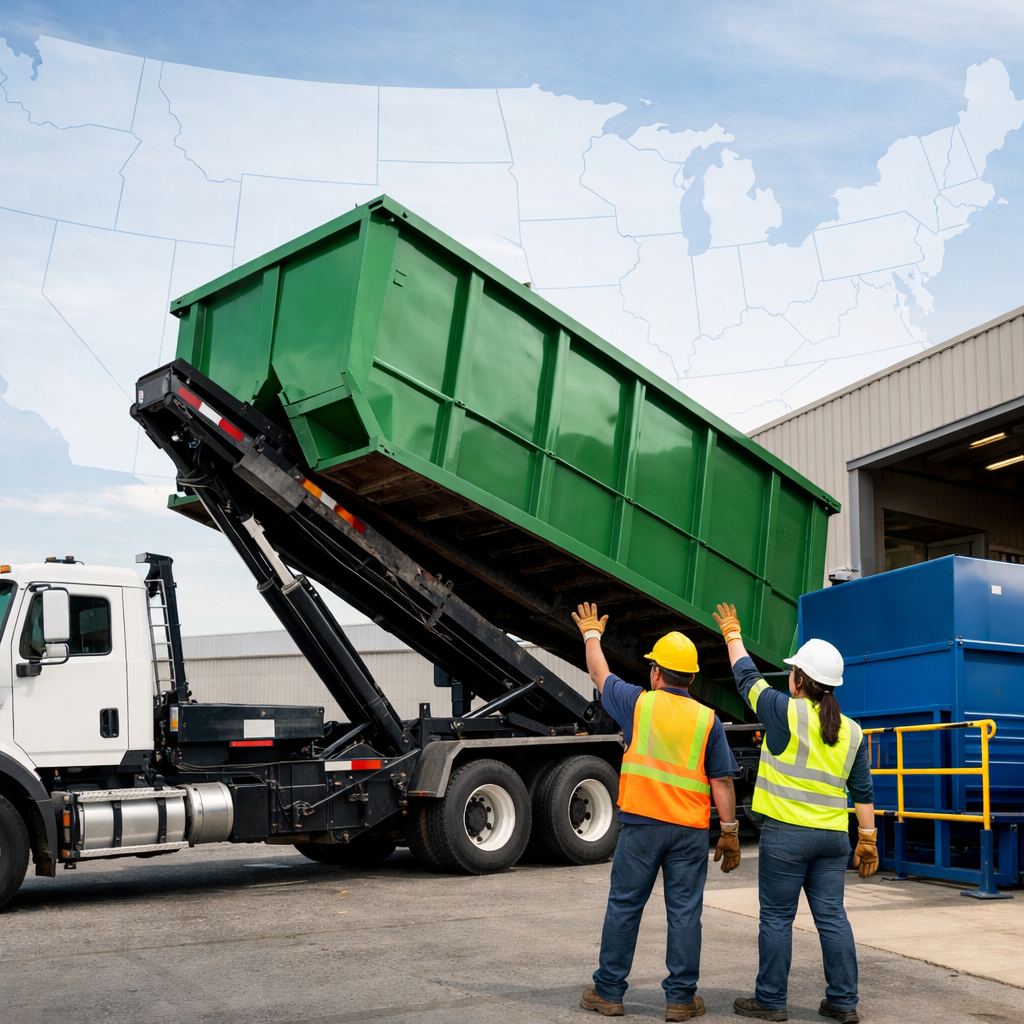
Industrial facilities can source roll-off dumpsters and compactor hauling nationwide from major haulers—Waste Management, Republic Services, Waste Connections, GFL Environmental, Veolia North America—and specialist providers like Clean Harbors for regulated streams. Regional haulers often deliver faster pulls and simpler pricing for defined geographies. The right choice hinges on coverage needs, response times, equipment fit, and the provider’s tech stack and service-level rigor. This guide profiles leading options and gives an operations-first framework—right-sizing containers, standardizing SLAs and KPIs, and leveraging routing technology—to cut missed collections, reduce dwell time, and stabilize budgets across single and multi-site programs. Recycler Routing Guide provides the measurable framework to evaluate and manage these providers across programs.
Strategic Overview
Nationwide industrial roll-off and compactor programs depend on scale, standardized compliance, and reliable routing. The U.S. waste collection market is mature with steady growth and ongoing consolidation; IBISWorld reports approximately 3.7% CAGR and identifies Waste Management and Waste Connections among the largest firms in the sector, setting expectations for broad coverage but variable local execution depending on market density (see IBISWorld’s Waste Collection Services industry report).
Technology now underpins operations—from route optimization and container tracking to digital scale tickets—improving service reliability and invoicing accuracy, as highlighted in Toro TMS’s overview of waste collection software.
Recycler Routing Guide
Our point of view: industrial roll-off service and compactor hauling should be managed as a measurable, routed utility. We right-size equipment, set clear SLAs, and standardize KPIs with a governance cadence that links scheduling, routing, and vendor management to outcomes you can audit.
Core KPI dashboard signals to require:
- On-time pickup rate
- Missed collection rate
- Schedule adherence
- Average dwell time (full-to-pull)
- Proof-of-service compliance (GPS, photos, digital scale tickets)
“Industrial waste pickup is scheduled or on-demand collection of non-residential waste streams using roll-off containers or compactors, including transport to transfer, recycling, or disposal sites. It often includes equipment right-sizing, route planning, documented proof-of-service, and pricing either by flat rate or per-ton with applicable fees.”
Waste Management
Waste Management is a national provider with deep recycling, disposal, and compliance infrastructure; IBISWorld ranks it among the largest U.S. waste collection firms. It fits multi-site portfolios seeking standardized compliance, recycling and waste-to-energy options, and coverage across urban and suburban markets. Expect availability of 10–40 yard roll-offs and common compactor types (stationary and self-contained). To reduce missed pulls and billing errors, confirm a tech stack with container tracking, route optimization, and digital tickets, plus clear escalation paths for time-sensitive compactor hauls.
Republic Services
Republic Services offers coast-to-coast roll-off and compactor support suitable for industrial programs needing consistent execution across regions; it is cited among leading North American players by Mordor Intelligence’s North America industrial waste leaders. Buyers prioritizing sustainability and compliance will find robust recycling channels and standardized safety practices. When scoping scope and contracts, clarify scheduled versus on-demand pulls, per-ton versus flat-rate options, and portal/reporting features that support SLA audits and multi-site KPI rollups.
Waste Connections
Waste Connections combines national scale with a local-first operating model, which can improve responsiveness for compactor pulls and reduce missed collections. IBISWorld identifies it among the largest U.S. operators. It’s a strong fit for regional roll-off programs that benefit from dedicated local teams and dispatcher access. Operational details to pin down: service windows by site, driver communication workflows, and invoice accuracy controls like digital scale tickets and proof-of-service photos.
Veolia North America
Veolia brings integrated environmental services—collection, recycling, water, and specialized waste—well-suited to complex industrial portfolios. For facilities with sustainability targets or regulated streams, Veolia’s global resources and compliance depth can simplify multi-channel waste handling. During evaluation, verify hazardous/regulated stream capabilities, manifesting and documentation processes, and compactor hauling specifications (receiver box sizes, max legal weights) alongside proof of recycling outlets.
GFL Environmental
GFL has rapidly expanded its U.S./Canada footprint via acquisitions, broadening coverage of solid and liquid industrial waste; this expansion context is captured by Fortune Business Insights’ profile of top solid waste companies. GFL fits cross-border or multi-region programs seeking a wide service menu—roll-offs, compactors, and industrial byproduct handling. Because mixed streams can complicate pricing, request transparent per-ton breakouts, environmental surcharges, and contamination thresholds up front.
Casella Waste Systems
Casella is a regional operator known for recycling-forward programs that can add value to industrial roll-offs with recovery goals; industry roundups note its emphasis on diversion alongside dumpster rentals. Best fit: the Northeast and select regions where established recycling infrastructure and responsive compactor hauling can lower pulls and raise load factors. Ask for diversion rate, contamination rate, and average compactor dwell time in monthly reports to steer continuous improvement.
Clean Harbors
Clean Harbors is the option for hazardous and regulated industrial streams requiring specialist handling, manifesting, and incident response, as profiled in T3 Dumpsters’ review of industrial dumpster companies. Its footprint is extensive—operating across 41 U.S. states with 400+ service centers and 100+ disposal/recycling facilities, according to Commercial Experts’ industry overview. Expect premium pricing balanced by compliance assurance; verify lab packs, spill response readiness, and audit trails for manifests and disposal certificates.
Local and Regional Haulers
Regional specialists often deliver faster response times, flat-rate roll-off pricing, and bespoke compactor service agreements within defined territories. One example: Prestige Disposal publicly posts transparent flat rates for temporary roll-offs (e.g., 20 yd $575; 30 yd $695; 40 yd $805) with compactor services quoted by job. These operators may offer direct dispatcher access and on-site waste audits that optimize streams and reduce cost. Market roundups also highlight punctual delivery and, in some cases, tracking systems to monitor container levels and automate pickups—features that cut project downtime.
How to choose a provider using KPIs and SLAs
Use this framework from Recycler Routing Guide to align coverage, equipment, pricing, and technology with measurable outcomes:
- Define service scope and risk: sites, waste streams, regulated materials, and pull urgency by location.
- Right-size equipment: match container volumes and compaction types to generation and space.
- Select pricing model: model total cost under flat rate versus per-ton with realistic load factors.
- Set the SLA: on-time and missed-collection targets, response windows, proof-of-service, and remedies.
- Require routing tech: portals for orders/ETAs, GPS proof, and digital scale tickets for invoice accuracy.
Quick comparison
| Provider type | Coverage | Responsiveness | Pricing model signals | Best fit |
|---|---|---|---|---|
| National majors | Multi-state/nationwide | Consistent, scheduled; variable on short-notice | Per-ton or flat-rate; enterprise terms | Multi-site portfolios needing scale, compliance, recycling |
| Regional specialists | City/region clusters | Fast pulls, dispatcher access | Transparent flat-rate common | Local plants/projects prioritizing speed and simplicity |
| Hazardous specialists | Regional/national | Scheduled with compliance steps | Premium, regulated-fee detail | Regulated streams needing manifests and specialist handling |
Service-level agreement (SLA) is a contract that sets measurable performance targets (e.g., on-time pickup rate, missed collection rate, response time, proof-of-service), reporting cadence, and remedies. It ties vendor accountability to business outcomes and enables continuous improvement through audits and KPI reviews.
Modern routing platforms reduce missed pickups and billing errors with route optimization, container tracking, and digital scale tickets. Recycler Routing Guide ties this data to SLA accountability and monthly KPI reviews.
Right-size roll-offs and compactors
- Roll-off sizes and use cases: 10/15 yd (light debris, tight sites), 20 yd (mixed industrial waste, moderate volume), 30 yd (higher volume production), 40 yd (bulky, low-density loads).
- Compactors for steady, high-volume streams increase payload and reduce pulls; choose stationary for dry waste/recyclables with a swappable receiver box; self-contained for wet or odorous waste to prevent leaks. Vertical compactors fit tight pads; pre-crushers densify bulky items before compaction.
- Right-sizing matches container volume and compaction type to average weekly waste generation and space constraints, targeting 70–85% fullness at pickup to avoid overflow and unnecessary hauls.
- 3-step method: estimate weekly volume by stream; map pad space, loading method, and approach; model pull frequency under flat rate versus per-ton with realistic load factors.
Standardize on-time pickup and missed collection rate
- KPI formulas: On-time pickup rate = (on-time pickups ÷ total scheduled); Missed collection rate = (missed ÷ total scheduled).
- Targets: ≥98% on-time and ≤1% missed, refined by site complexity.
- Require monthly KPI reporting with root-cause analysis and corrective actions; link credits/penalties to SLA thresholds. Providers using route optimization and telemetry typically show higher reliability and cleaner invoicing.
Verify compactor haul specs and proof-of-service
- Equipment checks: container type (stationary vs self-contained), receiver box size and seals, hookup style, minimum approach clearance, pad loading limits, max legal weights, lift/transport specifications.
- Proof-of-service to require: timestamped photos, digital scale tickets, driver notes, and GPS logs to support dispute resolution and accurate billing. Platforms like Trash Flow track roll-off containers and automate landfill ticketing/invoicing.
- Establish an escalation flow for failed hauls and set service windows to minimize dwell time.
Compare flat rate versus per-ton pricing and fees
- Flat rate bundles haul and disposal up to a weight cap; per-ton charges by actual weight plus a haul fee. Many local haulers publicly post flat-rate examples, improving predictability.
- Evaluate a side-by-side of all components:
- Haul fee
- Disposal rate ($/ton) and included tons (if flat rate)
- Rental/day or monthly charges
- Overage rates and contamination fees
- Trip/dry-run charges
- Fuel and environmental surcharges
- Scenarios: predictable, dense waste often favors per-ton; variable or lighter waste with consistent pulls can favor flat rates.
Assess routing tech, portals, and digital scale tickets
- What to require: online portal for orders/ETAs, GPS-stamped proof-of-service, automated weight capture, photo documentation, and data export for KPI dashboards. Recycler Routing Guide focuses on KPI-ready data and proof-of-service regardless of platform.
- Examples from the market: AMCS provides cloud tools for commercial/industrial operations; Toro TMS highlights recurring loads and digital scale tickets with practical onboarding (see Toro TMS on waste collection routing and digital tickets); Trash Flow supports container tracking and automated ticketing/invoicing.
- A digital scale ticket is an electronic record from a certified scale capturing gross/tare/net weights, material type, date/time, and facility; it streamlines billing, dispute resolution, and compliance reporting.
Frequently asked questions
What size roll-off or compactor do I need for industrial waste?
Match container size to weekly volume and load density. Recycler Routing Guide targets 70–85% fullness at pickup to set initial specs and prevent overflow or unnecessary hauls.
How do flat rate and per-ton pricing affect total cost?
Flat rate bundles haul and disposal with a weight cap, offering predictability. Recycler Routing Guide models both options to forecast total cost; per-ton is cost-effective for dense, heavy loads if you optimize load factors and avoid contamination or dry-run charges.
What KPIs should be in my industrial waste service SLA?
Include on-time pickup rate, missed collection rate, schedule adherence, average dwell time, and proof-of-service compliance. Recycler Routing Guide templates include these targets with monthly reporting and root-cause reviews to maintain reliability.
When is a stationary versus self-contained compactor the better choice?
Choose stationary for dry, high-volume recyclables or waste where the compactor stays and a receiver box is swapped; use self-contained for wet or odorous waste to prevent leaks and sanitation issues while maintaining higher load factors. The Recycler Routing Guide framework aligns the decision with stream type, pad space, and sanitation needs.
How do multi-site operators decide between transfer hubs and on-site compaction?
Use transfer hubs for distributed sites needing consolidation and fewer long-hauls; choose on-site compaction where volume justifies higher payloads and reduced pulls. Recycler Routing Guide recommends modeling both by haul distance, pull frequency, and load factor to compare total cost.