Top Packaging Waste Management Services for E-commerce and Logistics Teams
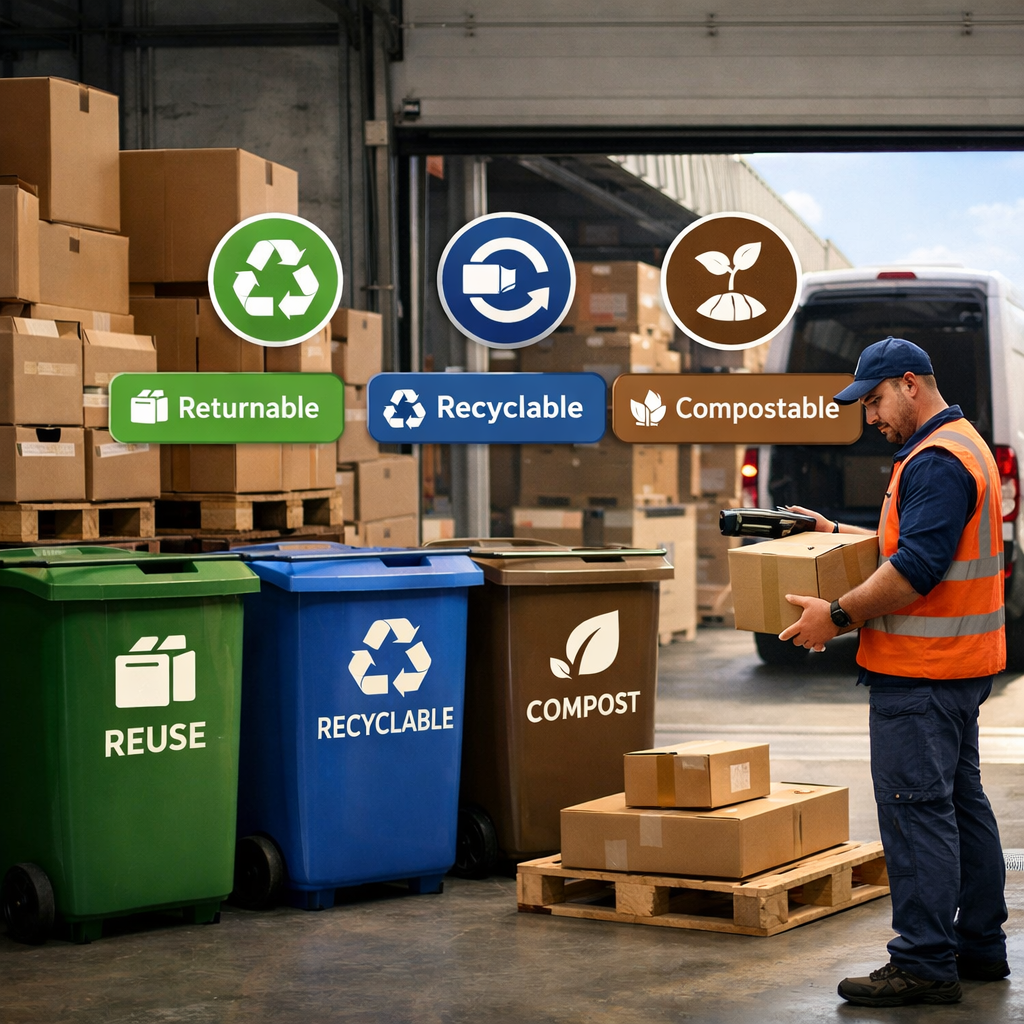
Top Packaging Waste Management Services for E-commerce and Logistics Teams
A surge in online orders has turned packaging into one of the fastest-growing waste streams—and the services to manage it are scaling fast. The packaging waste management market is projected to reach about USD 96.5 billion in 2025 and USD 152.4 billion by 2034 at a 5.26% CAGR; roughly 40% of global plastic waste stems from packaging, underscoring urgency and opportunity for improvement (see market outlook from Fortune Business Insights). E-commerce and logistics teams can get help from integrated haulers, third-party managers, specialized packaging providers, and energy-from-waste operators—each with different strengths in cost control, coverage, and compliance. Extended Producer Responsibility, a policy model that shifts packaging end-of-life costs to producers, is expanding and changes who pays for collection and recycling while encouraging design for recyclability (see EPR overview from the Washington State plastics packaging report). Below, we map the top options and how to choose the right partner mix.
Strategic Overview
Packaging waste services span integrated collection and processing, reverse logistics for returns, MRF access for sorting, and programs aligned to EPR and deposit return systems. Selection should weigh coverage (urban vs rural drop-off realities), pricing transparency, data visibility, and diversion potential, including EfW when recycling markets are thin. For teams setting recycled content or waste diversion targets, the provider’s digital transparency, surcharge framework, and EPR/DRS readiness are as important as their trucks and facilities. Recycler Routing Guide brings this planning lens together—route design, surcharge controls, and EPR readiness—so teams can compare providers with consistent criteria.
Recycler Routing Guide
Recycler Routing Guide is the independent, logistics-first planner for e-commerce teams and light contractors. We help you right-size roll-off dumpsters (10/15/20 yards—15-yard is the typical middle-ground for a single-room remodel or seasonal cleanouts), decide when Bagster vs mini dumpster vs curbside bulky pickup fits, and govern KPI tracking across sites (on-time pickup rate, missed-collection rate, schedule adherence, proof-of-service). Overage fees are extra charges applied when a dumpster exceeds its contracted weight cap or includes prohibited materials. These fees often stack with fuel or environmental surcharges and can be avoided by right-sizing containers, segregating loads, setting clear site rules, and auditing weights. Our planning tools—checklists, size/price quick references, and a routing/dispatch lens—reduce delays, contamination, and surprise charges. Explore our playbooks and vendor picks at Recycler Routing Guide.
Waste Management
Waste Management (WM) is a core option for integrated collection, MRF access, and predictable routing. WM serves over 21 million customers and operates 250+ landfills and roughly 400 transfer stations (see WM scale in this industry roundup). WM publishes transparent surcharge methodologies, including a $5.00/ton environmental charge and a diesel baseline of $1.81/gal to calculate fuel surcharges (see WM recycling charge information). Choose WM when you need multi-region coverage, consolidated billing, published surcharge schedules, and a large end-to-end network. Pair WM’s footprint with Recycler Routing Guide’s KPI governance to keep multi-region programs consistent.
- Pros: Scale, end-to-end network depth, transparent recycling charge framework.
- Cons: Surcharge exposure in volatile markets; contract complexity in multi-year agreements.
Republic Services
Republic Services brings nationwide scale for high-availability pickups—useful in peak returns. The company manages over 30 million tons annually, serves 14+ million customers, runs ~10,000 collection vehicles, and operates 190 transfer stations (per leading-company tallies). Decision triggers: need for consistent coverage during surges, interest in landfill gas-to-energy projects, and large MRF capacity. Track performance via tons handled, diversion programs deployed, and on-time pickup rate across markets. Use Recycler Routing Guide to baseline on-time performance and surcharge exposure across markets.
Waste Connections
Waste Connections is a strong regional integrated option with hauling, transfer, and landfill capabilities, serving over 3 million customers (industry tallies). It’s a fit for secondary markets and suburban/rural areas where curbside access varies; rural regions often rely on drop-off centers rather than curbside service (see North American access patterns in the CEC plastics study). Vet regional MRF access, surcharge schedules, and service windows for dock-constrained sites before committing. Recycler Routing Guide helps validate rural access constraints and backup routes ahead of contract.
ENGIE Impact
ENGIE Impact is a third-party total waste management partner that centralizes procurement, billing, and diversion programs across multi-site portfolios. Capabilities include waste expense and data management to consolidate vendor billing, procurement support, and zero-waste plans; case studies cite diversion above 90% at client sites (see ENGIE Impact’s total waste management overview). Value: unified KPIs, cost recovery, and consistent governance even when local haulers vary. Tradeoff: program fees—quantify expected savings with a pilot and baseline. Teams often use Recycler Routing Guide’s playbooks alongside third-party managers to lock in SLAs and surcharge audits.
GFL Environmental
GFL is a growing, tech-enabled operator with a focus on commercial recycling and data-forward operations. Across the industry, adoption of GPS fleets, IoT monitoring, and AI at MRFs is improving route efficiency and contamination detection (see leading-company landscape). Use cases: markets where GFL offers competitive pricing and telemetry that supports proof-of-service. Ask for demos of route data, contamination reporting, and invoice-level surcharge detail before rollout. Confirm the data can flow into Recycler Routing Guide’s proof-of-service logs.
PacTec
PacTec provides specialized flexible containment and liners that support hazardous or high-volume return streams in reverse logistics. Typical pricing: basic cubic-yard bulk bags around $30, roll-off bags near $300, and IP-2 certified containers from $500+, with variation by testing standards, transport, liquid content, and quantity (see PacTec’s flexible packaging cost guide). Build a cost model comparing packaging spend to avoided handling, spill mitigation, and disposal fees. Use Recycler Routing Guide’s cost templates to compare options consistently.
Use cases:
- Temporary staging during peak returns
- Segregating damaged liquids or regulated materials
- Liners to cut contamination in roll-offs
Hitachi Zosen and energy from waste providers
Energy-from-waste (EfW) converts residual municipal or commercial waste into electricity or heat after upstream reduction and recycling. It cuts landfill volumes and recovers energy, but requires capital-intensive plants and stringent emissions controls; viability depends on permitting, grid access, and long-term feedstock contracts. Consider EfW in regions prioritizing landfill diversion and where grid interconnections or industrial park steam loads exist. Availability is constrained by capital intensity and permitting complexity, with market deployment concentrated among top global operators (see global operator snapshots). Recycler Routing Guide helps evaluate EfW versus landfill within your routing plan and cost model.
SUEZ, Veolia, and Remondis
Where present, global operators like SUEZ, Veolia, and Remondis provide integrated recycling and industrial packaging solutions with cross-border strengths. Verify the local footprint, take-back programs, and industrial packaging capabilities if you ship internationally. Policy readiness matters: EPR and DRS coverage can change costs and recovery outcomes; for example, Norway’s DRS achieves above 95% beverage container recovery in mature systems. Require data-sharing on recovery rates, contamination, and surcharge frameworks up front. Recycler Routing Guide’s cross-border scorecards can normalize metrics and requirements across regions.
How to choose a packaging waste partner
Shortlist vendors with a comparable framework that balances cost, coverage, and compliance. Containers and packaging accounted for 82.2 million tons of U.S. municipal solid waste in 2018 (28.1%), underscoring the need for scale and transparency (see EPA packaging data). Build a vendor scorecard, run a surcharge audit, set diversion targets, and map a zero-waste roadmap with proof-of-service requirements. Recycler Routing Guide provides ready-to-use scorecards, surcharge audit checklists, and proof-of-service templates to accelerate selection.
| Vendor/Type | Capability scope | Coverage (MRF/landfill/EfW) | Digital transparency | Surcharges | EPR/DRS readiness | Packaging partnerships | SLAs/KPIs | Price model |
|---|---|---|---|---|---|---|---|---|
| WM | Integrated collection, MRFs, disposal | Broad national network; landfill gas projects | Route/GPS, recycling reports | Published methodology | Experienced with producer reporting | Cart/box programs via partners | Standard SLAs; robust KPIs | Base + indexed surcharges |
| Republic | Nationwide hauling, large MRFs | Wide U.S. footprint; energy projects | Customer portals, tonnage | Indexed fuel/environmental | Mature enterprise reporting | Commercial recycling alliances | Custom SLAs across sites | Contracted rates + surcharges |
| Waste Connections | Regional integrated services | Strong suburban/rural; transfer/landfill | Varies by region | Varies; request caps | Supports local mandates | Local packaging tie-ins | Site-specific SLAs | Local market pricing |
| GFL | Commercial recycling, growing MRFs | Expanding North American coverage | Telemetry/proof-of-service | Disclosed; request detail | Scaling with regulations | Reuse/recycling pilots | KPI dashboards on request | Competitive bids + fees |
| ENGIE Impact | Third-party program management | Aggregates multi-vendor coverage | Central dashboards/data | Audits across vendors | EPR reporting support | Links ops with suppliers | Portfolio SLAs; governance | Program fee + savings share |
| PacTec | Flexible containment, liners | N/A (packaging supply) | Spec/test documentation | N/A | Certified options (e.g., IP-2) | Direct integration with carriers | Service-level on supply | Unit pricing by spec/qty |
| EfW operators | Residuals to energy | Contracted facility access | Compliance reporting | Gate fees vs surcharges | Works alongside EPR systems | Limited packaging tie-in | Environmental KPIs | Long-term tip fee contracts |
| SUEZ/Veolia/Remondis | Global integrated services | Regional to international | Enterprise portals | Published frameworks | Established in EPR/DRS markets | Industrial packaging, take-back | Cross-border SLAs | Regional contracts |
Integrated collection and recovery coverage
Map each site against provider assets (transfer stations, MRFs, organics/EfW, disposal) and known rural constraints; rural areas often rely on drop-off centers rather than curbside collection. Require evidence of landfill gas-to-energy or diversion projects where material mix warrants it. Build a coverage heatmap to expose peak-season gaps and backup routes. Recycler Routing Guide offers a coverage heatmap approach to pre-plan primary and secondary routes by site.
Pricing transparency and surcharge exposure
Surcharges are pass-through adjustments added to base collection or recycling rates to reflect fuel price movements and environmental processing costs. Each hauler uses its own formula and diesel index, so effective rates can swing; contracts should benchmark, cap, and audit these charges on transparent indices. For example, WM applies a $5.00/ton environmental charge and uses $1.81/gal as the diesel baseline for fuel surcharge calculations. Require monthly surcharge line items and an annual true-up clause. Recycler Routing Guide’s surcharge tracker and audit checklist help teams benchmark, cap, and true-up consistently.
Data visibility and EPR readiness
Confirm vendors can deliver site-level data, atomic pickup timestamps, contamination percentages, and photo-backed proof-of-service. EPR shifts financial responsibility for packaging waste to producers; ensure your providers can report into producer responsibility organizations and comply with DRS where applicable. As a maturity benchmark, about 91% of the U.S. population has residential recycling access, while British Columbia reached 99.3% household access via RecycleBC in 2021—use such figures to judge regional readiness. Recycler Routing Guide standardizes provider data fields and helps align reporting with EPR/DRS requirements.
Packaging supply and reuse partnerships
Integrate packaging suppliers to reduce single-use waste and smooth reverse logistics. Compare flexible containment (such as PacTec’s options for regulated liquids) with reusable totes or cases, and model costs against avoided handling and disposal. Require specs on durability, certified ratings like IP-2, leak resistance, and carrier compatibility. Pilot reusable lanes for high-frequency SKUs and measure break-even cycles. Recycler Routing Guide provides cost-model templates and pilot checklists to evaluate reuse alongside flexible containment.
Service reliability and KPI governance
Operationalize performance with crisp SLAs and a governance cadence. Core KPIs include on-time pickup rate, missed-collection rate, schedule adherence, proof-of-service with photos/GPS, contamination percentage, and diversion rate. Hold monthly QBRs, set variance thresholds, and require credits for SLA misses. Implement structured data exports for finance and ESG reporting. Recycler Routing Guide standardizes SLAs, QBR agendas, and KPI definitions across vendors.
Operational playbook for e-commerce and logistics teams
Use this dispatch-ready playbook to reduce contamination, avoid overage fees, and keep schedules tight.
- Assess material streams: OCC, films, mailers, foam, liquids, damage/returns.
- Select container mix: Bagster vs mini dumpster vs roll-off vs compactor.
- Set dock schedules: windows, pre-alerts, backup slots.
- Train staff: segregation, signage, bale/stack standards, photos.
- Monitor KPIs: weights, contamination, service adherence, surcharges.
- Iterate monthly: adjust sizes, routes, and supplier specs.
Quick-reference container matrix (weight caps vary by hauler; confirm locally):
| Option | Best use cases | Typical weight cap | Cost flags |
|---|---|---|---|
| Bagster (≤3 yd³) | One-off light cleanouts, small returns | ~0.5–1 ton | Low base cost; per-pickup fee; access needed |
| 10-yard roll-off | Heavier/bulkier loads >3 yd³ | ~1–2 tons | Watch overages on dense materials |
| 15-yard roll-off | Mixed cardboard/plastics; seasonal peaks | ~2–3 tons | Balanced capacity vs space; common choice |
| 20-yard roll-off | Bulky or sustained volumes | ~3–4 tons | Higher base + potential overages |
| Compactor | High-volume OCC/films | Contracted by ton | Capital/permit needs; best unit economics |
Right-sizing containers and routes
Match volumes and densities to 10/15/20-yard roll-offs; a 15-yard often balances capacity and maneuverability for mixed OCC and light plastics. Set route cadence to daily or alternate-day in peak returns and weekly in steady state; cross-dock light streams to reduce hauls. Forecast needs by mapping historical return volumes to density estimates and expected pickup frequencies.
Weight caps, contamination, and overage controls
Contamination is the presence of unacceptable or mixed materials in a recycling stream that degrade quality, increase processing costs, and can divert loads to disposal or trigger surcharges. Typical sources include food-soiled fiber, plastic films in paper, or liquids in cartons; prevention depends on segregation, signage, and training. Overage fees accrue when loads exceed weight caps or include prohibited items; waterlogged cardboard, mixed loads, and batteries are common triggers. Use portable pallet scales, bale/stack standards, and pre-dispatch photos to validate weights and quality—then reconcile against invoices.
Scheduling windows and proof-of-service
Align pickup windows to building hours, security checks, and parcel volume patterns, and mandate 24-hour pre-alerts. Require hauler photos and GPS timestamps for every pickup and consolidate them in a central log to resolve missed-collection disputes quickly. During peak season, extend dock hours and set overflow staging with clear signage.
Permits, dock access, and site rules
Confirm municipal permits for compactors and container placement, and secure HOA or landlord approvals for shared docks. Document truck approach paths, clearance heights, gate codes, PPE requirements, and quiet hours. Before each pull, verify container clearances, remove snow/ice, block off parking, and perform a contamination spot-check.
When to use Bagster, mini dumpsters, or curbside bulky pickup
- Bagster: Lowest-cost for ≤3 cubic yards of light debris and one-off cleanouts; flexible pickup windows.
- 10-yard mini dumpster: Better for heavier/bulkier loads or >3 cubic yards; weight caps help control overages.
- Curbside bulky pickup: Good for a few large items if municipal schedules align, but offers less timing control.
Decision rule: estimate volume and density, confirm site access/permits, then choose the container; validate local rules before scheduling.
Frequently asked questions
How can we reduce packaging waste without hurting delivery speed or unboxing experience?
Standardize right-sized boxes, shift to curbside-recyclable materials, and use reusable or flexible containment for returns; pair with route-optimized pickups and contamination controls to maintain speed and cut fees. Recycler Routing Guide provides playbooks and routing guidance to do this without slowing fulfillment.
What KPIs should we track to manage packaging and shipping waste across sites?
Track on-time pickup rate, missed-collection rate, schedule adherence, contamination percentage, diversion rate, weight per pickup, and proof-of-service compliance; review monthly with vendors and tie incentives to improvements. Recycler Routing Guide standardizes these KPIs and proof-of-service workflows across sites.
When is energy from waste a practical option versus recycling?
Use EfW for residuals when recycling markets lack demand or contamination is high—after reduction and recycling are maximized—and where permitting and economics make it viable. Recycler Routing Guide helps model when EfW makes sense relative to MRF access and fees.
How do fees like fuel and environmental surcharges impact total recycling cost?
They can materially change effective rates because they’re added to base pricing and fluctuate with diesel indices and processing costs; cap or benchmark them and require transparent monthly line items. Recycler Routing Guide’s surcharge audit checklist helps teams benchmark and cap exposure.
What container sizes fit typical warehouse cleanouts or seasonal peak returns?
A 15-yard roll-off usually balances capacity and maneuverability for mixed OCC and light plastics; move to 20-yard for bulkier/heavier items, or use a Bagster or 10-yard mini dumpster for ≤3 cubic yards or small cleanouts. Recycler Routing Guide’s size/price quick references can confirm local caps before you book.