Top Walk-In Roll-Off Dumpster Companies vs. Bagsters for Garage Cleanouts
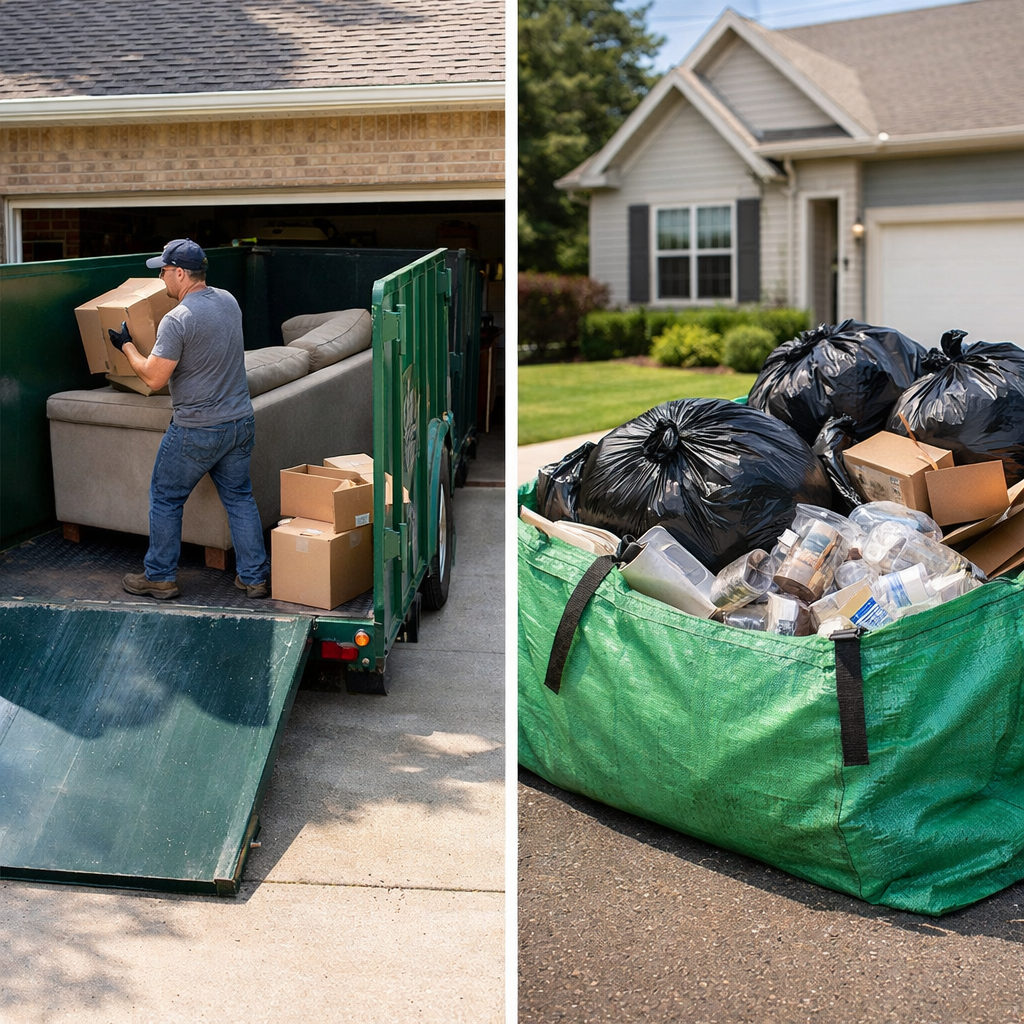
Top Walk-In Roll-Off Dumpster Companies vs. Bagsters for Garage Cleanouts
A fast, one-day garage cleanout usually comes down to two options: a walk-in roll-off dumpster or a Bagster. For most full-garage volumes, a walk-in roll-off dumpster for garage cleanout delivers more capacity, safer loading, and firmer pickup windows at a lower cost per cubic yard. A walk-in roll-off is a steel dumpster with a swinging door that opens at ground level, so you can walk or roll items in before stacking. Unlike single-use dumpster bags, it’s placed by a roll-off truck, supports heavier loads, and provides scheduled drop/pick windows that align with labor. Recycler Routing Guide focuses on practical scheduling, site-fit, and diversion planning to keep a one-day cleanout on track.
Snapshot comparison for garage cleanouts
A quick-glance overview to decide in under a minute.
| Feature | Bagster (dumpster in a bag) | Walk-in roll-off dumpster |
|---|---|---|
| Capacity & weight | 3 cubic yards, up to 3,300 lb | 10–40 cubic yards; higher weight limits measured in tons |
| Total cost range | About $130–$330 total (bag purchase plus pickup), varies by market | National average around $663, with a broad range of ~$286–$1,538 by market and material |
| Setup & pickup | Buy at retail, self-stage, then schedule pickup | Delivered and placed by hauler; pickup scheduled within defined windows |
“Dumpster in a bag (Bagster) is a foldable 3-yard container rated to 3,300 lb that you buy retail and schedule for pickup, best for light debris and tight spaces.” See specifications on the WM Bagster page for details (3 yd/3,300 lb and service rules) via the WM Bagster program.
For cost and size context on roll-offs (10–40 yards, average pricing and ranges), see the Dumpsters.com comparison, which also contrasts dumpster bag vs. dumpster rental processes. For typical Bagster total costs and lead times, see Sourgum’s Bagster vs. dumpster guide.
When a walk-in roll-off beats a Bagster
Choose a walk-in dumpster when you need more volume, heavier loads, or reliable scheduling:
- Better value per cubic yard for larger loads. Many markets show 10-yard roll-offs undercutting the Bagster’s cost per yard when you’re doing a full garage purge, especially once Bagster pickup fees are included, as covered in the Dumpsters.com comparison and Sourgum’s guide.
- Wider materials acceptance. Roll-off dumpster rental often allows mixed household junk, bulky furniture, yard waste, and sometimes appliances or tires (market rules vary). Budget Dumpster’s guide notes roll-offs typically accept a broader range than bags.
- Predictable drop/pick windows. If you’re staging labor for a single-day sweep-out, scheduled delivery and pickup windows reduce bottlenecks. Bags rely on later pickup dispatching.
- Heavy debris. Bricks, concrete, and dense demolition debris can overload or tear bags; roll-offs are built for high-weight materials with tonnage pricing and safe loading (Dumpsters.com comparison notes these constraints).
Two bags vs. one dumpster: Accurate Recycling’s comparison points out that buying a second Bagster often costs more while still holding less than a single 10-yard dumpster—common in garage cleanouts.
When a Bagster makes sense
A Bagster is the right fit when:
- You have very small volumes (under 3 cubic yards), light debris, and tight space where a driveway-sized container won’t fit.
- You value flexible fill timing and don’t need a guaranteed pickup date. Typical lead times are often 5–7 days without guaranteed service windows, per Sourgum’s guide.
- You understand true cost: the bag purchase is low (about $30), but pickup fees drive the total to roughly $130–$330 depending on ZIP and materials (Sourgum; Dumpsters.com).
Watch restrictions: bags have stricter material rules and can tear if loaded with heavy or sharp debris; bulky garage items may exceed weight or geometry limits (Dumpsters.com).
Capacity, weight limits, and driveway fit
- Capacity: Bagster is 3 cubic yards and 3,300 lb (WM Bagster program). Walk-in roll-offs range 10–40 yards with higher weight allowances measured in tons (Dumpsters.com comparison).
- Driveway fit criteria:
- Measure clear length, width, overhead clearance, and slope.
- Confirm truck approach path and turning radius.
- Chalk placement to protect pavers; lay plywood under rails.
- Leave door swing clearance for walk-in loading.
- Street placement usually requires a permit; check local rules (Dumpsters.com).
Quick checklist: driveway length, truck approach, door swing, surface protection, and municipal permitting.
Pricing and total cost per cubic yard
- Typical anchors:
- Bagster: ~$30 for the bag plus pickup fees; total commonly $130–$330 depending on location and material (Sourgum; Dumpsters.com).
- Roll-off: national average ~ $663; broad range ~$286–$1,538 by market and weight (Dumpsters.com).
- Cost-per-yard math: total price ÷ usable capacity. For full-garage volumes, 10-yard roll-offs often beat the Bagster on cost per yard (Sourgum).
- Budget accurately: list delivery, rental days, included tonnage, per-ton overage, fuel/environmental fees, and any permit costs.
Scheduling, delivery logistics, and pickup reliability
- Roll-offs are delivered and placed by the hauler, with scheduled pickup windows that support labor planning (Dumpsters.com comparison).
- Bagsters are purchased and set up by you; pickups are arranged online/phone and typically occur within 5–7 days in many areas without guarantees (Sourgum; Bagster pickup process).
- Policy watch-outs: Some Bagster markets note fees for missed/non-pickups or phone scheduling and remind that bags can fill faster than expected during demo (Moving.com review of Waste Management; Dumpsters.com).
Recycler Routing Guide’s recommended scheduling flow for a one-day cleanout:
- Confirm site fit with photos, 2) Reserve a delivery window, 3) Set a load deadline, 4) Pre-authorize tonnage, 5) Schedule a firm pickup aligned to your final sweep-out.
Material rules, safety, and diversion options
- Material acceptance:
- Bagsters often prohibit appliances, electronics, hazardous materials, and sometimes yard waste—always verify local rules (Dumpsters.com; Budget Dumpster).
- Roll-offs allow a wider mix in many areas; still confirm your provider’s list.
- Safety:
- Bags can tear if overloaded or filled with concrete/bricks; choose roll-offs for heavy or sharp debris (Dumpsters.com).
- Diversion-first plan:
- Stage donatables (tools, bikes), scrap metals, e-waste, and cardboard separately.
- Ask roll-off vendors for verified outlets and diversion reporting to document recycling and reuse outcomes.
- For logistics tips and standardized specs, see Recycler Routing Guide’s approach to diversion-minded routing.
Transparent provider evaluation criteria
Use Recycler Routing Guide’s KPI-driven rubric to compare local roll-off providers, marketplace options, and national haulers.
- Route reliability and windows documented
- Container specs validated against site-fit photos
- Clear billing with included tons and overage rates
- Verified outlets with permits and scale data
- Incident reporting and property protection commitments
Route coverage and on-time performance
- Request service-area maps and on-time definitions (e.g., within ±2 hours) and performance rates.
- Require published lead times and SLA credits for misses; confirm contingency plans for weather or truck outages.
- Scale matters: Waste Management serves over 21 million customers across segments, demonstrating broad coverage (Moving.com review of Waste Management).
Container specs and site fit verification
- Collect spec sheets for 10–20 yard walk-in roll-offs (footprint, door swing, empty weight).
- Provide site-fit photos or request a pre-delivery check to validate driveway length, slope, clearance.
- Require an edge-protection plan (plywood) and driver placement notes; confirm the walk-in door can fully open.
Weight allowances, overage policies, and clear billing
- Get included tonnage, per-ton overage, rental day limits, fuel/environmental fees in writing.
- Compare cost per cubic yard and per ton across quotes.
- Ask for itemized invoices and proactive weight alerts; if considering bags, have pickup and non-pickup fees disclosed (Moving.com review of Waste Management).
Verified outlets and diversion reporting
“Verified outlets” are documented downstream facilities—recycling MRFs, scrap processors, transfer stations, and disposal sites—validated with permits, receipts, and scale data to trace materials and substantiate diversion metrics. Request outlet lists, permits, scale tickets, and quarterly diversion reports by site.
Insurance, permits, and property protection
- Require a Certificate of Insurance with adequate limits and endorsements.
- Specify responsibility for surface damage and use of roll-off mats.
- Confirm who handles municipal permits for curb placements; many cities require permits for street setouts (Dumpsters.com).
Who delivers walk-in dumpsters for garage cleanouts
Match your project to the right channel, then standardize specs and KPIs before booking.
- Shortlist workflow: get 2–3 quotes across categories, standardize specs (10–20 yd, included tons, windows) using Recycler Routing Guide’s standard specs, compare cost-per-yard and on-time rates, and request diversion documentation.
National haulers and networks
- Large haulers offer multiple sizes, scheduled pickups, and broad coverage that helps multi-site consistency (Dumpsters.com comparison; Moving.com review of Waste Management for scale context).
- Verify regional routing windows, included tonnage, and diversion reporting; request example invoices and a single point of contact.
Marketplace aggregators
- Marketplaces aggregate local capacity and help compare roll-off sizes from 10–40 yards across regions, often with quick sizing guidance (per the Dumpsters.com comparison’s framing of sizes and selection).
- Use standardized RFQ specs and ask for outlet verification from the underlying haulers.
Local roll-off providers
- Regional firms often deliver competitive pricing and flexible scheduling for garage cleanouts, with local dispatch benefits (as noted in Accurate Recycling’s comparison).
- Validate insurance, permit support, material lists, and availability of 10–20 yard walk-in units.
Side-by-side: Bagster vs. walk-in roll-off for a one-day cleanout
| Criterion | Bagster | Walk-in roll-off |
|---|---|---|
| Capacity/weight | 3 yd / 3,300 lb (WM Bagster program) | 10–40 yd; higher tonnage limits (Dumpsters.com) |
| Allowed materials | Stricter rules; typically no appliances/electronics; limits on heavy/yard waste (Dumpsters.com) | Broader acceptance; appliances/tires often allowed with rules; verify locally (Budget Dumpster) |
| Total cost | ~$130–$330 including pickup (Sourgum) | Avg. ~$663; range ~$286–$1,538 (Dumpsters.com) |
| Space/permits | Fits tight spaces; no truck placement | Requires driveway or permitted curb space; truck access |
| Pickup timing | Scheduled after fill; often 5–7 days, not guaranteed (Sourgum) | Firm delivery/pickup windows via hauler dispatch |
| Risk | Tearing/overage risk with heavy/bulky items | Safer for heavy loads; overage billed by ton |
Guidance: Choose a roll-off when load >3 yd, heavy items, or you want a firm pickup window. Choose a Bagster for <3 yd, light debris, tight space, and flexible pickup.
Recommendation by garage size and load profile
- Single-car garage, light clutter (<3 yd): Bagster is fine if you comply with material restrictions and flexible pickup timing.
- Full garage or heavy items: a 10–20 yard walk-in roll-off is safer, faster to load, and cheaper per yard for single-trip disposal (Sourgum; Dumpsters.com).
Watch-out: Two Bagsters can cost more and still hold less than one 10-yard dumpster (Accurate Recycling).
KPI gates for multi-site rollouts
- Gates to approve vendors: on-time rate ≥95% (±2-hour window), cost-per-yard targets by market, included tonnage and overage thresholds, verified outlets documentation, incident rate for property damage.
- Rollout flow: pilot 3–5 sites → measure KPIs for two cycles → iterate specs (size, placement, permits) → expand with vendor scorecards, SLA credits, and diversion reporting standardized across locations. Recycler Routing Guide scorecard templates help standardize criteria and reporting.
Frequently asked questions
Do I need a permit to place a roll-off in my driveway or street?
Driveway placements usually don’t need a permit, but many cities require one for street or curb placement; check local rules before delivery. Recycler Routing Guide checklists help confirm permit steps quickly.
What size walk-in roll-off is best for a standard garage cleanout?
Most garage cleanouts fit a 10–15 yard roll-off. Use 20 yards if you have bulky furniture or heavier debris, and refer to Recycler Routing Guide sizing tips to decide.
Can I load appliances, electronics, or tires in a roll-off or Bagster?
Roll-offs often accept appliances and tires with restrictions; electronics vary by market. Bagsters typically prohibit appliances and electronics; verify rules with your provider and use Recycler Routing Guide’s material checklist.
How do weight limits and overage fees work?
Your rental includes a set tonnage; if you exceed it, per-ton overage fees apply. Recycler Routing Guide recommends asking for included tons and rates up front and loading heavier items first.
How do I ensure my materials are recycled or donated where possible?
Stage donatables, metals, and cardboard before loading, and choose providers offering verified outlets and diversion reports. Recycler Routing Guide templates include scale-ticket checklists to document destinations.