Waste Pickup Scheduling KPIs That Cut Facility Downtime In 2026
Waste Pickup Scheduling KPIs That Cut Facility Downtime In 2026
A reliable pickup schedule is one of the fastest ways to cut facility downtime in multi-site, non-hazardous waste programs. The route plan, live conditions, and proof-of-service data form a closed loop that keeps docks clear, containers available, and crews moving. This article lays out the waste pickup scheduling KPIs for reducing facility downtime, with targets, formulas, and actions you can implement within 90 days. The short answer to reducing downtime caused by inefficient waste pickup: instrument your scheduling process with on-time pickup rate, missed collection rate, schedule adherence, and proof-of-service, then use AI routing, right-sized equipment, and a tight governance cadence to continuously fix the drivers of delay. Recycler Routing Guide centers on this closed-loop scheduling approach for multi-site, non-hazardous waste.
Why scheduling KPIs are the new downtime lever
When trucks, office, and customer are connected through shared data and real-time communication, service reliability improves and costs fall. That’s the operational backbone for 2026: data as infrastructure, powering dispatch, driver apps, customer notifications, and post-route analytics in one flow of truth, not emails and guesswork. Organizations that “wire up” this loop reduce cascading delays and resolve exceptions before they become shutdowns, as highlighted by connected truck–office–customer operations guidance on real-time comms and audit-ready data flows (Routeware’s 2026 outlook).
Smart bins and AI routing are now mainstream. Cities applying sensor signals and adaptive routes report material gains—case studies cited in smart waste trends note collection time drops around 30% in Seoul and emissions reductions near 18% in Dubai; municipal pilots in Toronto demonstrated mobile alerts improving compliance, and Amsterdam’s container sensors improved recovery rates by roughly 20% (IoT and smart waste trends for 2026). With this tech foundation, scheduling KPIs become procurement-grade: precise, comparable, and actionable from plan through proof-of-service.
Outcome-first metrics that tie scheduling to uptime
Measure outcomes first, then cascade to operational levers. Facility downtime and reactive maintenance percentage outrank raw counts because they capture the real business impact of scheduling quality. Recycler Routing Guide anchors scheduling programs on these outcome KPIs before chasing activity metrics.
- Reactive maintenance % = (reactive maintenance hours ÷ total maintenance hours) × 100. A persistently high ratio signals poor coordination between routes, equipment readiness, and site windows (Maintenance KPI definitions and targets).
- As a benchmark anchor, many industries aim to keep equipment downtime below 5%—a useful upper bound when attributing downtime to pickup-related causes (Maintenance KPI definitions and targets).
Use the table below to align each KPI to the lever that moves it and the cadence that sustains action.
| KPI | Primary lever | Review cadence |
|---|---|---|
| On-time pickup rate | AI routing, route buffers, customer/dispatch notifications | Daily |
| Missed collection rate | Access readiness, escalations, backup windows | Daily |
| Time to recovery | Auto-alerts, secondary routes, provider standby | Daily |
| Schedule adherence to plan | Telematics compliance, exception tagging, re-sequencing | Daily |
| Facility downtime (pickup issues) | Dock scheduling, equipment right-sizing, congestion control | Monthly trend, weekly review |
| Reactive maintenance % | PM bundling with routes, inspections during service | Weekly |
| Preventive maintenance compliance | Synchronized PM calendar for trucks/lifts/bins | Monthly |
| Proof-of-service & notification success | Driver app compliance, API/webhook reliability | Daily |
| Route efficiency (tonnage, dwell, fuel/mile) | Re-sequencing, container sizing, stop consolidation | Weekly |
Priority KPIs for reliable waste pickup
On-time pickup rate
Definition: Percent of scheduled pickups completed within the agreed window by site and provider.
- Formula: (On-time pickups ÷ total scheduled pickups) × 100.
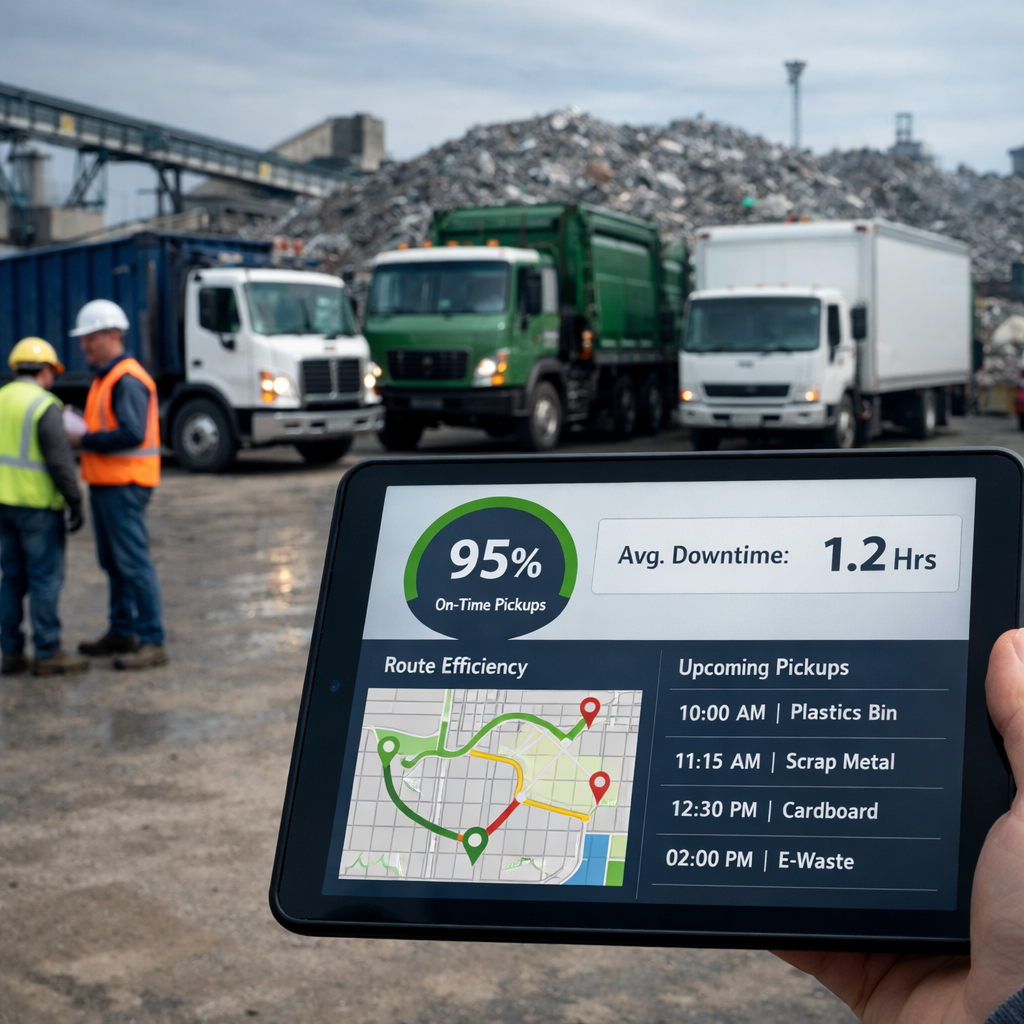
- Targets: 95–98% with window definitions that match operations (e.g., 60–120 minutes); Recycler Routing Guide recommends stream-specific windows to avoid false failures.
- Primary data: Telematics timestamps, driver app events, portal SLA windows.
- When off-target:
- Tighten buffers via AI-assisted sequencing and dynamic ETA risk alerts (connected operations guidance).
- Push real-time notifications to site teams and dispatch to avoid cascading delays.
- Use sensor-informed demand to shift low-value windows; smart operations examples justify tighter SLAs as sensors become standard (smart waste trends for 2026).
Missed collection rate and time to recovery
Definition: Frequency of service misses and responsiveness from report to completion.
- Formulas: Missed collection rate = (missed pickups ÷ scheduled pickups) × 100; Time to recovery = completion time − report time.
- Targets: <1% missed per period; same-day recovery on compactors, medical, and food streams.
- Primary data: Driver exceptions, CSR tickets, customer portal events.
- When off-target:
- Auto-alert sites on route ETA slips; pre-approve secondary service windows for critical streams with proof-of-service notifications.
- Apply KPI exemplars used across waste operations to standardize tracking of missed collections (industry KPI examples for waste operations).
Schedule adherence to plan
Definition: Percent of planned route steps executed in the intended sequence and time window.
- Formula: (Steps executed as planned ÷ total planned steps) × 100.
- Primary data: Telematics breadcrumbs, driver app scans, geofence events.
- When off-target:
- Tag exceptions with a clear taxonomy (traffic, access block, overweight, equipment fault, contamination).
- Feed exceptions into AI optimization; a connected driver–dispatcher–customer loop speeds course corrections (connected truck–office–customer operations).
Facility downtime attributable to pickup issues
Definition: Facility downtime attributable to pickup issues is the minutes or hours that operations are halted or slowed due to missed, late, or incomplete waste collections and related congestion, spills, or equipment unavailability. Track per incident per site to quantify the operational impact of scheduling failures.
- Measurement: Log incident start/stop times, impact area, and service ID; sum per site per month; use a consistent incident taxonomy (as in Recycler Routing Guide) to enable governance.
- Targets: Use <5% of total equipment downtime as an upper bound for pickup-related contributors (Maintenance KPI definitions and targets).
- When off-target:
- Implement a cause-code matrix (access, equipment, routing, comms) and dock scheduling rules.
- Right-size container count/volume and add on-site compaction to relieve peak congestion.
Reactive maintenance percentage
Definition: Share of maintenance hours spent on unplanned work tied to waste equipment and dock interfaces.
- Formula: (Reactive maintenance hours ÷ total maintenance hours) × 100.
- Target trend: Drive a 90-day decline; <30% reactive is a common step-down waypoint depending on context (Maintenance KPI definitions and targets).
- When off-target:
- Bundle PM tasks with route cycles; require quick bin/lift inspections during service.
- Shift collection frequencies dynamically based on sensor data to prevent overflows that trigger unplanned repairs.
Preventive maintenance compliance for pickup assets
Definition: Percent of scheduled preventive maintenance completed on time for vehicles, lifts, and on-site containers.
- Formula: (On-time PMs ÷ scheduled PMs) × 100.
- Targets: >90% on critical fleets and dock equipment.
- When off-target:
- Synchronize PM windows with low-occupancy periods and off-peak docks.
- Use a shared calendar across provider and facilities to lock dates before route release (Maintenance KPI definitions and targets).
Proof of service completion and notification success
Definition: Percent of pickups with verified mobile proof (photos, signatures, weight) and notifications successfully delivered to stakeholders.
- Targets: >98% proof captured; >99% notification delivery; Recycler Routing Guide defines minimum proof fields by stream.
- Primary data: Driver app attachments, portal logs, webhook/API status.
- When off-target:
- Retrain crews on scan-and-photo workflows; hard-stop completion without proof.
- Monitor notification bounces; real-time communications reduce disputes and rollbacks (connected operations guidance).
- Use municipal alert models (e.g., Toronto’s mobile notifications) as a template for site comms (IoT and smart waste trends for 2026).
Route efficiency metrics
Track the productivity that shrinks service windows and prevents dock congestion.
- Standard measures include tonnage per route/stop, dwell time per facility, mileage per route, and fuel per route—routine in operations scorecards (industry KPI examples for waste operations).
- AI/IoT impact: AI cuts collection time; sensors improve recovery and right-size frequencies (smart waste trends for 2026).
Quick-glance actions:
| Metric | Primary source | Typical threshold | When off-target, do this |
|---|---|---|---|
| Tonnage per route | Scale tickets, route logs | Trending up with stable miles | Consolidate partial stops; add right-sized containers |
| Dwell time per facility | Telematics geofences | ≤10–15 min per stop | Pre-clear access; shift window; stage containers closer to dock |
| Miles per route | Telematics odometer | Flat or down month-over-month | Re-sequence; remove redundant stops; enable local transfer nodes |
| Fuel per route | Fuel card, telematics | Down with stable tonnage | Address idling, overweight lifts; tighten zones |
| Stops per hour | Driver app scans | ≥4–6 (context-dependent) | Eliminate low-yield stops; convert to on-call with sensors |
Data as infrastructure for procurement and performance reviews
Treat KPI data as the backbone of sourcing, budgeting, and contract governance. Embed KPI clauses in MSAs with audit rights and require per-pickup data streams—on-time, missed, recovery time, proof-of-service, route efficiency, and diversion. Performance data should justify route design, equipment, and staffing, aligning with connected-operations principles that emphasize real-time, auditable metrics (connected truck–office–customer operations). Include sustainability fields (diversion and percent recycled off site) to support ESG reporting and peer comparability (industry KPI examples for waste operations). Recycler Routing Guide includes a minimum data model and KPI definitions you can adopt in MSAs and portals.
AI in routing and scheduling
AI must move from experiments to embedded tools that influence daily plans and SLAs. A 2026 waste tech survey underscores the shift from pilots to production-grade capabilities such as assisted route sequencing, overflow prediction from smart bins, and ETA risk alerts (2026 waste tech survey). By 2026, sensors are a standard signal feeding scheduling engines, and acceptance criteria should include:
- Explainability of route changes and risk scores
- Override logging with reason codes
- Measurable gains in on-time performance and reduced dwell time (IoT and smart waste trends for 2026) Recycler Routing Guide uses these acceptance criteria when evaluating routing and scheduling tools.
Localized processing and routing resilience
Decentralized, local processing reduces emissions and stabilizes costs while insulating schedules from long-haul disruptions (IoT and smart waste trends for 2026). For multi-site networks, compare hub-and-spoke consolidation versus on-site compaction using modeled route time, haul frequency, and capex-light options; see Recycler Routing Guide on comparing hub-and-spoke vs on-site compaction. Build contingency routing playbooks for weather, events, and closures with predefined alternate MRF/transfer nodes and service windows.
Regulatory and ESG alignment without sacrificing uptime
State-level reforms and extended producer responsibility are reshaping 2026 programs; PFAS controls, food waste mandates, and landfill emissions rules are in active motion (2026 waste and recycling policy trends). Add diversion rate and percent recycled off site to the scheduling scorecard (industry KPI examples for waste operations). Choose equipment that speeds compliance checks—clear-sided or RFID-enabled receptacles and durable materials to withstand heavier handling—consistent with 2026 facility equipment trends (facility waste equipment trends for 2026). Recycler Routing Guide folds these fields into the scheduling scorecard.
Review cadence and governance model
- Daily: on-time pickup rate, missed collection rate, proof-of-service and notification success. Dispatch and provider supervisors own same-day corrections.
- Weekly: route efficiency metrics and reactive maintenance %. Operations and maintenance co-own re-sequencing and PM bundling decisions.
- Monthly: downtime trends and PM compliance; strategic adjustments to right-sizing, frequency, and contingency nodes.
Create a RACI across dispatch, facilities, procurement, and provider. Hold a monthly joint review with corrective actions, owners, and due dates. Your dashboard should present one widget per KPI, with site rollups and a spotlight list of exceptions to resolve this week. Recycler Routing Guide provides a lightweight RACI and dashboard layout that fit this cadence.
From insight to 90-day results
Ninety-day windows are proven change cycles in facilities management—short enough to sustain focus, long enough to bank real gains (facility management 90‑day improvement cycles). Aim for a 10–20% reduction in missed collections and time to recovery.
- Weeks 1–3 (Baseline and data plumbing): Connect telematics, driver app events, smart bin feeds, and proof-of-service to a single portal. Validate SLA windows per site.
- Weeks 4–6 (Quick wins and AI pilot): Re-sequence two routes with AI; add auto-alerts; right-size containers at top three congestion sites.
- Weeks 7–9 (Verify and extend): Compare KPI movement vs. baseline; expand exception tagging; tune backup windows for critical streams.
- Weeks 10–12 (Lock standards): Codify SLAs, update MSAs, publish the scorecard, and schedule the recurring governance cycle. Recycler Routing Guide sequences these 90-day sprints through baseline, quick wins, verification, and standards.
On-site assessments and recurring waste audits
Run a 10-point site walk: dock access, container placement, lift clearances, traffic flows, contamination sources, peak occupancy rhythms, staging space, signage, spill controls, and proof-of-service capture points. Schedule recurring waste audits to validate volumes and contamination; feed findings into window length, buffer sizing, route sequence, and equipment specs.
Program right-sizing and service model selection
Match equipment and frequency to real volume patterns to prevent over-servicing and dock jams. Use bin-sensor data for dynamic frequencies that reflect seasonality and event calendars. For portfolios, weigh hub-and-spoke consolidation against on-site compaction using modeled route time and haul frequency; see Recycler Routing Guide: comparing hub-and-spoke vs on-site compaction for decision frameworks.
Diversion opportunities tied to equipment and routing
Add diversion and percent recycled off site to the core scorecard (industry KPI examples for waste operations). Integrate contamination checks into proof-of-service to prevent false diversification. Target sensors where recovery lags; smart city programs report roughly 20% better recovery with sensor-driven interventions (IoT and smart waste trends for 2026).
Portal-enabled transparency across service, cost, and sustainability
Standardize a portal that shows per-pickup proof-of-service, on-time/missed flags, dwell time, fuel per route, diversion metrics, and ESG-ready exports. Connected, audit-ready data makes it easier to justify budgets, staffing, and equipment changes to leadership (connected truck–office–customer operations). Recycler Routing Guide outlines the minimum fields and exports for per-pickup transparency.
Selecting providers for consistent execution and reporting
Score vendors on telematics coverage, AI routing maturity, proof-of-service rate, notification success, preventive maintenance reporting, and integration capability—favor embedded, repeatable AI over pilots (2026 waste tech survey). Require SLAs aligned to your KPIs, with remedies for missed/multi-missed collections and strict time-to-recovery. Include sustainability KPIs (diversion and percent recycled off site) and validate resilience through localized processing and alternate routing nodes (IoT and smart waste trends for 2026; industry KPI examples for waste operations). Use Recycler Routing Guide’s scoring rubric to compare providers against these criteria.
Frequently asked questions
What targets should facilities set for on-time pickup and missed collection rates?
Aim for 95%+ on-time with daily exception review and keep missed collections below 1%. Recycler Routing Guide provides baseline targets and a simple daily/weekly cadence.
How do we quantify downtime attributable to waste pickup issues?
Log each incident’s start/stop times when operations are slowed or halted by pickup delays or misses and sum minutes per site per month. Recycler Routing Guide’s incident taxonomy helps tag root causes for targeted fixes.
Which data sources are required to track these KPIs accurately?
Combine telematics, driver app events, smart bin sensors, proof-of-service photos, maintenance system data, and site calendars. Recycler Routing Guide consolidates these feeds into a single KPI scorecard structure.
How often should scheduling KPIs be reviewed to prevent downtime?
Review on-time pickup, missed collections, and proof-of-service daily; route efficiency and reactive maintenance weekly; downtime trends and PM compliance monthly. Recycler Routing Guide’s cadence checklist keeps owners and actions clear.
What changes reduce reactive maintenance linked to waste operations?
Align preventive maintenance with route cycles, add quick bin/lift inspections during pickups, and right-size container frequency with sensor data. Recycler Routing Guide links these steps to KPI targets to stabilize schedules.