Worried About Your Driveway? Choose Residential-Friendly Bin There Dump That Dumpster Rentals
Worried About Your Driveway? Choose Residential-Friendly Bin There Dump That Dumpster Rentals
Homeowners delay projects because they’re worried a roll-off dumpster will crack concrete, dent warm asphalt, or invite hidden fees. The good news: those risks are manageable when you choose residential-friendly dumpster rentals like Bin There Dump That and prep your site. A residential-friendly dumpster is a smaller-footprint roll-off bin designed for driveways and tight home sites. It pairs trained drivers with property-care protocols—protective boards under rails, clean equipment, and rear doors for safe loading—to minimize surface damage and disruption. With flat-rate pricing vs. overage fees clarified up front, plus right-sized containers such as a 10-yard dumpster for homeowners, you can get fast, even same-day delivery without surprises. For step-by-step planning, Recycler Routing Guide provides homeowner checklists and sizing tools linked below.
Why driveway safety stops homeowners from renting
Your driveway’s surface, slope, and the weight you load are the real risk drivers. A 20-yard dumpster can exceed 10,000 pounds when full, concentrating force at the rails and stressing concrete, asphalt, or pavers; most damage events occur within the first few days of placement, when the container is set and begins to load up, according to the Frontier Waste driveway protection guide (Frontier Waste driveway protection guide). Soft asphalt in warm weather, aging concrete, and interlocking pavers are more vulnerable—especially on slopes or where cracks already exist, as noted in Guidos Services’ driveway damage tips (Guidos Services driveway damage tips).
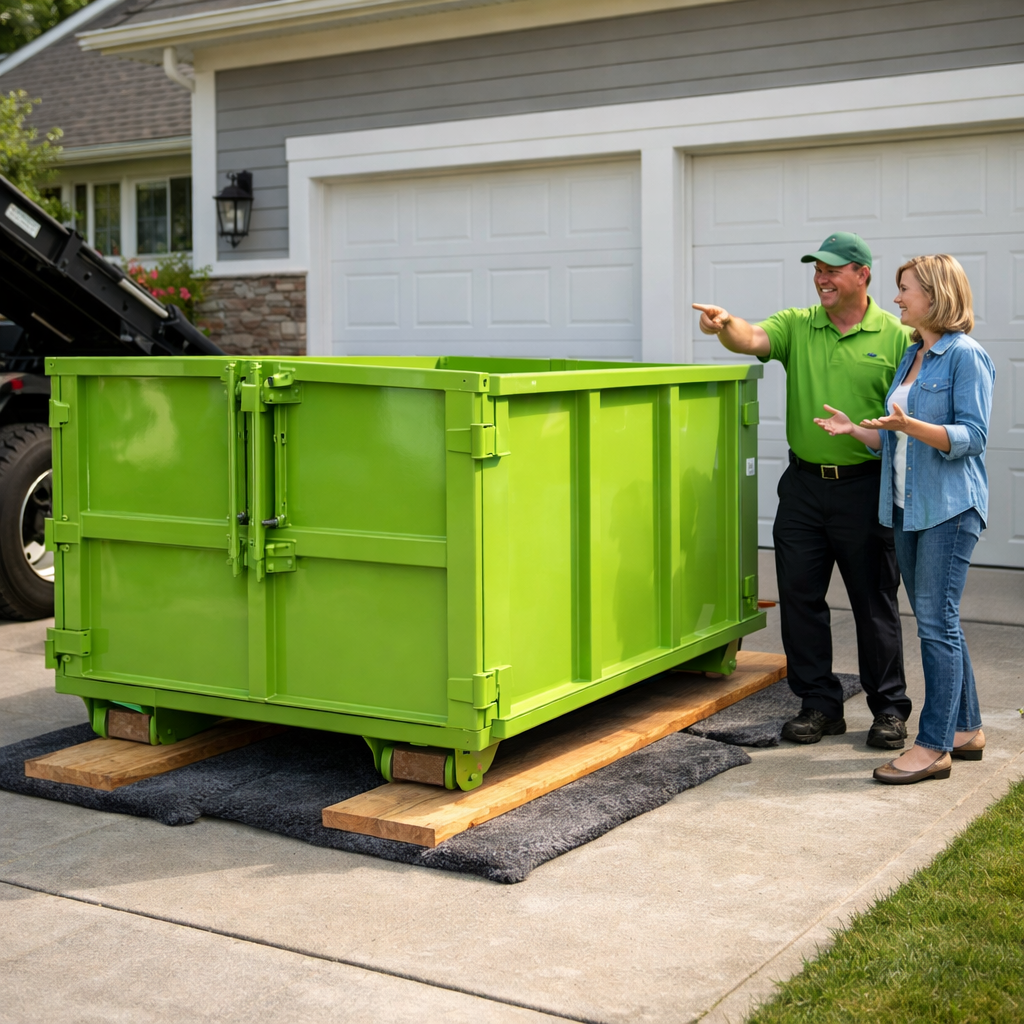
Driveway protection refers to methods that spread load and prevent direct metal-to-surface contact—such as plywood sheets or rubber mats under dumpster rails—to reduce cracking, gouging, or indentations during delivery, loading, and pickup.
Fears vs. fixes you can control:
- Fear: cracking concrete → Fix: weight-distribution boards, correct sizing, avoid overfilling.
- Fear: sinking into warm asphalt → Fix: plywood or rubber mats, shaded or firm gravel placement.
- Fear: debris mess → Fix: tarped loads, on-site sweeping at pickup.
What residential-friendly means for dumpster rentals
Residential-friendly is more than a small bin—it’s an operating standard designed around homes. The BTDT Consumer Guide details hallmark features: bins engineered to fit most driveways and tight spaces, double rear doors for safe, level loading, uniformed drivers who place protective boards before the bin touches down, and pickups that include sweeping the area and tarping the load for a clean, safe exit (BTDT Consumer Guide). In practice, residential-friendly service combines driver training, property-protection materials, clean equipment, and proactive communication to reduce risk and simplify loading in household spaces. Recycler Routing Guide’s homeowner guides outline what to expect so you can verify these practices at booking.
Typical homeowner use cases include moves, renovations, roof replacements, estate and garage cleanouts—projects where a driveway-safe, predictable service matters, as highlighted in the North Central Massachusetts Chamber feature on BTDT’s homeowner focus (North Central Massachusetts Chamber feature).
How Bin There Dump That protects your driveway
Here’s how BTDT’s standard protocol translates to less risk and less mess:
- Arrival with clean trucks and bins; uniformed, trained drivers who review placement options (BTDT Consumer Guide).
- Placement on protective boards before any metal touches your driveway, spreading weight and shielding surfaces (BTDT Consumer Guide).
- Rear-door loading so you walk items in level—protecting your back and reducing drop impact to the bin floor and driveway (BTDT Consumer Guide).
- Pickup includes sweeping the area and tarping the load to prevent debris fall on the way out (BTDT Consumer Guide).
First-time renters also get clear guidance on placement, allowed materials, and recycling options—part of BTDT’s residential positioning and community involvement noted by the North Central Massachusetts Chamber (North Central Massachusetts Chamber feature). Scale adds confidence too: the Franchise Times profile reports 237 U.S. units, about $130 million in global sales, 26.2% sales growth, founded in 2001 with U.S. expansion in 2011 (Franchise Times profile). Use the booking checklist later in this guide from Recycler Routing Guide to confirm these protections in your market.
What you still need to do as the homeowner
A little prep multiplies protection:
- Before delivery, clear a flat placement zone, inspect for cracks or soft spots, and pre-place plywood or rubber mats if advised (Frontier Waste driveway protection guide).
- Alert the hauler to steep slopes, pavers, or aging asphalt so they can adjust placement.
- Not all companies include boards; some treat driveway protection as an add-on—confirm what’s included at booking (Windsor Sanitation driveway protection tips).
Load distribution spreads the dumpster’s weight over a wider surface area using plywood or rubber mats under the rails. By lowering pressure at contact points, it helps prevent cracking concrete, denting warm asphalt, or shifting pavers—especially during initial set-down and when the container nears its weight limit.
Risk factor mitigation at a glance:
| Risk factor | What to check | Mitigation |
|---|---|---|
| Heavy, dense debris | Material type (concrete, shingles) | Choose smaller bin for dense loads; don’t overfill |
| Soft asphalt/warm weather | Midday heat, recent paving | Use thicker boards/mats; schedule early/late day |
| Pavers and driveway edges | Loose joints, unsupported edges | Place away from edges; add wider boards under rails |
| Slopes/limited visibility | Grade, tight turns, overhead lines | Flag hazards; request spotter guidance on arrival |
| Debris scatter and nails | Saw cuts, roofing tear-offs | Keep items walked in; expect sweeping at pickup |
Pick the right size without overages
Match size to debris type and density to protect your driveway and your budget. Roofing shingles, concrete, brick, and dirt are dense; even small volumes reach weight caps quickly. Because a loaded 20-yard can exceed 10,000 pounds, dense loads are often safer and cheaper in a 10–15 yard to manage weight caps and surface stress (Frontier Waste driveway protection guide).
Flat-rate pricing vs. overages: Flat-rate pricing typically bundles delivery, pickup, a set rental period, and a weight allowance into one fee. Overage pricing adds per-ton charges if you exceed the included weight or per-day fees if you keep the bin longer.
Size and weight planning guide:
| Size (yards) | Best for | Typical watchouts | Driveway notes |
|---|---|---|---|
| 10-yard | Weekend cleanouts, small bath/kitchen demo, 15–25 roofing squares | Lower volume, but still heavy with shingles | Compact footprint fits most driveways |
| 15-yard | One- to two-room cleanouts, light remodels | Dense debris may hit weight caps sooner | Good balance of capacity and maneuverability |
| 20-yard | Multi-room cleanouts, lighter demo, bulky items | High total weight if overfilled with dense loads | Confirm protection boards and even loading |
Tip: Ask for the included rental period (many quotes include seven days with per-day charges after) to prevent time-based overages (BTDT Consumer Guide). For more help sizing, see Recycler Routing Guide’s dumpster-size chooser (dumpster-size chooser).
Weekend and same-day delivery expectations
For weekend cleanouts, book early and align your drop-off with the start of demolition so the container spends fewer days on your driveway. Reliability and on-time service often matter more than the rock-bottom price—an industry trends report notes on-time performance increasingly beats “cheapest” for customer satisfaction (dumpster rental trends). To secure a dependable slot:
- Call by early afternoon for same-day options.
- Request a 2–4 hour delivery window and confirm text/phone ETA updates.
- Keep driveway and street access clear 30 minutes before the window.
For more weekend planning tips, see Recycler Routing Guide’s weekend-focused rental guide (weekend-focused rental guide).
Compare roll-off dumpsters and Bagster for driveway impact
When should you choose a Bagster vs. a mini roll-off dumpster? Consider capacity, contact points, and total cost per cubic yard.
| Option | Capacity/weight guide | Footprint and contact points | Driveway impact notes | Best for | Pricing model |
|---|---|---|---|---|---|
| Bagster (waste “bag”) | ~3 cubic yards, up to ~3,300 lbs | Laid on driveway/yard; lifted by crane/boom truck | Avoid under overhead lines; protect surface under bag | Light junk under ~3 yd³ | Bag cost + flat pickup fee |
| 10-yard mini roll-off | ~10 cubic yards; weight cap varies | Rests on steel rails; needs 1 car-width driveway | Use protection boards under rails; precise placement | Heavier debris or >3 yd³ loads | Flat-rate pricing with overage options |
Decision guide:
- Light junk under ~3 cubic yards → Bagster.
- Heavier debris or more than ~3 cubic yards → 10-yard roll-off with driveway protection boards.
For a deeper cost and project fit comparison, see Recycler Routing Guide’s mini dumpster vs. Bagster guide (mini dumpster vs. Bagster guide).
Local franchises versus national haulers
Local franchises like BTDT blend national standards with local responsiveness, emphasizing residential protocols and community trust-building (North Central Massachusetts Chamber feature). Larger regional or national haulers may have broader coverage and fleet depth. Either way, verify driveway protection is standard rather than a paid add-on (Frontier Waste driveway protection guide; Windsor Sanitation driveway protection tips).
Questions to standardize your quotes (from Recycler Routing Guide):
- Will you place protective boards under the rails?
- Do your bins have rear doors for walk-in loading?
- What’s the included rental window and weight cap?
- Do you sweep and tarp at pickup?
Contractors increasingly plan waste logistics earlier in bids; homeowners benefit from the same early coordination to avoid rush fees and placement compromises, a trend echoed in recent rental analyses.
How to book with fewer surprises
Use this 6-step Recycler Routing Guide script to get apples-to-apples quotes:
- Define debris type, volume, and density (e.g., roofing shingles vs. mixed junk).
- Request flat-rate details: delivery, pickup, seven-day rental, included weight, overage per ton, and per-day extension fee (BTDT Consumer Guide).
- Confirm protections included (boards/mats) and pickup protocols (sweep, tarp) (BTDT Consumer Guide).
- Share site specifics: slope, surface type, weak spots, clearance obstacles.
- Lock a 2–4 hour delivery window; ask about same-day options if urgent.
- Prepare the site day-of: clear cars/obstacles; pre-place plywood if advised (Frontier Waste driveway protection guide).
Pro tip: Email or text the same details to 2–3 providers using a simple template so you can compare quickly. If you’re pricing multiple vendors, Recycler Routing Guide’s guide to getting local quotes can help (get multiple dumpster quotes).
Frequently asked questions
Will a dumpster crack my concrete or sink into asphalt
It’s unlikely if you size the bin correctly and protect the surface with plywood or rubber mats; also flag slopes or soft asphalt for the driver. Recycler Routing Guide’s driveway prep tips in this article can help.
Do I need plywood or will the hauler bring protective boards
Ask at booking—some haulers include boards and others charge. Keep plywood or rubber mats handy for older concrete, pavers, or warm asphalt; Recycler Routing Guide explains how to place them.
What size dumpster should I choose for a weekend cleanout
A 10-yard usually fits most driveways and weekend timelines; for dense debris like shingles, watch weight caps or plan a second haul. Use Recycler Routing Guide’s size chooser for a quick pick.
Can I put broken concrete or roofing in a residential dumpster
Yes, but dense materials reach weight limits quickly, so use smaller containers and load evenly through rear doors. Recycler Routing Guide covers allowed materials and tonnage basics.
How do weight limits and flat-rate pricing work
Flat-rate pricing bundles delivery, pickup, rental days, and a weight allowance; overages apply per ton or per extra day. Recycler Routing Guide’s booking script helps you confirm these numbers up front.